Reviewed · WALKING TOURS
Weimar Private Walking Tour With A Professional Guide
Weimar feels like a living textbook. This private walking tour strings together the big ideas of the city, from Goethe and Schiller to the birth of German democracy, site by site, without wasting time.
I especially like the private guide format, with Alexander singled out in feedback for being highly on-point and able to answer questions as you walk. I also love how the route connects literature, politics, and everyday life in one smooth loop, so Democracy Square is not just a stop, it is part of the story.
One drawback to plan for: the tour is about 2 hours, so you cannot linger forever at every landmark. If you want maximum time in museums or reading every exhibit panel, you will likely want to follow up on your favorite stop afterward.
In This Review
- Key things I’d plan for on this Weimar walking tour
- Why a private guide makes Weimar click faster
- Market Square and Theaterplatz, where classicism meets real streets
- The House of the Weimar Republic, democracy explained in plain words
- Saint Peter and Paul Church, the Lutheran moment you can still touch
- Weimar Palace and the architecture of power, feudal to palace to story
- Democracy Square and Anna Amalia’s world of gatherings
- Park an der Ilm, Tempelherrenhaus ruins, and Goethe’s design influence
- Goethe’s House on Frauenplan, the writing space behind Faust
- Friedrich Schiller’s House, the meeting that changed everything
- Liszt Haus, piano lessons and a summer gift from a duke
- Finishing back at the Market Square, and keeping your day flexible
- Price and value for a private group up to 15
- Who this Weimar private walking tour suits best
- Should you book this tour?
- FAQ
- How long is the Weimar private walking tour?
- How much does the tour cost?
- Is the tour private or shared?
- What language is the tour offered in?
- Do we need transportation during the tour?
- Where does the tour start and end?
- Is the tour good for people of different ages?
Key things I’d plan for on this Weimar walking tour
- Market Square to Theaterplatz connects painters, memorials, and the people who shaped Weimar
- House of the Weimar Republic explains how democracy was attempted, then crushed in 1933
- Saint Peter and Paul Church ties Luther, theologian Herder, and Anna Amalia to one physical place
- Anna Amalia’s Library and Park an der Ilm show how reading and design influenced Goethe’s life
- Goethe’s House, Schiller’s House, and Liszt Haus cover three different arts, all with strong local backstories
- Easy pacing and no transit needed make it a good choice even if you are on limited time
Why a private guide makes Weimar click faster
Weimar is compact, walkable, and packed with meaning. The city almost dares you to connect the dots, and a private guide helps you do it without turning your day into a scavenger hunt.
This is a private walking tour for up to 15 people, with an assigned local guide who stays with your group the whole time. That matters because you get more chances to ask questions on the spot, and the route is designed so the next stop answers the last one.
The experience runs about 2 hours and is rated easy, so you are not dealing with hills or long distances. You also do not need transportation during the tour, which is a big time-saver in a city where the best parts are close together.
The tour uses a mobile ticket, and it is offered in English. If you are traveling with friends or family, the private setup is also a practical way to keep everyone together while still getting good explanations.
More walking tours in Germany:
- Discover Berlin Half-Day Walking Tour
★ 5.0 · 9,624 reviews - Berlin: Third Reich and Cold War 2 Hour Walking Tour
★ 4.9 · 6,830 reviews - Munich: Third Reich & WWII Walking Tour
★ 4.6 · 6,181 reviews
Market Square and Theaterplatz, where classicism meets real streets
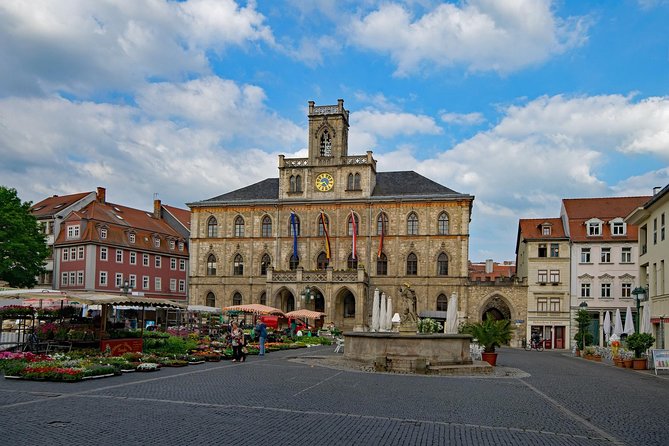
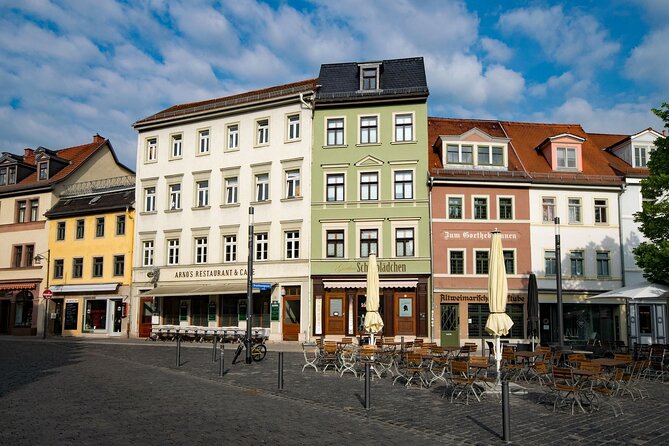
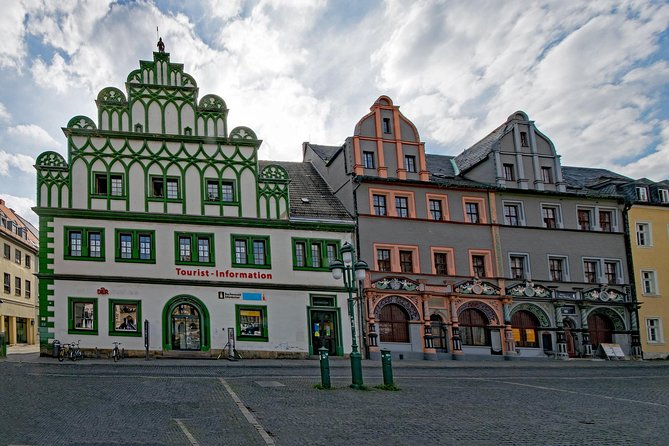
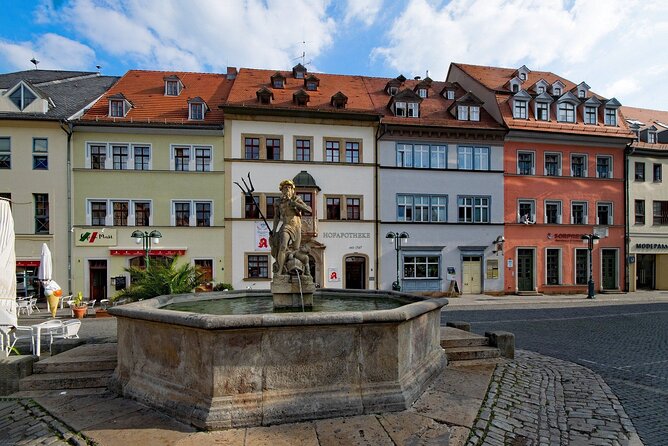
The walk begins at Markt 20 in Weimar, at the Market Square, a natural meeting point. This area is tied to everyday city life and to famous residents, including Lucas Cranach, a Renaissance painter who lived near the square.
Here is the thing that makes Market Square work for a walking tour: it is not just a pretty center. It sets up the idea that Weimar’s cultural importance was not only “in books,” it was in buildings and neighborhoods you can still recognize.
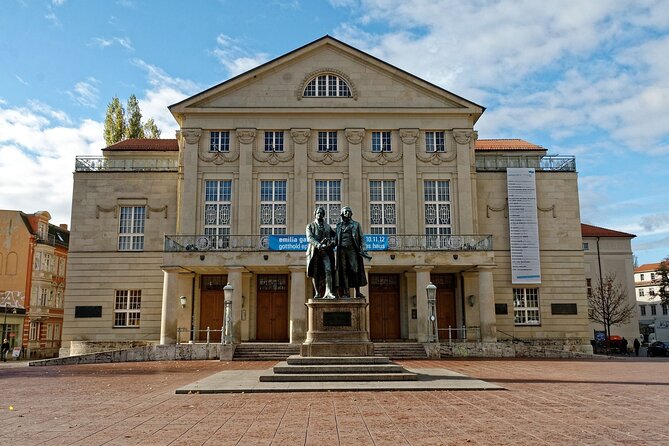
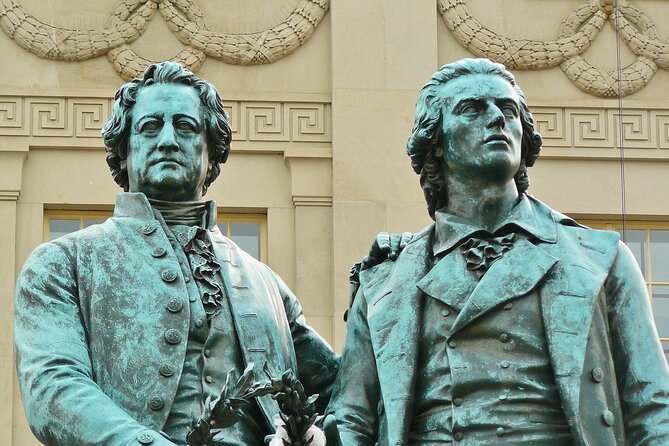
Next comes Theaterplatz, where you meet the Goethe and Schiller memorial in front of the National Theater. Weimar classicism is strongly linked to Anna Amalia, the dowager duchess, who hosted gatherings that included both writers.
Your guide’s job, and the tour’s value, is to make those statues feel like part of a working scene. The memorial is visually central, but you learn what was happening in the background, so it lands emotionally instead of just checking off a landmark.
Then you move to the House of the Weimar Republic, opposite the memorial area. This is where the tour pivots from literature into politics, and the walk becomes more than sightseeing.
The House of the Weimar Republic, democracy explained in plain words
One of the best parts of this tour is how it uses location to explain the Weimar Republic. You are taken to the building where the National Assembly gathered in 1919 to plan the future of Germany after World War I.
This is Germany’s first attempt to build a democracy after the German Empire fell. You also hear the uncomfortable ending: in 1933, the Nazi party rose to power, and the Weimar Republic was destroyed.
Inside the renovated building, you get the context of that story, and it functions as a Forum for Democracy. I like that framing because it turns a historical event into something you can connect to today, rather than leaving it as a distant headline.
If you care about politics but hate lecture-style tours, this is a strong match. The explanation is anchored in a specific address, and the walking route keeps the momentum.
Saint Peter and Paul Church, the Lutheran moment you can still touch
After the political stop, the tour shifts into religion and influential people. You pass by Saint Peter and Paul Church, described as the most important church in Weimar.
The church’s layers are the point. It was first built on foundations that go back to the 13th century, then built in gothic style in the 16th century. Later it was converted to Lutheran belief, and Martin Luther himself preached there.
You also hear about two major burials tied to the city. The theologian Johann Gottfried Herder is buried in the church, and Duchess Anna Amalia is also buried there.
There is even a nearby Herder Memorial in front of the church, dedicated in 1850. I like that kind of detail because it gives you a way to spot and remember the people, even if you are not a theology nerd.
A few more Germany walks and trips to compare
- Berlin: Private Reichstag and Glass Dome Tour
★ 4.8 · 2,226 reviews - Berlin Private Complete History All Day Walking Tour
★ 5.0 · 474 reviews - Munich Private Tour with a Local – Highlights & Hidden Gems
★ 5.0 · 469 reviews - Private Walking Tour Berlin Third Reich Hitler and World War II
★ 5.0 · 360 reviews
Weimar Palace and the architecture of power, feudal to palace to story
Next up is the Weimar Palace, once the residence of the dukes of Saxe-Weimar and Eisenach. The site starts as a medieval castle and is first mentioned in the 10th century.
It was remodeled after fires and gradually reshaped into a residential palace. The long development timeline, about 500 years to reach its present form, is a great reminder that cities change slowly, even when history makes sudden moves.
In a walking tour, architecture can easily become vague. Here, the better approach is to look at the palace and ask, what kind of power lived here, and how did that influence the city’s cultural identity?
You can connect that question directly to what comes next at Democracy Square, where the surroundings are full of royal buildings.
Democracy Square and Anna Amalia’s world of gatherings
The walk reaches Democracy Square, which used to be called Duke’s Square. That name change is a clue to what the area represents now, not just what it used to be.
The square is surrounded by royal buildings, including the so-called red and yellow palaces, plus the house where Duke Charles Augustus lived. Standing here, you can see how much physical space the old system used to occupy.
Right next to that area is Anna Amalia’s Library, a small palace that housed a library for centuries. The dowager duchess supported it strongly, and the library contains treasures, including a document that offers a first indication of Goethe’s presence in the city.
I like this stop because it makes Goethe feel less like a distant author and more like a person who actually entered the city’s intellectual life. A library is not just about books, it is about access, encouragement, and daily routine.
Even if you are not a serious reader, you will probably enjoy the idea that culture grew from institutions that were funded and maintained by local leaders.
Park an der Ilm, Tempelherrenhaus ruins, and Goethe’s design influence
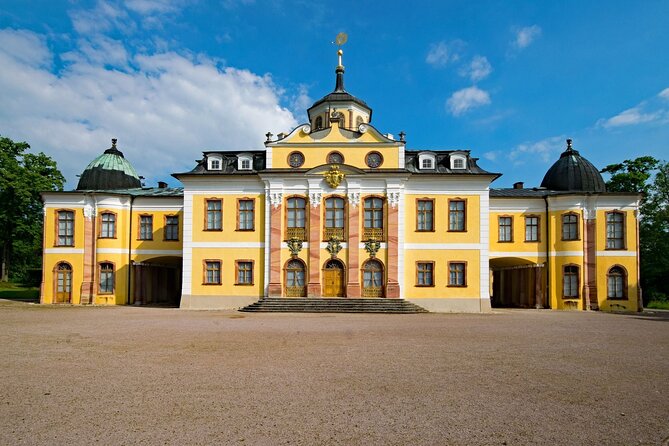
From the library palace, you walk to Park an der Ilm, created in the 18th century. The park is known for its valuable trees and architectural features, including the ruins of Tempelherrenhaus.
Goethe is part of the story here too. The tour highlights that Goethe played a role in designing the park, and he spent his early years in Weimar in a nearby house that Charles Augustus gifted to him.
This is one of those “slow down and look” parts of a walking tour. A park stop can feel like a break, but it is actually the bridge between the political and literary stops and real daily life in Weimar.
If you enjoy tracing how ideas shaped space, you will get a lot out of this section. It is also a nice palate cleanser after church and palace architecture.
Goethe’s House on Frauenplan, the writing space behind Faust
The next highlight is Goethe’s House on Frauenplan, where he moved after 1782 into a new and more impressive residence. Many of the rooms are described as looking like they did in Goethe’s final years.
One room in particular is emphasized, his study where he wrote works including Faust, with the study presented as unchanged. You also hear that Goethe stayed in Weimar until his death in 1832.
I like when tours give you an anchor object like the study. It helps your brain picture the person behind the famous name, and it makes the earlier stops about gatherings and libraries feel connected rather than random.
If you love literature, you will probably find yourself standing in front of the windows, imagining the daily routine behind the writing. If you are not a literature person, the atmosphere is still worth it, because the location makes the story feel physical.
Friedrich Schiller’s House, the meeting that changed everything
After Goethe’s house, you reach Friedrich Schiller’s House. The tour explains how an assembly brought Goethe and Schiller together, and how their meeting led to a lasting creative partnership.
Goethe invited Schiller to Weimar after being impressed. From that moment, you hear about the intense association between the two.
For me, the value here is seeing that the most important cultural figures in Germany were not working in isolation. They crossed paths locally, built relationships, and then shaped a city’s identity through ongoing collaboration.
It is also an easy stop to enjoy visually because Schiller’s house ties the story together. Without it, you might feel like Goethe was the only one with a Weimar “brand.” With it, you see the full picture.
Liszt Haus, piano lessons and a summer gift from a duke
The tour also includes Liszt Haus, where composer Franz Liszt lived during many summers as a gift from the local Duke.
One detail that makes this stop more than a name-drop is that Liszt taught young pianists from all over Europe for free while in Weimar. That is a rare kind of cultural generosity, and it helps you understand why Weimar mattered to artists beyond just famous residents.
A walking tour can become too focused on memorials and statuary. Liszt Haus adds an energy shift back into teaching and music, which keeps the route from feeling heavy all the way through.
Finishing back at the Market Square, and keeping your day flexible
The tour ends back at the Market Square, which is convenient because you can either grab lunch nearby or keep exploring without needing to relocate.
Since everything is set up for an easy walking level and all major stops are close together, this tour works well as a first activity in Weimar. You get an orientation that makes later self-guided wandering make sense.
You also do not need to plan for transport during the walk, which helps if your schedule is tight. If you are moving between cities, keeping your Weimar time simple like this is smart.
Price and value for a private group up to 15
The price is $244.41 per group for up to 15 people, for about 2 hours. That price makes the tour feel most cost-effective when you have more people splitting it.
For a solo traveler, it may feel like a lot compared to a larger group tour, but private walking tours often deliver value through flexibility and better Q and A time. You are not forced into one-way narration the whole time.
For families, couples, and small friend groups, this pricing structure can make the experience feel surprisingly fair. You also get the benefit of a local guide who stays with you for the full route, rather than bouncing between audio stations.
A quick reality check: this is a guided walk, not an all-day museum pass. You will see key sites and hear the stories tied to them, but if you want hours inside multiple buildings, you may want to pair it with additional time on your own.
Who this Weimar private walking tour suits best
This tour is a strong fit if you want Goethe and Schiller in a practical way. You will see the main touchpoints, and the guide ties the places together into a storyline.
It is also ideal if you care about more than literature. The inclusion of the House of the Weimar Republic and Democracy Square gives you the political context that many casual visitors skip.
Because the walk is marked easy and is suitable for any age, it can work for mixed groups. The pace also helps if you are traveling with kids who need frequent “look up, not just walk” moments.
If your priority is only museum time or you want to spend long hours indoors, you might find the tour too short. But if you want a clear, guided route that sets you up to explore further, it is a solid choice.
Should you book this tour?
Yes, if you want a guided overview that hits the most important Weimar ideas in one go, and you like the idea of connecting politics, art, and physical places. The route covers Market Square, the Goethe and Schiller memorial at Theaterplatz, the House of the Weimar Republic, Saint Peter and Paul Church, Anna Amalia’s Library, Park an der Ilm, Goethe’s House, Schiller’s House, and Liszt Haus.
If you are the type who gets more out of a city when someone helps you connect the dots, a private guide will help you move faster through the “what matters” part of Weimar.
Skip it only if you already know the full story and you want to spend your time deep inside buildings for hours. For most first-timers, especially those who want a smart start, this private walking tour gives you a strong foundation without overloading your day.
FAQ
How long is the Weimar private walking tour?
It runs about 2 hours.
How much does the tour cost?
The price is $244.41 per group, up to 15 people.
Is the tour private or shared?
It is private, meaning only your group participates.
What language is the tour offered in?
The tour is offered in English.
Do we need transportation during the tour?
No transportation is needed, and it is designed as an easy walking route.
Where does the tour start and end?
It starts at Markt 20, 99423 Weimar, Germany, and ends at 99 Weimar, Germany.
Is the tour good for people of different ages?
Yes, it is suitable for any age, with an easy activity level.
Newest Germany reviews on the site
- Munich – the essential walking tour★ 5.0 · 30 reviews
- Munich Beer and Bavarian Bites Small-Group Tour★ 5.0 · 167 reviews
- Munich to Prague – Private Transfer with 2 hours of Sightseeing★ 5.0 · 6 reviews
- 800 Years of History: A Munich GPS Audio Tour★ 4.5 · 12 reviews
- Munich in the 3rd Reich and WW2 private walking tour★ 5.0 · 148 reviews
- Munich Christmas Market Small Group Tour with Gingerbread Heart★ 4.0 · 9 reviews
- Munich Food Tour with Full Meal & Drinks by Do Eat Better★ 5.0 · 59 reviews
- Munich Scavenger Hunt and Sights Self-Guided Tour★ 4.5 · 8 reviews
Walking Tours, compared.



Berlin’s Best: 2 Hour Walking Tour Third Reich and the Cold War
Read our review →