
Reviewed · WALKING TOURS
Munich – the essential walking tour
Munich clicks into place on this smart walk. You get a local guide telling stories as you move between major sights, from grand churches to civic landmarks, with the pace kept friendly for groups. I especially like the easy central meetup around Marienplatz and the walk order that lines up well for an afternoon.
What makes it work is the “small-group feel” without you doing homework. The tour is limited to just your group (up to 10), so you can ask questions and linger for photos instead of being herded. One thing to consider: it is only 2 to 3 hours, and it involves a moderate amount of walking, so it is not the choice if you want long, museum-style stops.
In This Review
- Key highlights to look forward to
- Marienplatz meetup and how the timing really helps
- Frauenkirche, the brick cathedral, and the legend about the devil
- New Town Hall and the Glockenspiel story that ties to real life
- Old Town Hall, broken-glass night, and the Morien Dancer
- Viktualienmarkt: food, smells, and local flavors without the stress
- St. Peter’s Church and the tower view over old Munich
- Ohel Jakob Synagogue at Saint Jakobs Square
- Price and value: when $360 per group makes sense
- The guide makes or breaks the experience
- Who should book this walking tour (and who should skip it)
- Weather and comfort: the one factor you cannot control
- Should you book this tour?
- FAQ
- How long is the Munich essential walking tour?
- What group size is this tour limited to?
- Where do we meet and when does the tour start?
- What language is the tour offered in?
- Is there a mobile ticket?
- Are entrance fees included?
- What is the weather and cancellation plan?
Key highlights to look forward to
- Private group, up to 10, so the guide can tailor the pace and answer questions
- Short distances between stops, which keeps the walk from feeling like a marathon
- Frauenkirche and St. Peter’s Church, including a tower view over old Munich
- New and Old Town Halls, with Glockenspiel stories plus old-town legends
- Viktualienmarkt food time, with tasting and local staples like soup, bread, coffee, and beer
- Multiple faiths in one route, including Ohel Jakob Synagogue at Saint Jakobs Square
Marienplatz meetup and how the timing really helps
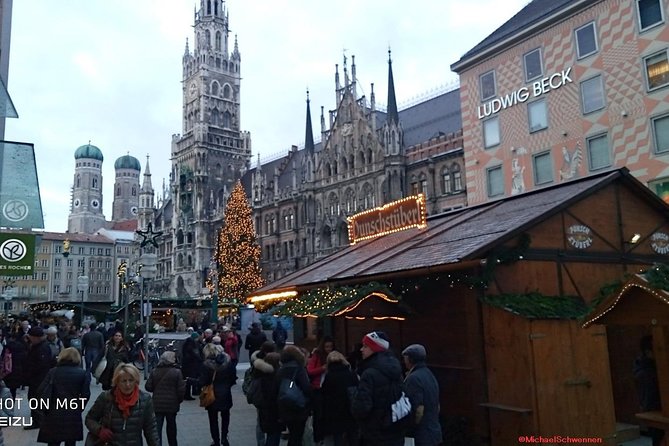
You start at Marienplatz (80331 München) at 12:00 pm, and the tour loops back to the same meeting point at the end. That matters more than you might think. Starting around midday puts you right in the center of the action, and it gives you a clean handoff to dinner plans right after.
The route is designed for convenience. You hit iconic spots clustered in the old-town core, and you are not stuck walking long stretches without a reason. It is also described as near public transportation, so if your timing is slightly off, you still have easy options to catch up.
You’ll get a mobile ticket, and the tour is offered in English. Service animals are allowed, and the overall activity expects a moderate physical fitness level. In practice, that means comfortable shoes and a steady pace. The stops are frequent enough that you should not feel stranded, but it is still a walk, not a sit-and-watch show.
More Walking Tours in Munich
- Munich: Third Reich & WWII Walking Tour
★ 4.6 · 6,181 reviews - Third Reich Walking Tour Munich
★ 4.5 · 4,291 reviews - Munich: Old Town & Viktualienmarkt City Walk in German
★ 4.7 · 2,304 reviews
Frauenkirche, the brick cathedral, and the legend about the devil
The first big wow moment is Frauenkirche, one of Munich’s most striking churches. It is known for its massive brick presence, and the folklore angle is part of the attraction, including the idea that even the devil was astonished by it. Even if you do not care about legends, you will probably care about the sheer visual impact, because this church dominates its surroundings.
This stop is about 45 minutes, and admission is free. That is a good setup for a walking tour, since you get time to look closely without feeling rushed into the next location. You also get your bearings fast. Standing here early helps you understand the city’s scale and how the rest of the center “fits” around this focal point.
A practical note: churches can have changing access, crowds, and security rules depending on the day. Since this is an on-foot tour, the guide’s pacing is the main thing that keeps it smooth, so you do not need to micromanage your timing. If you enjoy architecture and want the why behind what you’re seeing, this is a strong opening.
New Town Hall and the Glockenspiel story that ties to real life
Next comes New Town Hall (Neus Rathaus), where the famous Glockenspiel is built into the clock tower experience. The tour focuses on what the show is actually telling you, including stories about marriage and the legendary Scheffler dance. That is a smart way to approach it, because many visitors hear the chimes but do not get the context that makes it meaningful.
This stop is around 30 minutes, and admission is listed as free. With a limited time window, the guide’s job is to help you watch effectively and understand what you are seeing from the right angle. You’ll also have time for photos, but the emphasis is on comprehension, not just snapshots.
One small drawback to accept upfront: clocktower moments can be tricky on a walking schedule. The upside is that the pacing is built into the route, so you are not sprinting across town trying to catch a specific moment like a tourist obstacle course.
Old Town Hall, broken-glass night, and the Morien Dancer
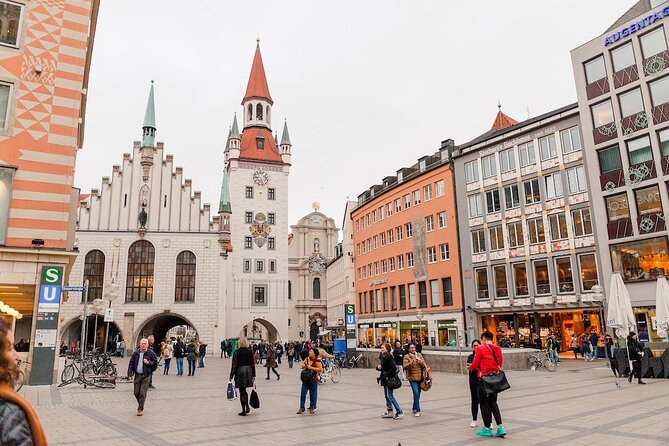
Then you step into the atmosphere of Old Town Hall, where the stories get darker and more dramatic. Here, you hear about historical events like the old lottery traditions, and you connect to the infamous Night of the Broken Glass. You also get the Morien Dancer reference, a figure that still dances since late medieval times.
This is a 20-minute stop, with free admission. That length is short, but it is enough when the guide is steering you to the right details and explaining the meaning of what you’re seeing. If you like urban legends with a factual spine, this is the portion that makes Munich feel like a living timeline rather than a list of buildings.
Because it is shorter, it’s also a moment that works well if you are traveling with different pacing preferences. Some people like to linger longer at one church. Others prefer quick hits and onward movement. This stop keeps everyone moving while still packing in stories.
Same city, a different way to spend the afternoon:
- From Munich: Neuschwanstein & Linderhof Castle Full-Day Trip
★ 4.6 · 14,646 reviews - Neuschwanstein & Linderhof Castle-Fairytale Day Tour from Munich
★ 4.5 · 7,275 reviews - Dachau Concentration Camp Memorial Site Tour from Munich by Train
★ 4.5 · 5,637 reviews - Neuschwanstein Castle Tour from Munich
★ 4.5 · 5,117 reviews
Viktualienmarkt: food, smells, and local flavors without the stress
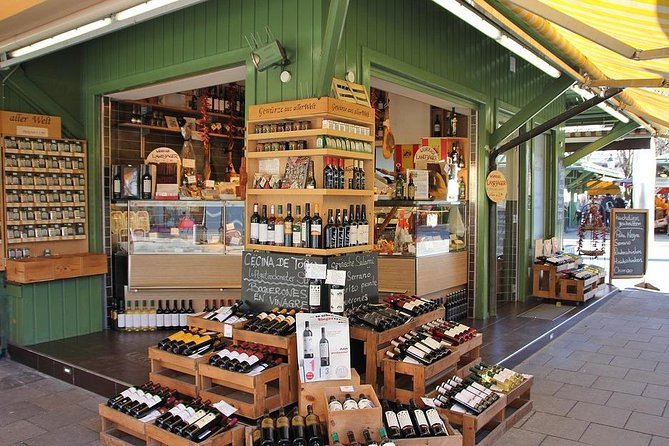
The mid-tour change of pace is Viktualienmarkt, and it is here that the experience turns from sightseeing into a real sense of daily life. This is not just a photo stop. The tour includes tasting and time to enjoy what the market offers, including local specialties, soup, bread, coffee, and beer.
You get about 1 hour here. Admission is free for the experience portion, which means your cost at this stop stays about what you choose to eat or drink. If you want an authentic Munich taste that feels connected to the city’s rhythm, this is one of the easiest wins on the route.
What I like about putting the market here is the reset. After churches and city halls, you need something human and sensory. Markets do that instantly. You can also browse at your own speed while still staying within the tour timeline.
Possible consideration: markets are busy places. If you do not love crowds, you’ll want to keep your expectations realistic. The good news is the tour framework gives you a defined time window and a guide who can help you focus on what’s worth your attention.
St. Peter’s Church and the tower view over old Munich

The next major landmark is St. Peter’s Church, with 45 minutes and admission included. This stop is packed with building-history layers that help you understand how Munich changed its architectural style over time.
You’ll hear how it started as the first church built in Munich, how it moved from Romanian-style foundations into Gothic work, and how it was later baroqued with ceiling paintings and a grand high altar. Then you get the payoff: from the tower, you have a great view over the old city of Munich.
This is the kind of stop that turns background into payoff. The guide’s explanations make the architectural changes feel purposeful, not random. And the included entrance means you are not juggling ticket questions in the middle of your walk.
A practical tip: if you want the best tower experience, plan to take it slow on the way up and down. Even when it is not extreme, towers can feel tighter than you expect, and the tour pace is built around getting back to street level without pushing anyone.
Ohel Jakob Synagogue at Saint Jakobs Square
You finish with Ohel Jakob Synagogue at Saint Jakobs Square. It is described as a newer synagogue with an architectural resemblance to the Temple in Jerusalem, which gives you a strong cultural contrast within the old-town core.
This stop is about 15 minutes, with free admission. That time is brief, but it works because it functions as a “multiple stories” capstone to the route. You move through Catholic church landmarks, civic history, and market culture, then close with a place of Jewish worship that broadens the picture of Munich beyond just one architectural tradition.
If you care about understanding a city as more than a set of famous photos, this stop helps. It nudges the tour from sightseeing into context, and it does it without dragging the schedule.
Price and value: when $360 per group makes sense
The price is $360.42 per group, with up to 10 people. That is the key value math. If you fill the group to capacity, you’re effectively paying about $36 per person. If you have fewer people, it costs more per head, so the best value happens when your group is large enough to spread the fee.
What you get for that spend is not just a checklist of stops. You get a guide leading you through short, focused time blocks, plus on-site guidance that helps you understand what you’re looking at while staying on schedule. Several accounts highlight that the pacing stays comfortable, with time for questions and pictures, and that the guide uses printed materials and historical images to support the explanations. That kind of structure is often what separates a “walk past things” tour from a “you actually get it” tour.
Also, many admission fees are listed as free for the stops, and St. Peter’s Church is the one where admission is included. That mix helps you avoid surprise costs during the walk.
The guide makes or breaks the experience
The reviews put a clear emphasis on the person leading the tour. One guide, Michael, comes up repeatedly, and another review calls him Mr Schwennen. Either way, the pattern is consistent: the guide is friendly, engaging, and strong at connecting the details to the bigger story of Munich’s development.
What I like most is how practical the guidance seems to be. One review notes that the guide even offered breakfast direction when shops were closed on New Year’s Day, which tells you he’s thinking beyond the exact tour stops. Another points out that printed handouts and historical pictures complement the stops well.
If you want to get more out of your time, bring a few questions with you. Ask what to see next after the walk. Ask what neighborhoods are best for a slow stroll later. A good guide can turn a good tour into a full day plan.
Who should book this walking tour (and who should skip it)
This tour fits best if you want:
- A tight route through major Munich sights in a short window
- Local context for churches, town halls, and the market
- Enough structure that you know what each stop means, without overplanning
- A group size that is small enough to ask questions and take photos
You might skip it if:
- You want very long stays inside multiple attractions. The stops are intentionally short.
- You’re looking for a museum-heavy day rather than a street-level orientation.
- You strongly dislike walking and crowds. The tour is manageable, but it is still a walk through central areas.
The moderate fitness requirement is there for a reason. Plan for steady walking and some stairs if you choose the tower view in St. Peter’s Church.
Weather and comfort: the one factor you cannot control
The experience requires good weather. If it is canceled due to poor weather, you’re offered a different date or a full refund. That policy matters for Munich, because rain can turn a walking tour into a stressful shuffle.
Your best strategy is to travel with an attitude of flexibility. Since this starts at 12:00 pm, you can also plan your morning to be low-stress, so weather won’t wreck your whole day.
Should you book this tour?
Yes, if you want an efficient, story-driven walk that covers the core of Munich without wasting time. The combination of iconic sights (Frauenkirche, New and Old Town Halls, St. Peter’s Church), a market food moment at Viktualienmarkt, and a cultural stop at Ohel Jakob Synagogue makes the tour feel like a compact “understand Munich” sampler.
The value is strongest when your group fills closer to the up to 10 capacity, because the price is per group, not per person. If you can align with friends or travel companions, it becomes a smart deal. If you are traveling solo or as a couple, it can still be worthwhile for the guidance and structure, just expect a higher per-person cost.
In short: it’s an easy way to get your bearings fast and leave with a clearer picture of how Munich grew.
FAQ
How long is the Munich essential walking tour?
It runs for about 2 to 3 hours.
What group size is this tour limited to?
It is private, limited to just your group, with a maximum of up to 10 people.
Where do we meet and when does the tour start?
You meet at Marienplatz, 80331 München, Germany. The start time listed is 12:00 pm.
What language is the tour offered in?
The tour is offered in English.
Is there a mobile ticket?
Yes, the experience includes a mobile ticket.
Are entrance fees included?
Admission is listed as free for several stops, including Frauenkirche, New Town Hall, Old Town Hall, and Ohel Jakob Synagogue. St. Peter’s Church has admission included.
What is the weather and cancellation plan?
The tour requires good weather. If it is canceled due to poor weather, you will be offered a different date or a full refund. You can cancel up to 24 hours in advance for a full refund.
Newest Munich reviews on the site
- Private day trip from Munich to Eagle’s Nest, Salzburg and back★ 4.5 · 15 reviews
- Private Tour from Munich to Salzburg with English Speaking Driver★ 4.5 · 10 reviews
- Private day trip: Munich to Neuschwanstein Castle, local driver★ 4.5 · 3 reviews
- Private day trip from Munich to Salzburg and Hallstatt★ 4.5 · 17 reviews
- Private Day Trip Munich to Harburg, Dinkelsbuhl & Rothenburg★ 4.5 · 24 reviews
- Private Day Trip from Munich to Eagle’s Nest and Hallstatt★ 4.5 · 9 reviews
- Private day trip from Munich to Eagle’s Nest and Salzburg★ 4.5 · 9 reviews
- In Depth Dachau Concentration Camp Tour (Private Tour)★ 5.0 · 43 reviews
Walking Tours, compared.

Berlin’s Best: 2 Hour Walking Tour Third Reich and the Cold War
Read our review →
Third Reich Berlin: Hitler and WWII Walking Tour
Read our review →Browse the lists this tour appears in