
Reviewed · WALKING TOURS
Best of Bamberg Private Walk Tour with a Professional Guide
Bamberg is small, but the stories hit hard. This private 90 minute walk tour uses the city’s landmarks to explain why Bamberg feels medieval in the best way, from the Cathedral’s tombs to the legends around the Old Town Hall. I especially like how the guide ties power and faith together, and how the tour spotlights the Bamberg Horseman and the city’s imperial connection.
You should expect a lot of talking, not just photos, and that is the only real consideration. If you want a quiet stroll with minimal explanation, this might feel a bit too story heavy for your taste. On the other hand, you will get a local professional guide who stays with your group only, so you can ask questions as you go.
In This Review
- Key highlights you will remember
- Meeting at Bamberg Cathedral, where the city’s big names live
- The Bamberg Horseman mystery, and why it still pulls people in
- How the Archbishop of Bamberg shaped what you walk past
- Emperor Heinrich II and Kunigunde: the story behind the tombs
- The Old Town Hall legend, and Bamberg’s civic independence
- New Residence and the Church of Our Lady, a needed change of pace
- Private group value: what $270 per group up to 15 really buys you
- What to do before and after the 90 minutes
- Best fit for this tour
- Should you book this Bamberg private walk?
- FAQ
- Where does the Best of Bamberg Private Walk Tour meet?
- How long is the tour?
- What is the price?
- Is the tour private?
- What language is the guide?
- Are entrance fees included?
- Can I customize the tour?
- Is the tour suitable for kids and older travelers?
- What is the cancellation policy?
- How does reserve and pay later work?
Key highlights you will remember
- The mystery behind the Bamberg Horseman, explained through local context, not guesswork
- Archbishop of Bamberg power, and how it shaped the city you see today
- Emperor Heinrich II and Empress Kunigunde, with stories that connect to major sites
- Why the Old Town Hall sits where it does, based on a legend tied to civic independence
- New Residence and Church of Our Lady, for a balanced view beyond the oldest medieval core
Meeting at Bamberg Cathedral, where the city’s big names live
The tour starts at Domplatz, right in front of Bamberg Cathedral. That matters, because Bamberg’s story is not just a background. It is built into the stones here. If you have only seen cathedrals as religious monuments, this stop reframes the Cathedral as a political and cultural anchor for nearly a millennium.
Bamberg Cathedral was consecrated in 1237, and it is still the focal point of the town. What makes it such a strong opening is what is inside. You get the tombs of Emperor Heinrich II and Empress Kunigunde, plus the only papal grave in Germany, that of Pope Clement II. Even if you do not plan to spend hours reading every inscription, your guide can help you understand what these burials meant for Bamberg at the time, and why people cared so much about controlling spiritual authority.
A practical tip: Domplatz is a great starting point for orientation, but Bamberg is built across seven hills, so you will likely feel some gentle uphill walking during the 90 minutes. Wear comfortable shoes, especially if you are visiting in cooler months when cobblestones can feel slick.
More Walking Tours in Bamberg
- Bamberg: Guided Walking Tour
★ 4.6 · 3,202 reviews - Bamberg: City Highlights Walking Tour
★ 4.6 · 679 reviews - Bamberg: Private Guided Walking Tour
★ 4.8 · 90 reviews
The Bamberg Horseman mystery, and why it still pulls people in
One of the most talked about parts of the tour is the mystery behind the Bamberg Horseman. You will see it as more than a striking statue. You will learn how questions about meaning, symbolism, and timing become part of the way Bamberg is understood.
This is also where a private format pays off. In a group tour, you often get one quick explanation and then you move on. Here, you can ask what you are thinking as you look at the details. That helps the statue land, because statue details only start to make sense when you know what to watch for.
What I like about this stop is the balance. You are not just told a single fact and expected to accept it. You get the story framework that explains why the mystery sticks around. That turns a quick photo moment into something more memorable, especially if you are the type of traveler who enjoys a good historical puzzle without feeling lost.
How the Archbishop of Bamberg shaped what you walk past
After the Horseman, the tour focuses on the role of the Archbishop of Bamberg. This topic is not abstract. It connects directly to the way Bamberg grew into a northern spiritual and political center.
Bamberg rose to prominence under Henry II, then later strengthened its position as part of the Holy Roman Empire. That imperial ambition did not float in a vacuum. Ecclesiastical authority helped define what mattered most, who had influence, and what buildings and institutions earned center stage.
As you walk, your guide’s explanations help you read the city as a map of authority. You start noticing how areas feel organized around religion and governance, not just commerce and daily life. That is a subtle shift, but it changes your whole experience. Suddenly you are not just admiring a medieval townscape. You are seeing the logic behind it.
This part also helps you avoid a common mistake. It is easy to look at old cities and assume everything happened naturally over time. Bamberg’s layout and prominence reflect deliberate power. The archbishop topic gives you that missing layer.
Emperor Heinrich II and Kunigunde: the story behind the tombs
The story of Emperor Heinrich II and Kunigunde is the emotional backbone of Bamberg. And the tour does not treat this as a dry biography. It connects the people to the physical places you came to see.
Henry II’s vision is key. He imagined Bamberg as a rival to Rome, at least in spiritual and political importance. That ambition explains why the city’s role lasted so long and why its architecture and institutions matter. Kunigunde, as Empress, belongs in the same conversation because her legacy is tied to why Bamberg became not only an imperial center, but also a deeply symbolic one.
When you hear this story while standing in Bamberg’s most important religious space, it clicks. The tombs stop being names on a list and start being proof of what Henry II and his circle wanted Bamberg to become. You also see how Bamberg Cathedral fits into a wider European story, not just local pride.
If you are traveling with kids or multiple generations, this is one of the easiest sections to follow. The personalities make it feel like a real saga, not a textbook chapter. The same is true if you enjoy history but do not want a long lecture. The tour is only 90 minutes, so the guide keeps it pointed.
Same city, a different way to spend the afternoon:
- Bamberg: Guided Beer History Tour with Optional Tasting
★ 4.6 · 772 reviews - Bamberg: Guided Historical Culinary Tour
★ 4.6 · 461 reviews - Bamberg: Immersive Medieval Tour
★ 4.7 · 232 reviews - Witch Trials in Bamberg
★ 4.4 · 187 reviews
The Old Town Hall legend, and Bamberg’s civic independence
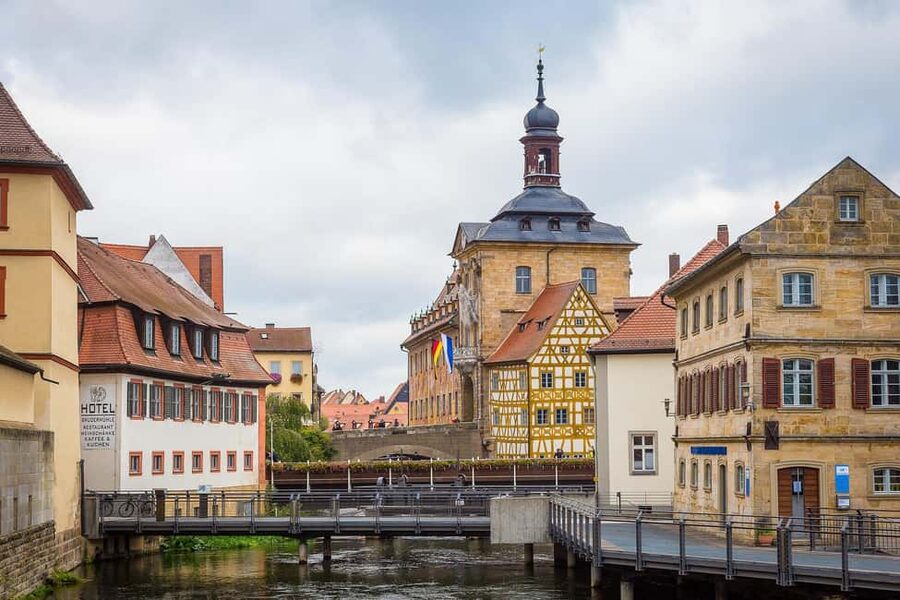
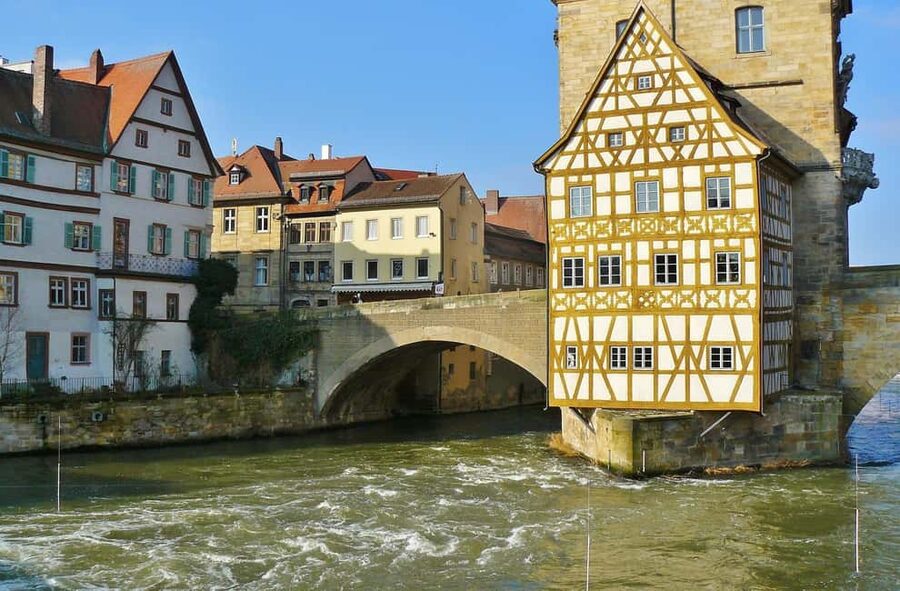
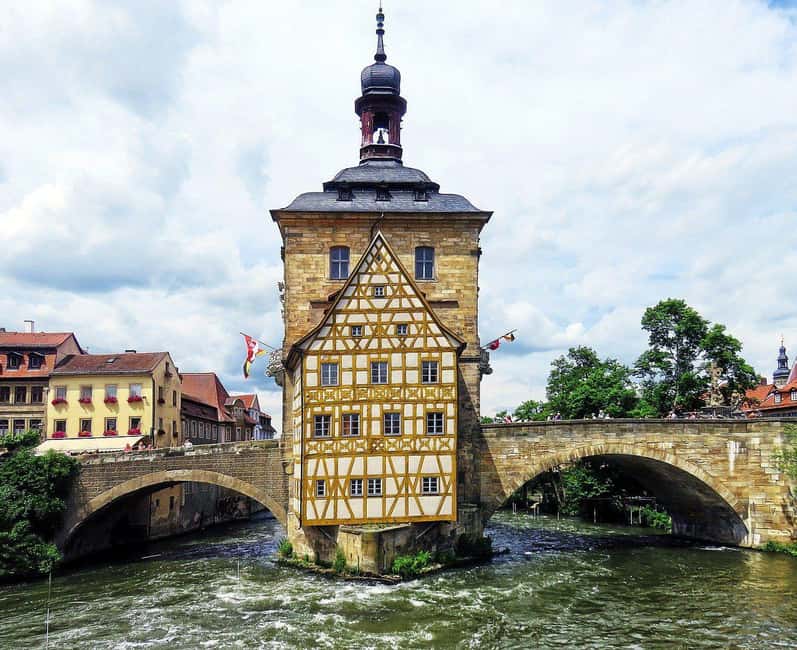
Bamberg’s Old Town Hall is striking for one reason you can literally see: it is built on an island in the Regnitz River. The legend of the Old Town Hall’s location gives you a way to understand why that design choice feels both bold and symbolic.
The story goes like this. When the bishop denied the townspeople land, they created their own space by building into the river. Whether every detail of the legend is 100 percent verifiable, the meaning is clear. Bamberg’s citizens were not passive. They found ways to operate within power structures while still pushing for independence.
This is why I like including a legend like this in a guided walk. You learn history, but you also learn how people explained their choices. Civic stories are part of how a city remembers itself, and Bamberg’s old town hall is built to reinforce that memory.
Look out for the way the river shapes the scene. Water makes the architecture feel more functional than decorative, and it helps you understand the town’s medieval relationship to trade, movement, and daily life.
New Residence and the Church of Our Lady, a needed change of pace
A smart Bamberg tour does not stop at the oldest layers. You also need a sense of what followed, and that is where the New Residence and the Church of Our Lady come in.
These stops give you a fuller sense of Bamberg’s long arc. The Cathedral anchors the medieval imperial and episcopal identity, while the New Residence and the Church of Our Lady help you see how religious and political importance carried forward. Even with just 90 minutes, the tour covers both the city’s core identity and the later expressions of that identity.
This also helps if you get tired of only one era. Standing in front of a range of sites keeps the walk interesting and gives you more angles to connect the story to what you see.
One thing I suggest: slow down for a minute when you arrive. Do not rush your photos. Let your guide finish a key point, then re-look at the building with that context in mind. The second glance usually makes the details feel more intentional.
Private group value: what $270 per group up to 15 really buys you
The price is $270 per group, for up to 15 people, for a total duration of about 90 minutes. That sounds simple, but the value depends on your group size.
If you are a small group, you are paying for a private guide rather than splitting the cost across many travelers. In return, you get focus. Your guide stays with you alone, and you can ask questions in the moment. That matters a lot in a place like Bamberg, where symbols and stories are tied closely to specific buildings.
If you are traveling with a bigger group that can reach the upper limit, the math becomes more attractive. The per-person cost drops, and you still keep the benefits of a private format. Either way, the tour is long enough to cover major story beats, but short enough that you are not losing your whole day to logistics.
Another value point: customizing is possible on the spot with your local guide. That means you can lean more into imperial figures, church authority, or city legends, depending on what your group cares about most.
What to do before and after the 90 minutes
Since the tour is only 90 minutes, you should plan it as your “story foundation” stop, not your entire Bamberg visit. I like booking this early enough that you can carry the context into the rest of your walking day.
Bamberg is a UNESCO World Heritage Site, declared in 1993, and it has a townscape that stays close to its medieval form. After your tour, you will likely enjoy wandering longer with better instincts. You will know what to look for and why it matters.
Also, Bamberg is famous for Rauchbier, smoked beer. The guide can point you toward what makes the beer distinct, but even if you skip drinking, the fact that local traditions like this still matter is part of why Bamberg feels alive rather than staged.
Best fit for this tour
This private walk works well if you:
- Want a guided history connection without committing to a full day
- Like stories tied to places, especially imperial and religious power
- Prefer a group that stays with one guide, instead of rotating through a schedule
- Travel with teens, adults, or mixed ages, since it is suitable for any age
It may not be the best fit if you want minimal conversation and mostly independent sightseeing. This is built around explanation, including legends and character-driven stories.
Should you book this Bamberg private walk?
I would book it if you want your time in Bamberg to feel purposeful. The strongest reason is how the tour links big names and big ideas to very specific sights: the Cathedral tombs and the papal grave, the Horseman mystery, the archbishop influence, the Heinrich II and Kunigunde story, and the Old Town Hall legend. You also get New Residence and the Church of Our Lady, so you leave with a fuller sense of how Bamberg developed.
If you are willing to trade a bit of quiet for clarity and storytelling, this is a smart way to start your Bamberg visit. The private format and short duration help you get value fast, and the chance to customize on the spot makes it easier to match what your group actually wants to hear.
FAQ
Where does the Best of Bamberg Private Walk Tour meet?
The meeting point is in front of the entrance of Bamberg Cathedral, Domplatz, 96049 Bamberg, Germany.
How long is the tour?
The tour lasts 90 minutes.
What is the price?
It costs $270 per group, up to 15 people.
Is the tour private?
Yes. It is a private group experience, with your group only.
What language is the guide?
The live guide is in English.
Are entrance fees included?
No, entrance fees are not included.
Can I customize the tour?
You may be able to customize the tour on the spot with your local guide.
Is the tour suitable for kids and older travelers?
Yes, it is suitable for any age.
What is the cancellation policy?
You can cancel up to 24 hours in advance for a full refund.
How does reserve and pay later work?
You can reserve your spot and pay nothing today, keeping your travel plans flexible.
Newest Bamberg reviews on the site
- Witch Trials in Bamberg★ 4.4 · 187 reviews
- Bamberg: Immersive Medieval Tour★ 4.7 · 232 reviews
- Bamberg: Self-Guided BierSchmecker® Tour★ 4.5 · 187 reviews
- Bamberg: Where Hollywood dreams and movies are born★ 4.5 · 26 reviews
- Bamberg: Guided Tour of the Gardeners’ District★ 4.4 · 26 reviews
- Bamberg: Historical City Tour in German with Brewery Visit★ 4.5 · 108 reviews
- Bamberg: Beer & Brewery Tour – 2 Hour – English Or German★ 5.0 · 150 reviews
- Bamberg: Bar & Club Tour with free Shots & VIP entry★ 4.5 · 25 reviews
Walking Tours, compared.

Berlin’s Best: 2 Hour Walking Tour Third Reich and the Cold War
Read our review →
Third Reich Berlin: Hitler and WWII Walking Tour
Read our review →Browse the lists this tour appears in