
Reviewed · WALKING TOURS
Jewish Life in Berlin – Private Walking Tour
Berlin can feel like a living museum. This private Jewish-life walk connects past and present through real streets and real stories. I especially liked the way the tour stays human, with Otto Weidt’s resistance told in a concrete, place-based way, and the comfort of a private group where questions actually get time.
I also liked how the route builds toward the big visual anchor at the end, the New Synagogue and its Centrum Judaicum. Along the way, you pass through neighborhoods and sites that help you picture daily Jewish life from the 17th century onward, not just the tragic headlines.
One consideration: this is not a quick-hit Holocaust tour. The schedule focuses on Jewish-quarter sites, plus Otto Weidt and the New Synagogue center, so if you want a very specific memorial experience, you should set expectations for the route you are getting.
In This Review
- Key highlights worth planning around
- Why this Jewish Life in Berlin route feels different than a basic history tour
- Getting oriented at Hackescher Markt before you start walking
- Die Hackeschen Hoefe and the meaning of small memorials
- Scheunenviertel: where the former Jewish quarter comes into focus
- Museum Blindenwerkstatt Otto Weidt: a workshop with moral weight
- Sophienstraße and Grosse Hamburger Straße: streets that explain community life and loss
- Sophia Church and the connection to Martin Luther King
- Auguststraße: art galleries plus old Jewish community landmarks
- The New Synagogue and Centrum Judaicum: the late-19th-century anchor
- Price and logistics: is $355.25 per group worth it
- What makes the guides’ style matter on this topic
- How to get the most out of your 3-hour Jewish Life in Berlin walk
- Who should book this tour
- Should you book this Jewish Life in Berlin private walking tour?
- FAQ
- Where do I meet the guide for the Jewish Life in Berlin tour?
- What is the duration of the private walking tour?
- How much does the tour cost and how many people can be in the group?
- Is this a private tour?
- What sites are included on the route?
- Does it run in bad weather?
- What is the cancellation policy?
Key highlights worth planning around
- Private walking route through Berlin’s former Jewish quarter with a guide matched to your group
- Museum Blindenwerkstatt Otto Weidt, a 1940s workshop tied to protecting blind and deaf Jewish workers
- Scheunenviertel and street-by-street context, so the neighborhood feels like a place, not a list
- Cemeteries, schools, and deportation context tied to Grosse Hamburger Straße
- New Synagogue and Centrum Judaicum, with the building’s story and 1938 Night of broken glass context
- Guides who handle sensitive moments well, with room for patient questions (I’ve seen this firsthand with guides like Caroline, Carlos, Finn, and Marriette)
Why this Jewish Life in Berlin route feels different than a basic history tour
This tour is built around one core idea: Jewish life in Berlin is not only a story of one era. You start with early Jewish settlement in the city, move through neighborhood life, and then follow the consequences of Nazi persecution all the way to 1938 context and the long afterlife of memory.
The big win for me is the pacing. You get short, focused stops, and each one is tied to a specific location. That matters in Berlin, where it is easy to look at a building and forget that people once worked, prayed, studied, and lived nearby.
And because it is private, the guide can adjust to your group. In practice, guides like Carlos and Caroline have a knack for keeping the tone respectful while still making the facts clear. That blend is important here, because you will be walking through places where history is heavy.
More Walking Tours in Berlin
- Discover Berlin Half-Day Walking Tour
★ 5.0 · 9,624 reviews - Berlin: Third Reich and Cold War 2 Hour Walking Tour
★ 4.9 · 6,830 reviews - Berlin: Discover Berlin Walking Tour
★ 4.9 · 5,998 reviews
Getting oriented at Hackescher Markt before you start walking
You meet your guide outside the Hackescher Markt S-Bahn station, at the Starbucks area. The tour’s first moment is an introduction to what you are about to see and why this neighborhood cluster matters.
This matters more than you might think. Berlin’s Jewish history spans centuries, and the route is meant to help you connect time periods to streets and landmarks. Getting oriented early helps you follow the story when the tour turns from older Jewish settlement patterns toward the Nazi era and its aftermath.
Tip: plan for an easy start. Even though the walking is described as flat in practice, you still want to arrive ready to walk for about three hours total.
Die Hackeschen Hoefe and the meaning of small memorials
One early stop is Die Hackeschen Höfe. Here, your guide explains the history of the site and talks about the Memorial of the woman protest.
This is one of those stops that can easily be skipped on a self-guided stroll, because it is not always obvious how to read a courtyard or a tucked-away site. In a guided format, you get the why behind the what, which turns the space into something you understand instead of something you just pass.
If you like tours where details add up, this is a good sign. The tour keeps rewarding you with context at multiple points, not only at the headline landmarks.
Scheunenviertel: where the former Jewish quarter comes into focus
From Die Hackeschen Höfe, the route moves into the Scheunenviertel area. Your guide explains the history of the former Jewish quarter and the history of the Jewish community in old Berlin.
This is where the tour starts to feel like a neighborhood story. You are not only learning names of institutions, you are learning how a community organized itself in physical space. That includes how the area worked before World War II and how that life was later disrupted.
One practical benefit: because you are walking, you get a real sense of scale. Berlin can feel huge, so seeing the quarter by foot helps you understand how close so many key places actually are.
Same city, a different way to spend the afternoon:
- Berlin: Reichstag, Dome and Government District Guided Tour
★ 4.7 · 18,288 reviews - Berlin: 1-Hour City Tour by Boat with Guaranteed Seating
★ 4.3 · 16,993 reviews - Berlin: TV Tower Standard Entrance Ticket
★ 4.4 · 15,883 reviews - Berlin: Boat Tour Along the River Spree
★ 4.4 · 11,252 reviews
Museum Blindenwerkstatt Otto Weidt: a workshop with moral weight
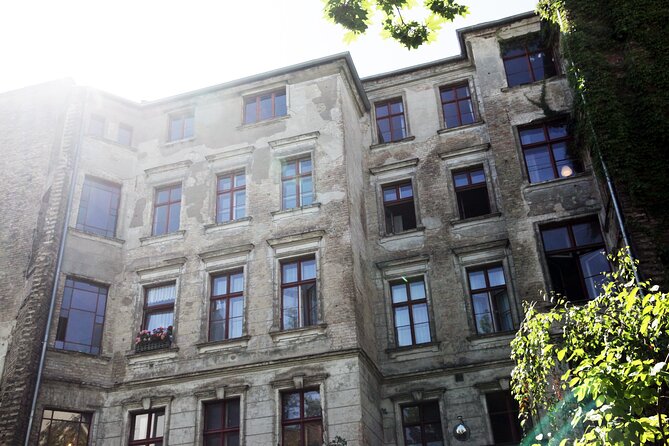
A major highlight is the Museum Blindenwerkstatt Otto Weidt. The guide explains Otto Weidt and the resistance connected to protecting blind and deaf Jewish workers from persecution during the Holocaust.
This stop stands out because it focuses on labor, care, and action, not only on destruction. The setting is a 1940s-era factory workshop, so the story lands with physical immediacy. You are not reading about bravery in the abstract.
Also, the museum tie-in gives the tour a rare balance. Many Holocaust-related tours can feel like a list of sites tied only to suffering. Here, you still face the horror, but you also hear about people who tried to protect others in the middle of danger. In my view, that balance makes the lesson harder to forget.
Sophienstraße and Grosse Hamburger Straße: streets that explain community life and loss
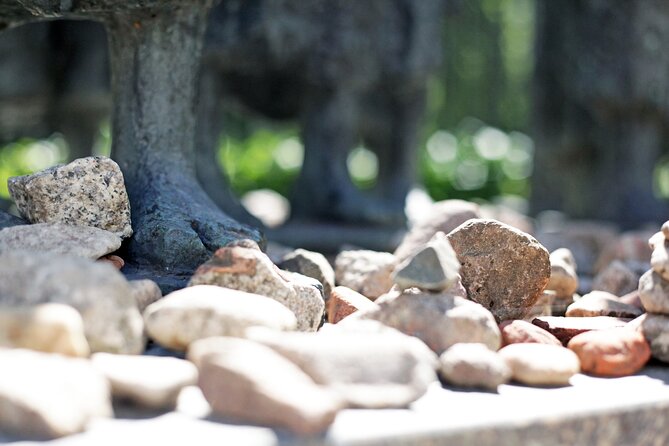
Next you head to Sophienstraße, described by the guide as a picturesque street in Berlin Mitte named after Queen Sophie. This part of the route helps you shift from big themes to the texture of city life.
Then comes Grosse Hamburger Straße, a key stop. Your guide explains the history of the Jewish cemetery, a Jewish school, and the deportation of Jews in the Nazi era.
This is an important pairing. A cemetery and a school both represent community continuity, daily life, and the future. Deportation context, explained at the same time and place, shows you what the Nazis sought to erase. For me, that contrast is one of the most powerful ways to understand the stakes.
Walking through these streets, you will likely feel how Berlin’s physical layout can preserve memory. It is not always obvious on your own, which is why this tour format works so well.
Sophia Church and the connection to Martin Luther King
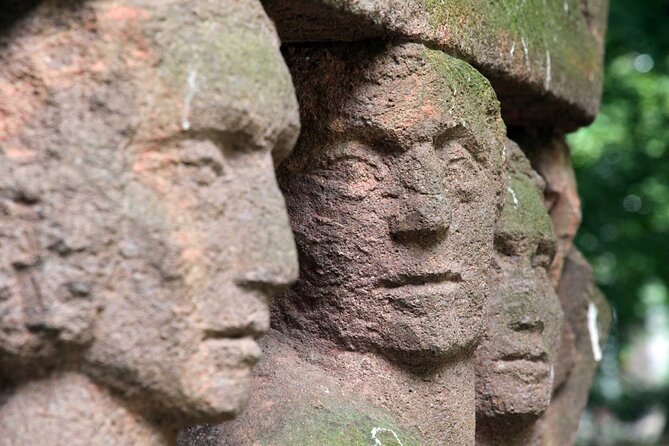
The tour includes Sophia Church. Your guide covers the history of the church and the link to Martin Luther King.
This stop can be a surprise if you expected everything to be strictly synagogue or Jewish-institution focused. But that is also what makes it useful. Berlin’s story is layered, and religions and communities have intersected in complicated ways.
You do not need to know much theology to appreciate this part. Think of it as a reminder that Berlin history is not one lane. The city’s moral and political debates have spilled into many settings, and your guide helps you connect the dots.
Auguststraße: art galleries plus old Jewish community landmarks
From Sophia Church, you walk to Auguststraße. Your guide explains the history of the site, described as known for art galleries and important buildings of the old Jewish community.
This segment helps you land in modern Berlin without losing the earlier story. Even if you are traveling in the here and now, you are seeing places where Jewish life once had major visibility. That helps you avoid the common trap of treating Jewish history as something that belongs only to books or distant museums.
If you like cities where culture and history are close together, you will likely enjoy this transition.
The New Synagogue and Centrum Judaicum: the late-19th-century anchor
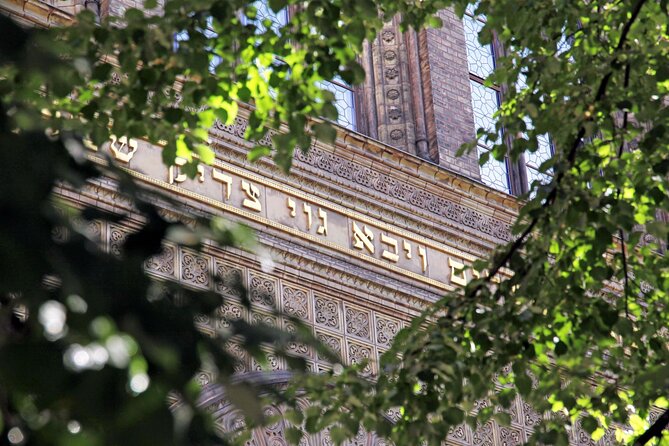
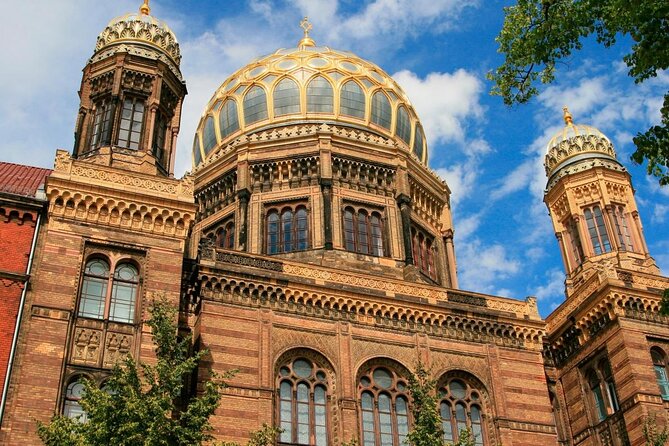
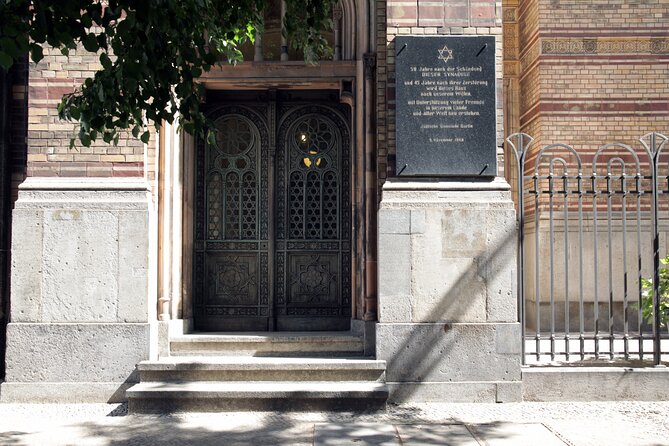
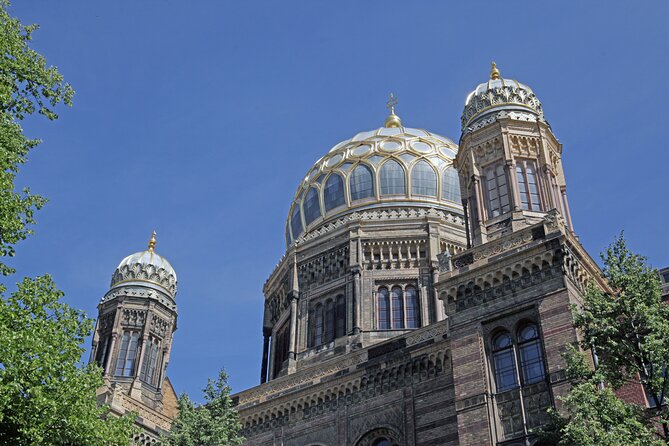
The final stop is Stiftung Neue Synagoge Berlin – Centrum Judaicum, at Oranienburger Str. 28-30. The guide explains the New Synagogue’s history, the 1938 Night of broken glass, and those who helped Jewish people.
This is the tour’s emotional and visual endpoint. The New Synagogue is described as one of Berlin’s most significant Jewish landmarks and a key architectural monument of late 19th-century Berlin. Today it houses the Centrum Judaicum, which traces the history of the building and the life connected with it.
What I like about this ending is that it connects building history to the human story. You leave with a stronger mental picture of why the building matters in the present, not only because of what happened there, but because the center helps document the community’s past and experiences.
If you want a closing takeaway, mine would be this: the tour uses the synagogue to show continuity. The story goes beyond destruction and into preservation through learning and remembrance.
Price and logistics: is $355.25 per group worth it
The price is $355.25 per group, up to 15 people, and the tour runs about three hours. That pricing is about group value, not per-person value. So the deal gets better as your group grows.
For me, this kind of private walking tour can be worth it when:
- you want a guide who can pace to your group and answer questions,
- you care about context at each stop, not only big monuments,
- and you like the idea of a route that connects multiple related sites into one story.
At the same time, you are paying for an experience that is largely interpretive. You are not spending a long time inside multiple museums, because many stops are short on purpose. If you want a museum-heavy format, you might find this feels more like a street-level history lesson than a deep museum day.
Also, it is a mobile ticket, and the tour is designed to run in all weather. Bring a rain layer, even if you are hoping for clear skies.
What makes the guides’ style matter on this topic
On a sensitive theme, the guide tone is not a small detail. You want clarity, respect, and the ability to handle tough questions without getting rushed.
The best signals from people who have done the tour are consistent: guides can keep the facts sharp while also managing emotional weight carefully. You will see that in how Otto Weidt and the Nazi-era material are presented, and in how the guide talks about remembrance sites.
You may also notice how guides manage different ages in the group. Carlos, Finn, Caroline, and Marriette have all been praised for passion, perspective, and staying patient with questions. If you are traveling with teens, grandparents, or a mixed crowd, that flexibility helps a lot.
How to get the most out of your 3-hour Jewish Life in Berlin walk
A few practical things will make your experience smoother:
- Wear shoes for city walking. The route is described as quite a lot of walking, but flat, which still adds up over three hours.
- Dress for weather. The tour operates in all conditions, so you will move even if it rains.
- Use the route as a way to build memory. After each stop, take 20 seconds to mentally connect that site to the bigger timeline you are hearing.
- Go in ready to ask questions. A private tour is your chance to turn curiosity into understanding.
One more tip: if you are hoping to see every famous Holocaust-related Berlin site, this route may not match that plan. It is focused on Jewish-quarter life and specific landmarks like Otto Weidt and the New Synagogue center. Plan your day so you do not feel like you missed something you never booked.
Who should book this tour
I think this is a great choice if you:
- want a guided narrative that links centuries, neighborhoods, and major landmarks,
- care about how communities lived, not only how they suffered,
- and prefer a private setup where you can ask questions without feeling rushed.
It is also a smart fit for first-time Berlin visitors who want to understand one of the city’s defining historical layers without trying to stitch together ten different destinations alone.
Should you book this Jewish Life in Berlin private walking tour?
Yes, if you want a focused route that connects Jewish life across time through specific places, including Otto Weidt’s workshop museum and the New Synagogue at Centrum Judaicum. I’d book it when your priority is guidance and story, not a long list of sites.
Skip it or pair it with other options if you are looking for a museum-heavy day or if you specifically want a certain Holocaust memorial experience. This tour is not built that way. It is built to explain a community, show its neighborhood footprint, and leave you with a clearer understanding of how Berlin remembers.
FAQ
Where do I meet the guide for the Jewish Life in Berlin tour?
You meet the guide outside the Hackescher Markt S-Bahn station area, with the meeting point described as in front of Starbucks. The tour start location is listed as Neue Promenade 3, 10178 Berlin, Germany.
What is the duration of the private walking tour?
The tour lasts about 3 hours.
How much does the tour cost and how many people can be in the group?
The price is $355.25 per group, with up to 15 people per group.
Is this a private tour?
Yes. It is a private tour, and only your group participates.
What sites are included on the route?
The tour includes stops such as Museum Blindenwerkstatt Otto Weidt, the Scheunenviertel area, Grosse Hamburger Straße, Sophia Church, Auguststraße, and Stiftung Neue Synagoge Berlin – Centrum Judaicum (the New Synagogue center).
Does it run in bad weather?
Yes. The tour operates in all weather conditions, so dress appropriately.
What is the cancellation policy?
Free cancellation is available up to 24 hours in advance for a full refund. If you cancel less than 24 hours before the start time, the amount you paid is not refunded.
Newest Berlin reviews on the site
- Your ticket to The Wall Museum Berlin★ 3.0 · 60 reviews
- Rickshaw Tours Berlin – Groups of up to 16 people with several rickshaws★ 4.0 · 97 reviews
- Love and War in Berlin: Self-Guided Story Puzzle Walk★ 5.0 · 7 reviews
- Warnemuende Shore Excursion: Berlin Private Sightseeing Tour from Rostock★ 5.0 · 4 reviews
- eSIM for Germany and 34 European Countries★ 4.5 · 16 reviews
- Walking on the Wall: 3-Hour Tour in Berlin★ 4.5 · 34 reviews
- Karl-Marx-Allee Tour: Life and Architecture in East Berlin★ 5.0 · 19 reviews
- Warnemuende Shore Excursion: Private Berlin Tour★ 4.5 · 27 reviews
Walking Tours, compared.

Berlin’s Best: 2 Hour Walking Tour Third Reich and the Cold War
Read our review →
Third Reich Berlin: Hitler and WWII Walking Tour
Read our review →Browse the lists this tour appears in