
Reviewed · WALKING TOURS
Dresden: Walking Tour with Virtual Reality elements
Nine sites, four centuries of seeing time.
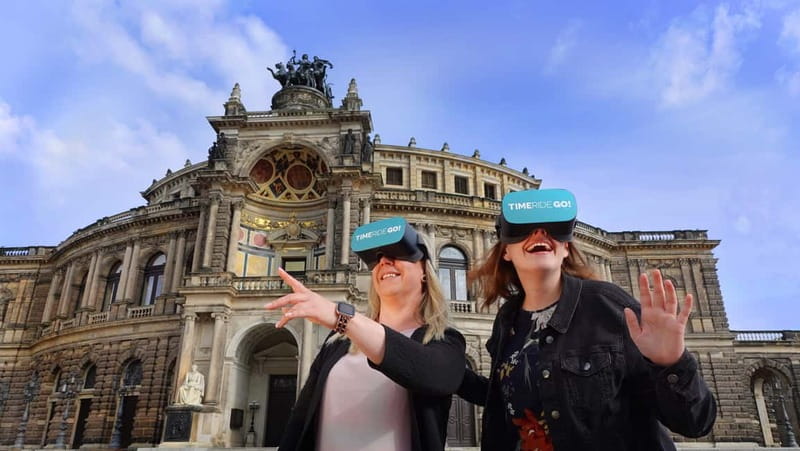
This Dresden walking tour uses a mobile VR headset to show the city in layered eras as you move through the Old Town. You get a live German guide, plus 360-degree views that help you compare what stood there then with what you see now.
What I like most is the pacing. It is structured, but it still feels like you are strolling with someone who knows the streets. Second, the VR idea works because it turns famous landmarks into a timeline, including the Baroque period, the city’s shifts up to the 1920s, the WWII destruction, later socialism-era thinking, and finally reunification.
One possible drawback: the VR clips can be a little rough around the edges. Some people note the films feel somewhat clunky, so if you expect a flawless sci-fi experience, you might be slightly disappointed, even though the overall effect still lands.
In This Review
- Key reasons this tour is worth your time
- Meeting TimeRide GO! and getting your bearings fast
- From Taschenberg 3 through Zwinger, you see Dresden’s “why”
- Postplatz and the Old Market Square: where daily life meets major change
- Pirnaischer Platz and Neumarkt: looking at how Dresden re-thinks itself
- Fürstenzug photo stop and the walk toward the Semperoper
- The 360-degree VR effect, what it does well, and what to watch for
- Price and value at about $38 for 90 minutes
- Guide quality is the secret ingredient (especially if you get Anna)
- Weather, comfort, and who should not join
- Should you book this Dresden VR walking tour?
- FAQ
- How long is the tour?
- Where do we meet?
- What’s included in the price?
- What language is the guide?
- Is this tour suitable for children?
- What should I bring, and what happens in bad weather?
Key reasons this tour is worth your time
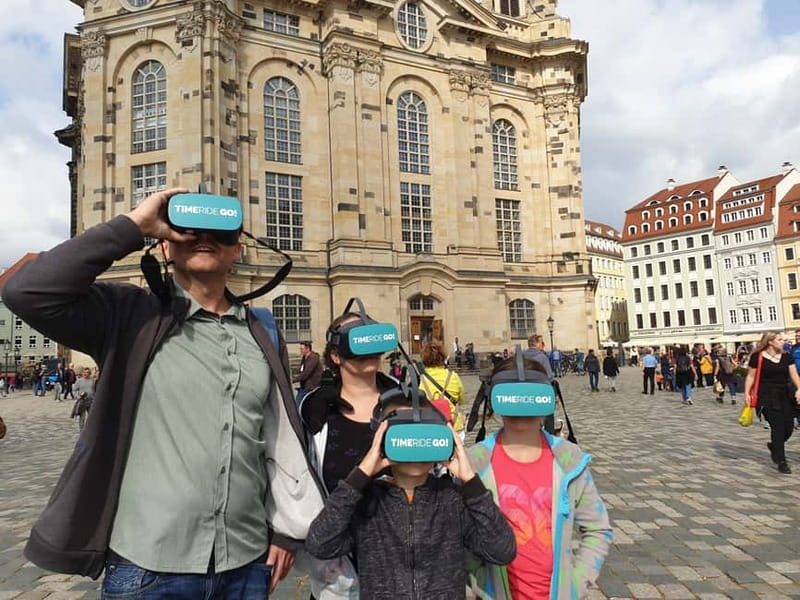
- Mobile VR at nine real locations, so you are always oriented in the present while watching the past overlay it
- A live German guide who explains what you are seeing in plain, story-based context
- 360-degree views that help you understand how these places changed over centuries
- A focused 90-minute route that hits major Old Town sights without turning into a full day of walking
- Clear “then versus now” comparisons, especially for WWII impact and later rebuilding ideas
- Good value at about $38, since the guide and VR headset are included
Meeting TimeRide GO! and getting your bearings fast
The tour starts at the TimeRide senseum area, meeting at the TIME RIDE GO! flag right in front of the building. From there, you set off on a short, guided route through Dresden city center, with the VR elements tied to specific stops.
Plan to keep it simple. Bring comfortable shoes and dress for weather, because you will walk between points. Also, the equipment has to be handled with care. Treat the headset like something you would not want to replace, because that is exactly how it feels when the guide is explaining basics and fit.
One more practical note: the guide is German. If your German is limited, you might still follow the structure and visuals, but you may miss some of the finer storytelling details.
More Walking Tours in Dresden
- Dresden: City & Semperoper Guided Walking Tour
★ 4.8 · 2,307 reviews - Dresden: Guided City Walk
★ 4.6 · 2,075 reviews - Dresden: Complete Walking Tour with Frauenkirche Visit
★ 4.8 · 700 reviews
From Taschenberg 3 through Zwinger, you see Dresden’s “why”
The tour’s starting point is Taschenberg 3, and the first big landmark area on the route is the Zwinger. You spend time here in two segments. That split matters because it gives you more than a quick look at stone and statues. You get time to watch how the visual story changes your sense of scale and intention.
At Zwinger, the VR concept really clicks. You are not just looking at one historic photo. You are standing in the same zone where later layers of Dresden life would have played out. The guide helps you connect architecture, power, and the city’s changing identity, which makes the VR feel less like a video and more like a tool for understanding place.
What you gain: perspective. The Zwinger is already visually dramatic in the present. With the VR layers added, it becomes an anchor for everything that comes after, including periods when Dresden’s priorities and politics shifted.
Possible downside to keep in mind: VR is only as good as the comfort level. If you feel pressure, motion discomfort, or you just hate wearing headgear, this part will be the moment you notice it most. If that is you, take your time getting the fit right at the start.
Postplatz and the Old Market Square: where daily life meets major change
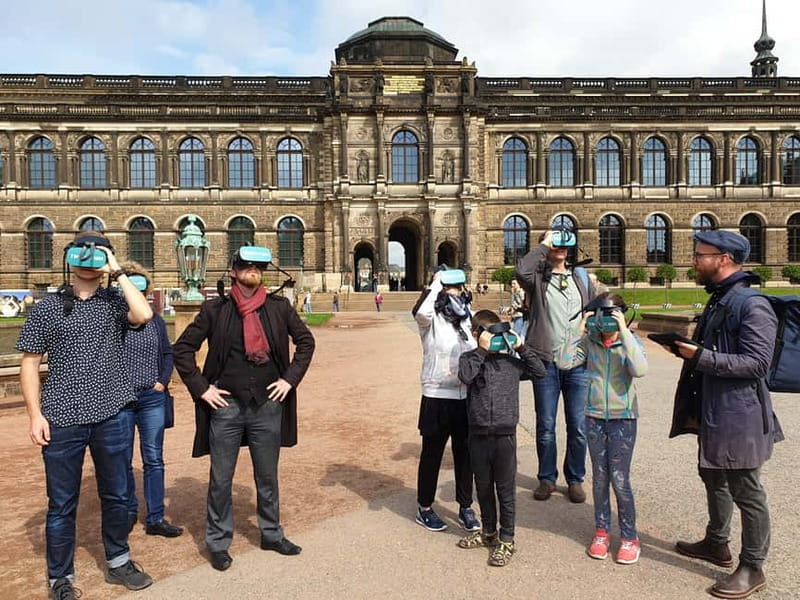
Next up is Postplatz, Dresden. This stop is a good “bridge” in the tour. After the Zwinger’s grandeur, Postplatz helps you drop back into the real city texture, so the timeline feels grounded rather than museum-like.
Then you move to Old Market Square. This is one of those places where history is not only in the monuments. It is in the geometry of the square, the way streets feed into it, and the sense of who would have passed through here day after day.
With the VR component, you are effectively being shown what those patterns meant across different eras. The tour’s historical sweep is big, covering the glamor of the Baroque period, a transformation up to the 1920s, WWII destruction, socialism-era ideas, and then reunification. Old Market Square is a strong place for that comparison because squares naturally read as social spaces, even when the political story changes.
Here is what is genuinely useful for you: the guide’s explanations help you stop treating WWII destruction as one generic tragedy. Instead, you start connecting it to specific places, specific vantage points, and why rebuilding choices mattered.
Pirnaischer Platz and Neumarkt: looking at how Dresden re-thinks itself
Pirnaischer Platz comes next, and it keeps the pacing easy while still feeding you story. The main value here is rhythm. You are not jumping from one huge headline to the next. You are getting gradual orientation, so each VR moment makes sense in relation to what you just walked through.
Then the tour reaches Neumarkt, Dresden. Neumarkt is where the tour’s “then versus now” theme can feel especially immediate. VR helps you see how ideals and eras shaped the cityscape, and the guide’s commentary ties that to the bigger historical arc, including the post-war years and later political shifts.
If you like history but get impatient with long lectures, this part is designed for you. You are moving, looking, and learning in small chunks. It is the kind of setup that keeps the information from turning heavy.
Same city, a different way to spend the afternoon:
- Dresden: Semperoper Tickets and Guided Tour
★ 4.7 · 12,102 reviews - Dresden: The Original Night Watchman Tour in Lantern Light
★ 4.6 · 6,653 reviews - Dresden: Semperoper and Old Town Tour
★ 4.8 · 5,735 reviews - Dresden: River Sightseeing Boat Cruise
★ 4.3 · 5,323 reviews
Fürstenzug photo stop and the walk toward the Semperoper
The Fürstenzug is built for stopping. Your time here includes a photo stop, plus guided explanation before you continue. Even in the present, the mural-like procession has scale and storytelling built in. With VR, that feeling of narrative gets stronger, because you are encouraged to compare how people would have experienced the area at different points in time.
Finally, you finish at the Semperoper Dresden. That ending point matters because it is a symbolic capstone. The tour’s timeline covers eras that changed Dresden’s identity again and again. Ending at a cultural landmark gives you a sense of continuity, even after the hardest moments in the story.
You are left with a sharper mental map. You will likely start noticing sightlines and architectural relationships you normally would skip. That is the best souvenir here: your ability to “read” the city.
The 360-degree VR effect, what it does well, and what to watch for
The tour’s promise is simple: you wear a mobile VR headset at key locations, and you get a 360-degree view of major sites through time. The VR scenes are paired with the guide’s storytelling, so you are not just watching something happen in the abstract.
From the provided information, the historical span is clear: Baroque, changes up to the 1920s, WWII destruction, later socialism-era ideas, and then reunification. This is the core value. You learn that Dresden’s “look” is the result of political choices, rebuilding priorities, and cultural shifts.
That said, here is the consideration: some people note the films can be a bit clunky. In plain terms, the visuals may not feel like a perfectly smooth modern production. Still, the VR use case is not about cinematic perfection. It is about giving you a strong spatial sense of how the city changed.
If you want the best experience, keep your expectations practical. Treat the VR as a guide to place and time, not as a premium Hollywood effect.
Price and value at about $38 for 90 minutes
At $38 per person and 90 minutes, this sits in the “worth it if it helps your understanding” category. The big value lever is what you actually get: a live guide and the VR headset.
What is not included also matters for decision-making. The entrance to the TimeRide senseum and the Dresden 1719 exhibition are not included. So if you were hoping the tour fee would automatically cover everything inside that broader attraction, it will not. You may still want to visit those spaces separately, but that is an extra cost.
On top of that, the tour notes that you skip the ticket line. In practice, this usually means less waiting once you arrive, so you spend more of your limited time walking and experiencing the timeline. Since the tour is only 90 minutes, reducing dead time is genuinely part of the value.
Who gets the best return on this price? People who love architecture and want context, but do not want a full-day museum schedule. Also, anyone who benefits from seeing how a place looks in different eras without relying entirely on photos.
Guide quality is the secret ingredient (especially if you get Anna)
A major theme in the experience is that the guide’s delivery makes the difference between a cool tech demo and a meaningful tour. One guide specifically named Anna received praise for being super, relaxed, and engaging, with information plus personal anecdotes and stories.
That combination matters. VR shows you scenes. The guide helps you interpret them. And interpretation is where you start remembering what you learned, instead of just remembering that you wore a headset.
There is also an important tone element: multiple comments point to a calm, respectful style, with lots of information that does not feel rushed. If you like learning without being yelled at by a megaphone, this is a good fit.
Weather, comfort, and who should not join
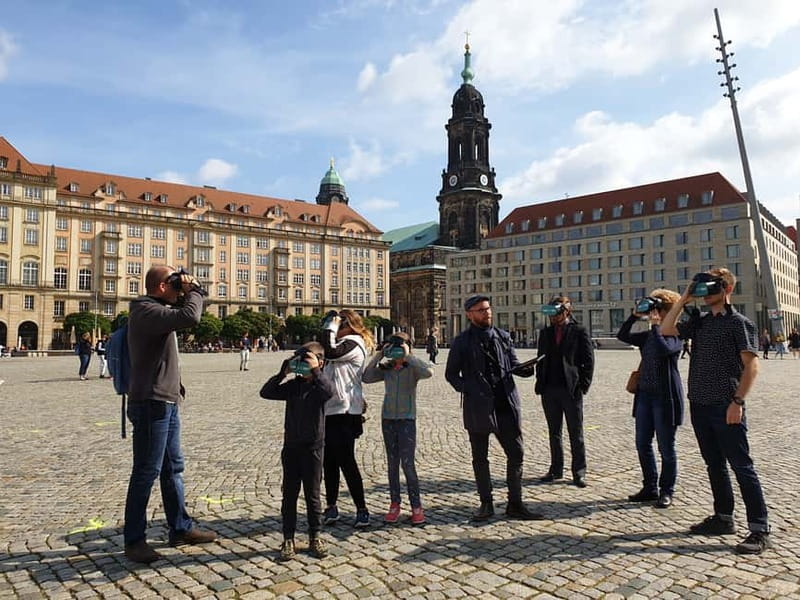
This tour involves walking across Dresden’s center. If the weather turns truly bad, the tour may be canceled. So check conditions the day of, and do not rely on perfect weather forecasts in winter.
As for comfort, you will want comfortable shoes and weather-appropriate clothing. The route uses short walking segments between stops, but you still spend the full 90 minutes moving and stopping.
Age suitability is clearly stated: it is not suitable for children under 6 years. VR headset experiences and tight attention spans do not always mix. If you are traveling with young kids, plan something else for them.
Should you book this Dresden VR walking tour?
Book it if you want a fast way to understand how Dresden changed across 400 years, and you like the idea of learning with your eyes as well as your ears. The strongest reasons to choose it are the combination of a live guide, nine VR moments at specific places, and the way the VR encourages real “then versus now” comparison, including the emotional weight of WWII impressions.
Skip it or treat it as a partial bonus if you are picky about video polish. A few notes suggest the VR films can feel a bit holprig, so you should not expect everything to feel state-of-the-art.
FAQ
How long is the tour?
The tour lasts 90 minutes.
Where do we meet?
Meet at the TIME RIDE GO! flag in front of the TimeRide senseum.
What’s included in the price?
The tour includes a guide and a virtual reality headset.
What language is the guide?
The live tour guide speaks German.
Is this tour suitable for children?
It is not suitable for children under 6 years.
What should I bring, and what happens in bad weather?
Wear comfortable shoes and dress for the weather. The equipment needs careful handling. In really bad weather, the tour may be canceled.
If you want, tell me what month you are going and your German level. I can help you decide whether this fits your day in Dresden.
Newest Dresden reviews on the site
- Historical tour of the old town including a Saxon dinner★ 4.7 · 23 reviews
- Climb the mountains together with goats★ 4.8 · 8 reviews
- Frozen Mysteries: Catch Cobra & Savor Soft Ice in Dresden★ 5.0 · 3 reviews
- From Prague: Day trip to Dresden★ 4.3 · 4 reviews
- From Dresden: Bohemian & Saxon Switzerland Day Trip★ 4.8 · 64 reviews
- Dresden: Express Walk with a Local in 60 minutes★ 4.3 · 3 reviews
- Discover Germany’s most exciting photo illusion world!★ 4.7 · 26 reviews
- Dresden with a touch of Xmas: English small group tour★ 4.7 · 41 reviews
Walking Tours, compared.


Berlin’s Best: 2 Hour Walking Tour Third Reich and the Cold War
Read our review →
Third Reich Berlin: Hitler and WWII Walking Tour
Read our review →Browse the lists this tour appears in