
Reviewed · HISTORICAL TOURS
Charité Hospital Walking Tour: Exploring Berlin’s Medical History
Medicine here had consequences.
This focused Charité Hospital walking tour turns Berlin street corners into medical milestones, from Nobel-prize discoveries to the darker parts of 20th-century care. I like that the route is small-group paced (max 15 people) and guided in English, so you get context for what you are seeing, not just dates and names.
Two things I especially like: the guided storytelling that links each monument to real medical breakthroughs and public health ideas, and the fact that the tour stays short enough to fit a busy Berlin day. One consideration: this is built around exterior sights and memorials, not visits inside the clinical or university working areas, so don’t expect hospital tours.
In This Review
- Key highlights to know before you go
- Why Charité Hospital matters more than just a name
- Price and timing, plus the walkable flow that keeps it painless
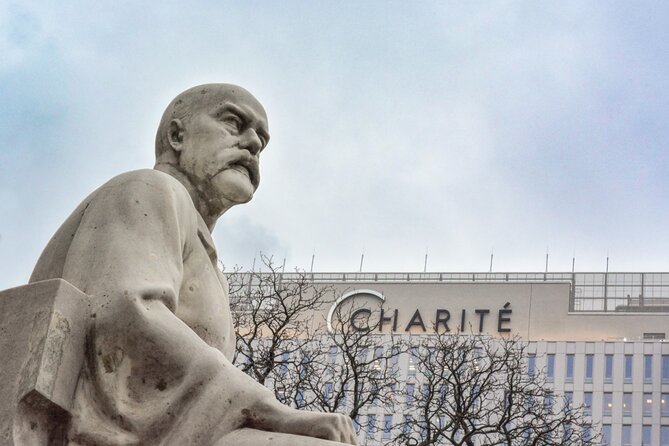
- Stop 1: Robert-Koch Denkmal and Berlin’s medical foundations
- Stop 2: Tieranatomisches Theater and the lessons of pre-science medicine
- Stop 3: Rudolf Virchow and the birth of modern pathology
- Stop 4: Albrecht von Graefe and the rise of eye medicine
- Stop 5: Charité Campus Mitte, red-brick neogothic and a hard moral chapter
- Stop 6: Humboldthafen canal escape stories near Design Offices Berlin
- What I think this tour does especially well
- Who should book this walking tour
- Should you book the Charité Hospital walking tour?
- FAQ
- How long is the Charité Hospital walking tour?
- How much does the tour cost?
- What language is the tour offered in?
- What is the group size limit?
- Where does the tour start and end?
- Is admission required for the stops?
- Does the tour include entering clinical or university buildings?
- Is the ticket mobile or do I need to print it?
- What happens if the weather is poor?
- What is the cancellation policy?
Key highlights to know before you go
- Charité through monuments: You start at Robert Koch’s memorial and work your way toward the Charité Campus Mitte story.
- Science meets ethics: The walk covers both advances and abuses tied to medicine in the Third Reich.
- A small group, 2 hours long: With a max of 15 travelers, it feels more personal than a big group history lecture.
- Free access at each stop: Admission is free at every scheduled monument or site.
- East Berlin escape history nearby: The canal escape attempt near Humboldthafen adds a powerful, human layer.
Why Charité Hospital matters more than just a name
Charité is Berlin’s medical heavyweight, and this tour helps you understand why fast. You are looking at memorials and academic buildings that point back to the 1700s, when the institution’s foundation and reputation started forming.
What I found most useful is the way the tour keeps two threads moving at once. First, it spotlights the big science names connected to infectious disease, pathology, public health, and specialized medicine. Second, it brings in the uncomfortable side, including how medical authority was abused during the Third Reich, and how care changed through wartime and after the Berlin Wall.
That mix is the real value. You end up seeing medicine as a social force, not just a set of lab breakthroughs.
More History Tours in Berlin
- Berlin: Natural History Museum Entrance Ticket
★ 4.6 · 3,382 reviews - Berlin: 3-Hour World Heritage Cruise to Potsdam
★ 4.5 · 1,569 reviews - Berlin: History of the Third Reich Guided Walking Tour
★ 4.7 · 791 reviews
Price and timing, plus the walkable flow that keeps it painless
The price is $30.12 per person for about 2 hours with a guide, and it runs with a maximum of 15 people. It is also booked fairly well ahead, with an average booking window of 19 days, so if you want a specific day, I would not wait until the last minute.
You get a mobile ticket, which is practical in Berlin. The tour is offered in English, and it is designed for most travelers, with service animals allowed. It also runs near public transportation, and the stated walking route begins at Robert-Koch-Platz and ends at Alexanderufer, by the Humboldthafen canal, about a 10-minute walk from Berlin Central Station.
Two practical notes. The tour requires good weather, and it is only about 2 hours, so you’ll want to treat it like a focused morning or afternoon slot, not something to stack with several other timed plans.
Stop 1: Robert-Koch Denkmal and Berlin’s medical foundations
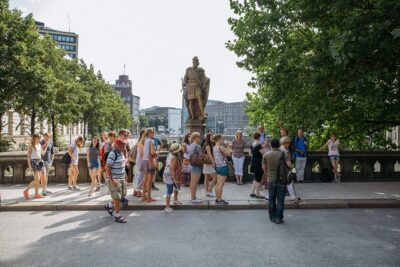
The tour starts at Robert-Koch-Platz, at the Robert-Koch Denkmal, where you learn why Charité traces back to an 18th-century start in Berlin. This is your orientation point, the place where the guide connects the idea of an institution to the people who shaped medicine at the time.
The monument story is doing a lot of work here. Robert Koch is described as the scientist who discovered causes of tuberculosis, anthrax, and cholera. That gives you a clear sense of why his name carries weight in public health.
Then the tour adds a twist that makes it feel real instead of statue tourism. You also hear about Koch’s role in what is described as the first pharmaceutical scandal in medical history. It is a reminder that even breakthroughs can travel with conflicts of interest, bad incentives, or questionable claims.
If you like your medical history with moral questions attached, this opener lands well.
Stop 2: Tieranatomisches Theater and the lessons of pre-science medicine
Next up is the Tieranatomisches Theater, an 18th-century neoclassical academic building that is described as Berlin’s oldest surviving of its kind. This stop matters because it shifts you from famous individual scientists to the environments where knowledge was taught and practiced.
You learn that veterinarians studied animal diseases here. That point is more meaningful than it first sounds. It helps you see how medicine developed through observation and training, not only through dramatic single discoveries.
The guide also shares stories about how diseases were treated before the advent of science. I like that the tour does not pretend early medicine was purely misguided, or purely heroic. Instead, it frames the evolution of treatment methods as a path from limited understanding toward better evidence.
Practical takeaway: this is a good stop if you enjoy the human side of learning, and how institutions shaped what people could even attempt.
More Walking Tours in Berlin
- Discover Berlin Half-Day Walking Tour
★ 5.0 · 9,624 reviews - Berlin: Third Reich and Cold War 2 Hour Walking Tour
★ 4.9 · 6,830 reviews - Berlin: Discover Berlin Walking Tour
★ 4.9 · 5,998 reviews - Berlin’s Best: 2 Hour Walking Tour Third Reich and the Cold War
★ 5.0 · 5,486 reviews
Stop 3: Rudolf Virchow and the birth of modern pathology
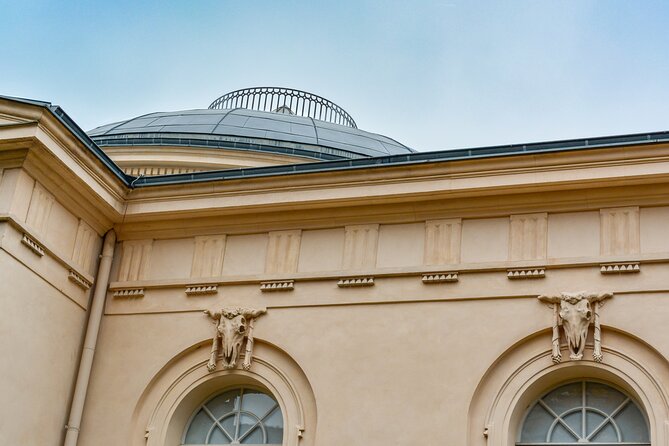
At Denkmal Rudolf Virchow, you get one of the most important leaps in medical thinking on the route. Rudolf Virchow is introduced as the father of modern pathology and the founder of social medicine.
This is where the tour starts to broaden your perspective beyond germs and into how societies respond to illness. Social medicine is a key theme for anyone who cares about why health outcomes differ across neighborhoods, jobs, and social systems.
And because this stop is a monument, it also shows you how ideas become part of public memory. Virchow’s name is not just on academic pages here. You are standing in Berlin with a physical reminder that his approach helped define what pathology and public health could be.
If you are a science-minded traveler, this is one of the stops you will likely remember afterward.
Stop 4: Albrecht von Graefe and the rise of eye medicine
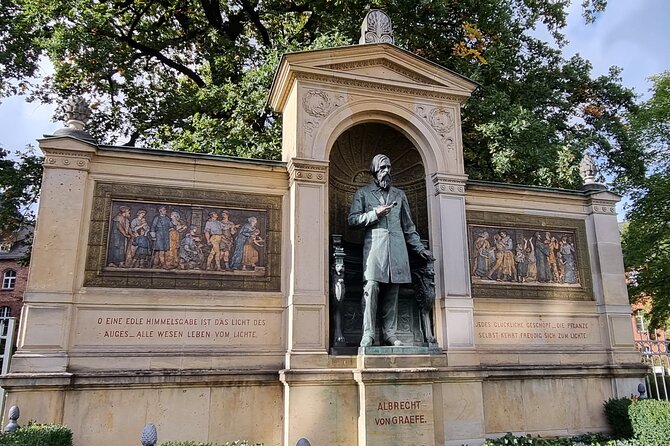
Then you move to Denkmal Albrecht von Graefe, where the focus turns to a specific medical specialty: ophthalmology. You hear the story of Albrecht von Graefe described as a groundbreaking ophthalmologist.
Why this matters on a walking tour like this is simple. A lot of medical history highlights the biggest infectious disease moments, but modern healthcare also depends on progress that is more specialized. Eye medicine is a clear example of how deeper understanding in one area can change daily life for many people.
This stop is shorter on the emotional punches compared with later stops, but it helps balance the overall arc. You get a sense of breadth: not only how epidemics were understood, but also how doctors advanced treatment by narrowing focus and building expertise.
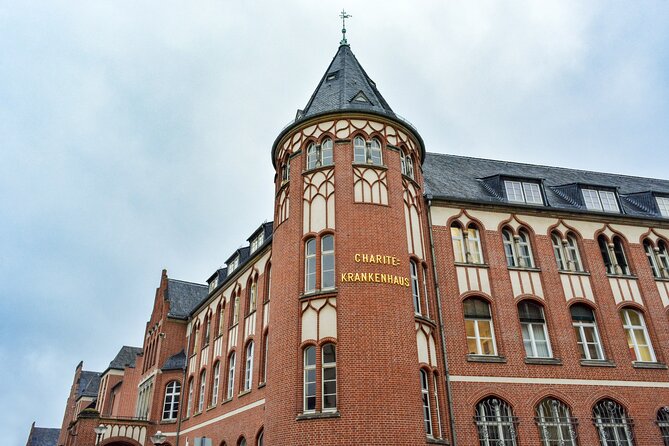
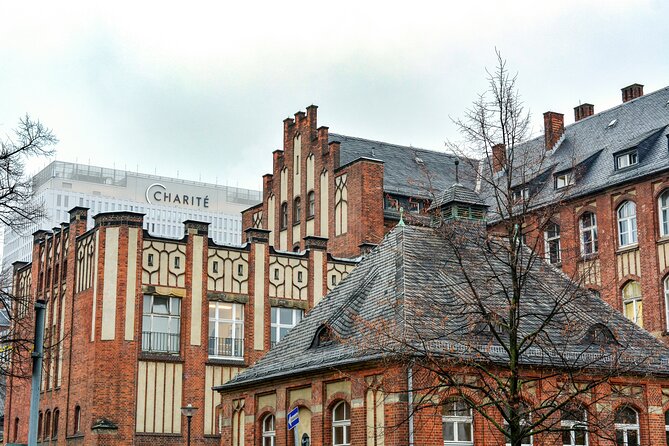
Stop 5: Charité Campus Mitte, red-brick neogothic and a hard moral chapter
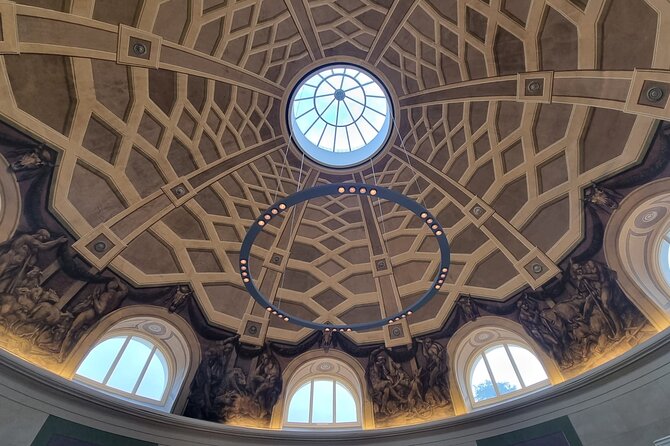
At Charité Campus Mitte, the tour shifts to the beautiful red-brick neogothic campus, and then immediately turns to what happened under the Third Reich.
You learn that some doctors abused medicine during that era, while others helped everyone indiscriminately until the last days of WWII. That contrast is intense, but it is delivered in a way that helps you think about individual responsibility inside medical systems.
This stop is the emotional core for many people. It is also where you start connecting the monuments to your own values. The story is not only about what happened medically, it is about how authority can be used, and how healthcare professionals can resist or comply.
Important expectation check: the tour does not include visiting buildings where clinical or university operations take place. So you are mainly observing the campus context from outside areas, then letting the guide connect the visible spaces to the moral narrative.
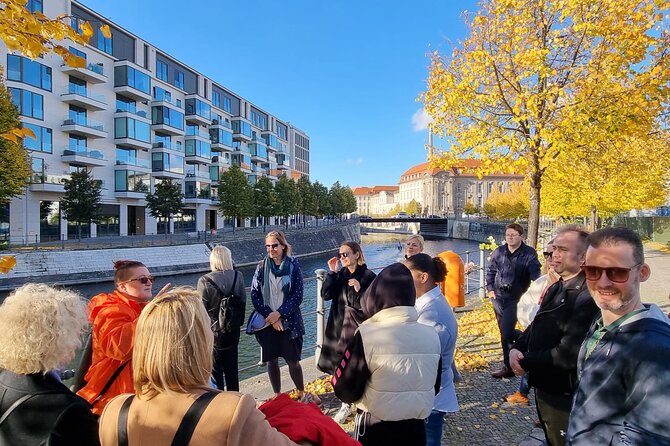
Stop 6: Humboldthafen canal escape stories near Design Offices Berlin
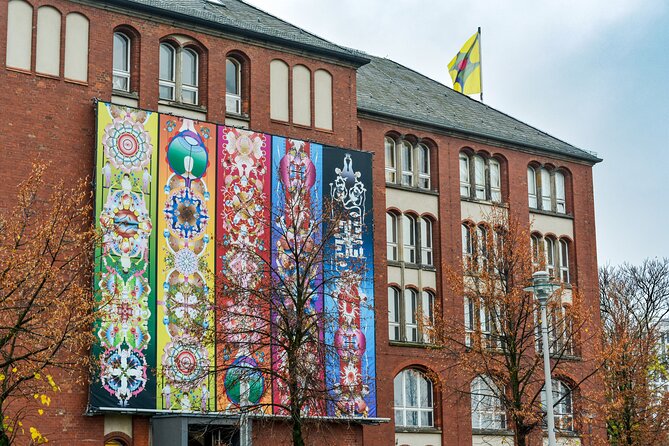
The final stop takes you near Design Offices Berlin Humboldthafen, where the tour describes the place outside the Charité campus linked to escape attempts. Several East Berliners tried to escape to the West by swimming across the city canal.
This is a powerful way to close the loop between medicine and society. Hospitals are often imagined as strictly medical spaces, but here you see how political pressure shaped life around Charité, both during the socialist era and after the fall of the Berlin Wall.
I also like how the canal detail adds something you can picture instantly. Instead of staying abstract, the story anchors in a specific physical feature nearby the campus. It makes the setting feel less like a museum and more like a living city memory.
By the time you finish at Alexanderufer, you have walked from early medical foundations through science milestones, into ethics in the 20th century, and out into human stories tied to Berlin’s political rupture.
What I think this tour does especially well
This is not a long lecture. It is a paced walk built around six stops that each explain why they matter. That format is valuable because it reduces the risk of medical history turning into trivia.
The strongest praised aspect here is the combination of medical history plus current issues, delivered in a way that keeps you listening. You also get the feeling that the guide is a real storyteller, not just someone reading facts off a list. That matters, because the subject moves between science, architecture, and moral decisions, and it needs a steady narrative thread.
One more thing I appreciate: the tour’s structure stays practical. Every stop has free admission, and each segment is about 20 minutes, so the timing feels manageable. For a short trip to Berlin, it is also easier to commit when you know it is only around 2 hours.
Who should book this walking tour
I think this tour fits best if you like any of these:
- Medical history that connects discoveries to real institutions
- Science plus ethics, including the darker chapters
- Architecture-as-context, especially around academic buildings and campus design
- A short, focused Berlin experience with a small group
If you are hoping for inside access to active hospitals or clinical units, adjust your expectations. This tour is explicitly not about entering buildings used for clinical or university operations.
Should you book the Charité Hospital walking tour?
If you want a compact way to understand Berlin through medicine, I’d book this. The price is reasonable for a guided walk, it stays under 2 hours, and the stops are all free to access, so you are not constantly paying entry fees on top.
The biggest reason to choose it is the balance: you get breakthrough names and the evolution of medical thinking, but you also get the ethical and political realities that shaped care in the Third Reich and in divided Berlin. If that mix sounds like your kind of travel, this one is a strong match.
FAQ
How long is the Charité Hospital walking tour?
The tour is about 2 hours (approx.).
How much does the tour cost?
It costs $30.12 per person.
What language is the tour offered in?
The tour is offered in English.
What is the group size limit?
The tour has a maximum of 15 travelers.
Where does the tour start and end?
It starts at Robert-Koch-Platz, 10115 Berlin, Germany, and ends at Alexanderufer, 10117 Berlin, Germany.
Is admission required for the stops?
Admission is free at the scheduled stops, and the tour includes all fees and taxes.
Does the tour include entering clinical or university buildings?
No. Visiting buildings where clinical or university operations take place is not included.
Is the ticket mobile or do I need to print it?
You get a mobile ticket.
What happens if the weather is poor?
The tour requires good weather. If it is canceled due to poor weather, you will be offered a different date or a full refund.
What is the cancellation policy?
Free cancellation is available up to 24 hours in advance of the experience for a full refund. Cancel at least 24 hours before the start time to get your full refund.
More Historical Tours in Berlin
- Berlin Historical Highlights Walking Tour
★ 4.9 · 657 reviews - Berlin: 1h Boutiquestyle-Cruise on the Historic HEMINGWAY
★ 4.6 · 563 reviews - Berlin Private Complete History All Day Walking Tour
★ 5.0 · 474 reviews - Berlin: Cold War Era History Guided Bike Tour
★ 4.8 · 413 reviews
Newest Berlin reviews on the site
- Day trip through multicultural city landscapes & photo highlights★ 5.0 · 5 reviews
- Berlin in one day – day tour with an expert guide★ 5.0 · 14 reviews
- Berlin on Your Own – Deluxe Round Trip from Warnemünde Port★ 4.5 · 5 reviews
- Berlin sightseeing boat tour on the Spree★ 4.0 · 93 reviews
- Berlin by Night Private Tour – All Must-See Sites Magically Lit Up at Night★ 4.0 · 5 reviews
- Berlin & Sachsenhausen Concentration Camp Tour from Warnemünde and Rostock Port★ 4.5 · 60 reviews
- Berlin & The Third Reich Private Guided Tour★ 5.0 · 3 reviews
- Berlin and Car Culture Tour★ 4.5 · 8 reviews
Historical Tours, compared.

City History Canal Sightseeing Tour on a Motorboat
Read our review →



Browse the lists this tour appears in