
Reviewed · CITY TOURS
Day trip through multicultural city landscapes & photo highlights
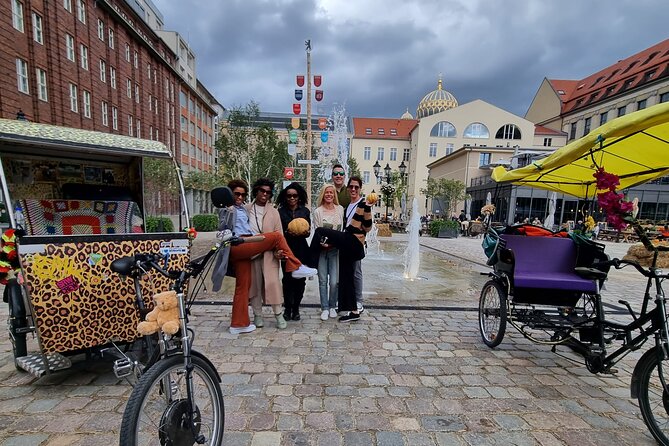
Rickshaws make Berlin stories move faster. This private, photo-focused rickshaw experience led by Leo Rickshaw Tours strings together major landmarks and everyday multicultural corners, all in English and for about 3 to 6 hours. I especially like the quick stop style that keeps you moving between scenes without burning your legs on Berlin pavement.
I also love the way the route mixes the big symbols of German history with calmer green pauses like Tiergarten and Tempelhofer Feld. One consideration: some major sights are mostly exterior or short photo stops, and tickets for certain interiors and exhibitions are not included, so a few add-ons can pop up if you want to go in.
If you like getting your bearings fast, this is built for that. And with a photographer onboard plus music on request, you can focus on enjoying the city, not fussing over logistics.
In This Review
- Key things that make this Berlin rickshaw day feel worth it
- The rickshaw set-up, Leo’s guiding style, and why that matters
- Brandenburg Gate to the Reichstag: classic architecture, modern power, and what to notice
- German Chancellery: modern design that feels almost weightless
- Tiergarten and the Soviet War Memorial: green calm and hard memory side by side
- Potsdamer Platz and Topography of Terror: modern city planning meets the dark record
- Museums and art stops: Gropius Bau as a breather between heavy sites
- The Wall is not a single place: Berlin Wall memorial areas, Checkpoint Charlie, Friedrichstraße, and the East Side Gallery
- Gendarmenmarkt to Konzerthaus: classic squares, liberal democracy, and a book-burning memorial
- Museum Island, the Berliner Dom, Alex, Nikolaiviertel, and Neptunbrunnen: Berlin’s city core in photo-friendly chunks
- Kreuzberg on camera: Bergmannstraße, Landwehr Canal, Admiralbrücke, and Oranienstraße nights
- Görlitzer Park, Tempelhofer Feld, and Park am Gleisdreieck: Berlin’s reclaimed open spaces
- Time, ticket add-ons, and how to match this tour to your travel style
- Should you book this Berlin rickshaw day trip?
- FAQ
- How long is the Berlin rickshaw experience?
- Is pickup available, and where does it happen?
- Is the tour offered in English?
- Are entrance tickets included for the main sights?
- What is included in the price?
- What happens if the weather is bad?
Key things that make this Berlin rickshaw day feel worth it
- A private ride, only your group, with Leo guiding in English
- Photographer included, so you get help turning sights into photos
- Parks and neighborhoods in one loop, including Tiergarten and Kreuzberg streets
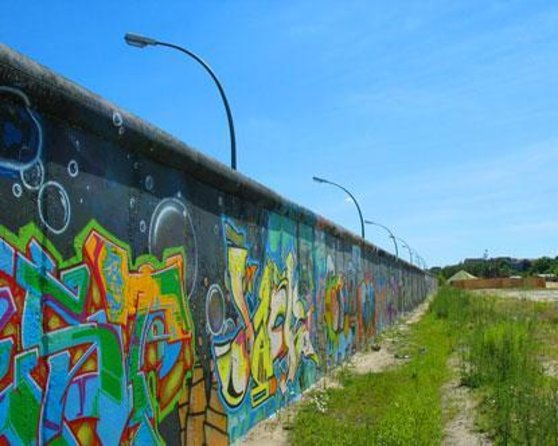
- Wall history on camera-friendly routes, from Checkpoint Charlie to the East Side Gallery
- Included drinks and music, with coffee or tea plus alcoholic beverages
- Many stops have free admission, with some interiors marked as ticketed
The rickshaw set-up, Leo’s guiding style, and why that matters
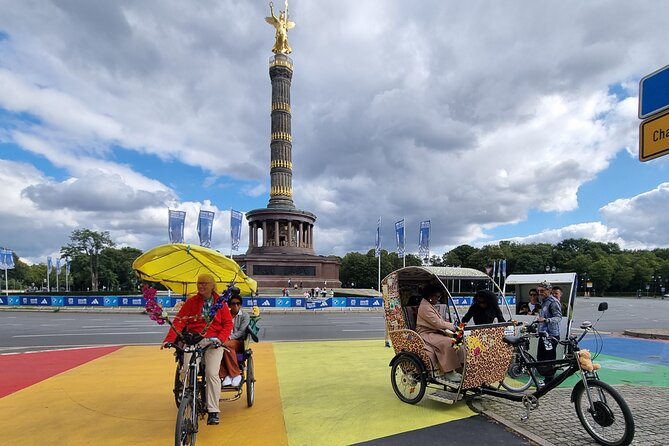
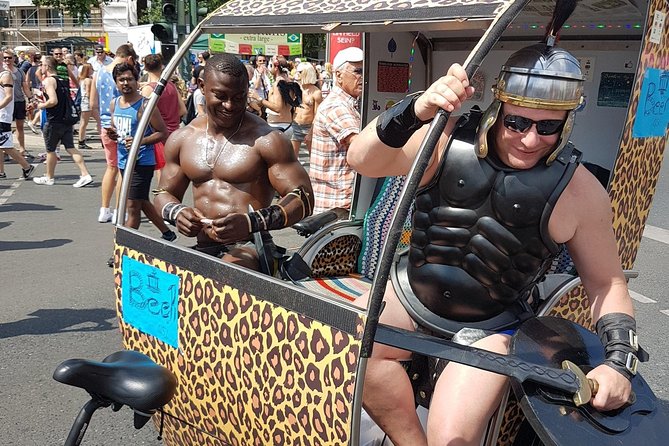
This is not a sit-and-stare bus tour. It’s a private rickshaw-style city ride with a dedicated travel guide, plus a photographer. That combination changes how you experience Berlin, because you can spend more time looking up at buildings and less time hunting for the next stop.
Leo Rickshaw Tours is built around speed and flow, and you can feel that in the way the day is paced: lots of iconic places, but you still get the sense of slipping through small pedestrian areas that cars do not cover easily. One of the standout vibes is how the route mixes famous monuments with more lived-in streets, so your photos end up telling a fuller story than a simple checklist.
You also get music on request and included drinks, coffee or tea and alcoholic beverages. Keep in mind that alcohol is included, not required, and the day includes solemn places like memorials. If you want to feel fully present at those stops, you can treat the drinks as a casual add-on rather than the point of the tour.
A few more Berlin walks and trips to compare
- Berlin: Reichstag, Dome and Government District Guided Tour
★ 4.7 · 18,288 reviews - Berlin: 1-Hour City Tour by Boat with Guaranteed Seating
★ 4.3 · 16,993 reviews - Berlin: TV Tower Standard Entrance Ticket
★ 4.4 · 15,883 reviews
Brandenburg Gate to the Reichstag: classic architecture, modern power, and what to notice
You start with Berlin’s classic face at the Brandenburg Gate, built from sandstone in 1788 to 1791 based on designs by Carl Gotthard Langhans the Elder. The design draws inspiration from the propylaea of the Athens Acropolis, and you see that balance of grandeur and proportion right away when you stop for photos.
What I like most here is the location logic. The Gate was ordered as a grand end point for the boulevard Unter den Linden, so even if you just look around the area, you get a feel for how planned sightlines shape how Berliners and visitors move.
Then you move into political history at the Reichstag/Bundestag. This building is tied to turning points like Philipp Scheidemann calling for the Republic from the west portal on November 9, 1918, and the Reichstag fire on February 27, 1933, when the plenary hall and dome were destroyed. Later, April 30, 1945, when a red flag of the Soviet Union was raised by two Red Army soldiers, adds another layer to what this site symbolizes today.
Practical note: admission for the Reichstag areas is not included. You can still see the building and understand its place in history, but if your priority is going inside or reaching specific viewpoints, budget for ticketed options separately.
German Chancellery: modern design that feels almost weightless
Next comes the German Chancellery, and this is where Berlin shows you its more contemporary side. The central administration building is 36 meters high and rises between and above two five-story administrative wings. The north and south have a large arch cut into the wall, and the east and west incorporate large glass surfaces supported by concrete pillars.
The effect is what you should watch for while you’re stopped. Instead of a heavy, closed government block, the design emphasizes transparency and lightness, with glazed atriums and side wings whose floor plans resemble a comb.
If you’re the type who likes architecture that you can explain in one sentence to a friend, this is an easy one. You’ll know what you saw: light, glass, and a structure meant to feel open even when it houses serious power. Tickets are not included, so this stop is best treated as a visual and photo moment from outside or at areas accessible without paid entry.
Tiergarten and the Soviet War Memorial: green calm and hard memory side by side
Berlin can switch emotional gears fast, and this stretch does it on purpose. You visit the Soviet War Memorial Tiergarten with two T-34 tanks flanking the space and a bronze statue of a Red Army soldier carrying a rifle on his shoulder. Names of fallen Soviet soldiers sit on the pillars behind them, and the memorial area includes graves of around 2500 soldiers in the rear.
This stop is brief, but it hits hard because it’s concrete. There’s no mistaking what it’s for. If you want to take a respectful minute, plan to do exactly that. Don’t rush your photos here.
Then you move into Tiergarten, which is more than a big stretch of trees. Historically, Elector Friedrich III created a pleasure park from the former hunting grounds in the late 17th century. Later, Peter Joseph Lenné transformed the zoo into an English public park between 1833 and 1838, and that influence still shows in the way paths and garden corners feel designed rather than random.
Tiergarten is also packed with sights beyond the greenery, like the Victory Column, monuments and memorials, bridges, the Federal President’s Office, and the House of World Cultures. One of the nicest photo pauses is the English Garden area around a pond, where the park design feels classic and readable.
Good news: admission here is free. You’re not paying to enjoy the big open-air feel, and you get a genuine contrast to the memorial stop.
Same city, a different way to spend the afternoon:
- Berlin: Boat Tour Along the River Spree
★ 4.4 · 11,252 reviews - Discover Berlin Half-Day Walking Tour
★ 5.0 · 9,624 reviews - Berlin: Government District around the Reichstag Guided Tour
★ 4.7 · 8,447 reviews - Berlin: Reichstag, Plenary Chamber, Cupola & Government Tour
★ 4.6 · 8,422 reviews
Potsdamer Platz and Topography of Terror: modern city planning meets the dark record
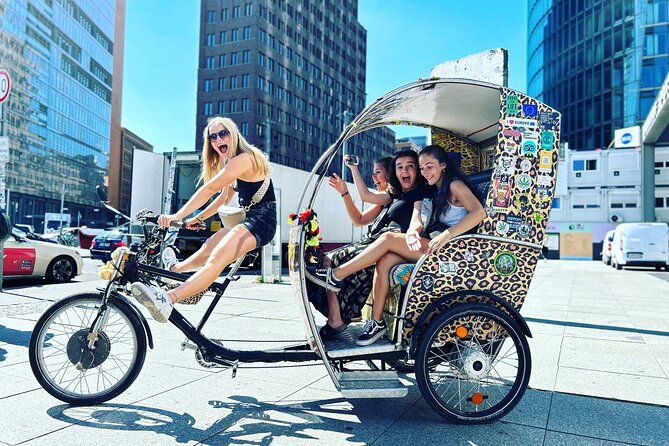
When you reach Potsdamer Platz, the tone turns urban and contemporary. This area was planned as an entire district by architects and it worked in the way it was intended: cafés, cinemas, and shops sit between futuristic high-rise buildings, and Berliners clearly use the space, not just tourists.
For photos, this area rewards you for looking at geometry. High-rises, arcs of streets, and the mix of older and newer city materials create a different Berlin than the formal grand avenues near the Brandenburg Gate.
Then comes Topography of Terror, and the emotional mood shifts again. This site became known by that name in 1987 and served as a central location for planning and control of Nazi crimes. Between 1933 and 1945, key SS and police institutions were housed here, including the Secret State Police Office, the Reichsführung SS, and the Reich Security Main Office.
Admission is free, which matters because it makes the visit easier to fit into your day. If you want to take in the story calmly, a rickshaw tour helps because it gets you there fast. Still, treat the time at each stop like short windows, not deep study sessions.
Museums and art stops: Gropius Bau as a breather between heavy sites
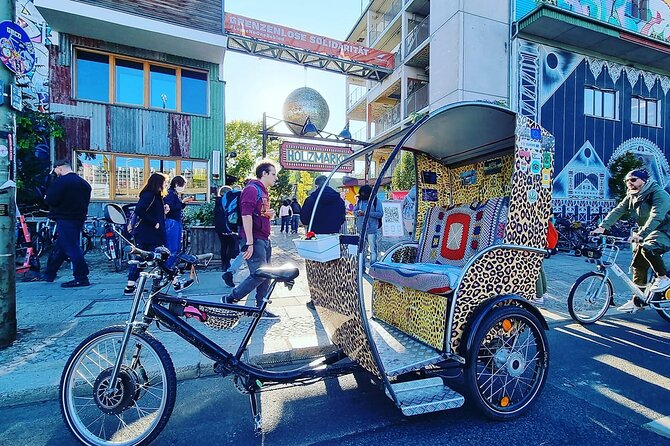
Gropius Bau is a cultural history, contemporary art, and photography stop. This can be a relief after heavy history because art spaces often let you change your mental gear without losing context.
Admission is not included here. So if a specific exhibition is a must for you, plan for extra costs. If not, even a quick look can still help you understand how Berlin balances its memorial sites with creative programming.
The Wall is not a single place: Berlin Wall memorial areas, Checkpoint Charlie, Friedrichstraße, and the East Side Gallery
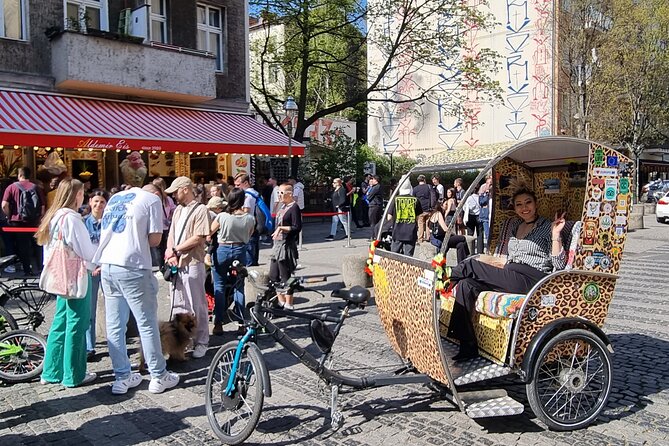
This part of the day does not treat the Berlin Wall as one viewpoint. It treats it as a network of memories spread across the city.
You pass by a Memorial of the Berlin Wall, and then you hit Checkpoint Charlie, the former military checkpoint that became the most famous border crossing when Berlin was divided. It was controlled by Americans next to the Glienicke Bridge. The other controlled checkpoints were Helmstedt-Marienborn (Checkpoint Alpha) and Dreilinden-Drewitz (Checkpoint Bravo). The crossing rules were strict, and the transition could only be used by foreigners and employees of the Permanent Representation of the FRG in the GDR, plus GDR officials.
Checkpoint Charlie is also one of those places where the visual context makes the story feel immediate. You can learn the facts and still feel the tension just by understanding the checkpoint as a real gate.
Next you go along Friedrichstraße, a north-south axis and a shopping mile that developed between Checkpoint Charlie and Friedrichstraße station after the fall of the wall. That is a useful reminder that Berlin’s history does not sit in a museum case. It continues into daily life.
Then you reach the East Side Gallery, a painted 1.3 kilometer section of the former Berlin Wall along the Spree. With over a hundred original wall paintings, it’s described as the longest open-air gallery in the world. For photos, this stop is basically your reward. You go from checkpoints and memorials to color, messages, and creative wall art.
Admission is not a stated cost here, and the gallery is outdoors, so it fits the rickshaw rhythm well.
Gendarmenmarkt to Konzerthaus: classic squares, liberal democracy, and a book-burning memorial
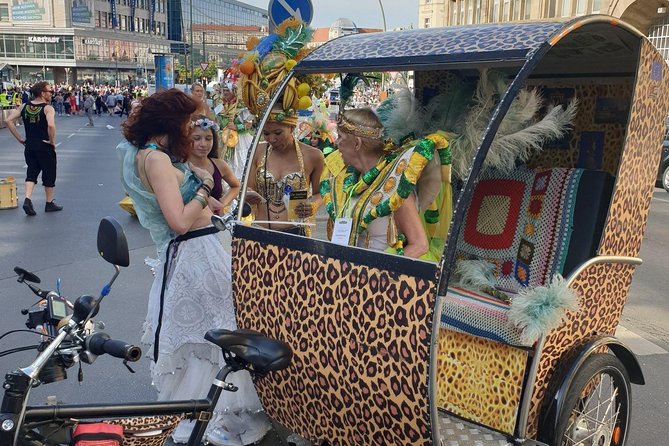
Berlin’s central squares have a way of being both pretty and serious. At Gendarmenmarkt, the square was created at the end of the 17th century based on plans by Johann Arnold Nering. French immigrants, mainly French Protestants or Huguenots, settled in the area, and the square’s earlier names included Esplanade, Lindenmarkt, Friedrichstädtischer Markt, and Neuer Markt.
In 1799, it became Gendarmenmarkt because from 1736 to 1782, guard and stables of the Gens d’armes ward regiment were located there. This is a small example of how Berlin’s identity is layered, not single-note.
Nearby, the Deutscher Dom includes the permanent exhibition Ways – wrong trails – detours, a five-floor look at the historical development of liberal parliamentary democracy in Germany. Admission is not included, so treat this as optional if you mainly want a photo stop from outside.
The Konzerthaus am Gendarmenmarkt is one of Karl Friedrich Schinkel’s major works and a classicist architecture highlight. It connects back to Frederick the Great, because in 1776 a small comedy house opened here based on plans by Johann Bouman the Elder. The theater’s renaming to the Royal National Theater in 1787 signals a rise to leading status.
If you love architecture details, this stop is satisfying because it’s readable. You can look at the building form and understand it as deliberate design, not just pretty stone.
Then you finish this theme stretch at Bebelplatz, where the Nazis burned books on May 10, 1933, including over 20,000 volumes they labeled non-German spirit. The list includes writers like Erich Kästner, members of the Mann family, Magnus Hirschfeld, Lion Feuchtwanger, Karl Marx, Else Lasker-Schüler, and many others. Heinrich Heine’s books were also burned.
Admission is free, and that makes the memorial feel accessible. This is the type of stop where you should slow down, look, and let the meaning land. It’s not there for speed.
Museum Island, the Berliner Dom, Alex, Nikolaiviertel, and Neptunbrunnen: Berlin’s city core in photo-friendly chunks
Next you head to Museum Island, one of Europe’s most outstanding museum complexes. It sits on the north side of the Spreeinsel and was gradually restored since the late 1990s, with a new reception building added. It was also UNESCO listed in 1999, and the ensemble formation involved five architects during a 100-year development story, with a big ensemble moment in 1930.
Admission is free here, which is a nice value angle. You can enjoy the setting and decide on deeper paid entries only if you want them.
From there, it’s hard to miss the Berliner Dom, the Berlin Cathedral with its striking dome. It was rebuilt between 1894 and 1905 under Emperor Wilhelm II. Even if you do not enter, the building’s scale and position make it a solid photo anchor.
You then reach Alexanderplatz, the central square and transportation hub known as Alex. It’s one of Berlin’s most visited places, and that alone tells you what it’s like: a real city junction, not a quiet courtyard.
After that, Nikolaiviertel gives a different texture. It’s described as an open-air museum of old Berlin, created in today’s form for the 750th anniversary in 1987, and it’s another chance to capture architectural vibe without needing a museum ticket.
Finally, you end this core stretch at Neptunbrunnen in front of the Red City Hall. Berliners call it Forckenbecken, tied to the mayor Forckenbeck and also to Neptune in a basin with his trident. Four female figures at his feet symbolize the Elbe, Rhine, Oder, and Vistula.
Admission is not included at some of these specific sights, so keep your expectations on an exterior and atmosphere basis unless you plan to add paid access.
Kreuzberg on camera: Bergmannstraße, Landwehr Canal, Admiralbrücke, and Oranienstraße nights
Berlin becomes more personal when you get into neighborhoods. Bergmannstraße in Kreuzberg is one of those stops. It sits between Gneisenaustrasse, Mehringdamm, Südstern, and Fidicinstrasse, and it’s described as a well-kept old-building area in Kreuzberg SW 61. It’s a good place to see Berlin’s daily variety: more sedate than SO 36, away from the notorious club scene, yet still multicultural and lively.
Then you shift to the watery calm of Landwehrkanal, an important inner-city canal running through Treptow, Kreuzberg, Neukölln, Tiergarten, and Charlottenburg. It’s Berlin’s first artificial waterway and has been part of the cityscape since the 19th century. The canal was designed after industrialization increased the need for transport that road and rail could not handle alone. Construction started in 1845 and finished in 1850 under the commissioning of Peter Joseph Lenné.
From the canal you get a classic photo and hangout spot at Admiralbrücke, a popular summer meeting place with cobblestone streets and old gas lanterns. The mood here is social, and the description includes a lot of evening conversation and music. It’s also practical: after local residents complained about nightly volume, the bridge is cleared peacefully every evening at 10 p.m. with police support.
Then comes Oranienstraße, where gastronomy and scene dominate the streetscape, especially at night. The street has about 100 small shops, bars, and restaurants with international flair, and it’s part of the SO 36 area identity.
Admission is not described as a ticketed cost for these neighborhood stops, so they fit the rickshaw style. You’ll likely get the most value here if you treat photos as a way to collect atmosphere, not only monuments.
Görlitzer Park, Tempelhofer Feld, and Park am Gleisdreieck: Berlin’s reclaimed open spaces
The last stretch feels lighter, more open. Görlitzer Bahnhof connects you to Görlitzer Park, created in the early 1990s on the site of the former Görlitz train station. You get lawns, sports fields, playgrounds, and a children’s farm near Glogauer Straße. There’s also the Spreewaldbad indoor swimming pool on Wiener Straße.
The historic layer is clear in the background: the train station was built in 1865 on 14 hectares of the Köpenicker Feld, rails and buildings were set for transport of people and goods, and it was inaugurated in 1866 by a Prussian king with the first troop transports. That’s a lot of past in a green space, and the contrast can make your photos feel more meaningful.
Next, you reach Tempelhofer Feld, the former Tempelhof Airport. After flight operations ended, the site opened to the public in May 2010, and it covers more than 300 hectares. It’s being redesigned into a park for a variety of uses with citizen participation. After a referendum in May 2014, the Tempelhofer Feld Law came into force in June 2014, including a development and care plan built with participation.
Finally, Park am Gleisdreieck shows Berlin’s grassroots side. The railway area around the Gleisdreieck traffic junction lay fallow after WWII, letting vegetation grow almost unnoticed. Citizens formed a group to green the area permanently, and they were successful. It’s a park with urban flair, and it fits the “Berlin changes shape” theme running across the whole ride.
Admission is free at these stops, and that matters because it keeps the day from turning into a pile of paid entries.
Time, ticket add-ons, and how to match this tour to your travel style
This experience runs about 3 to 6 hours, and the stops are generally short photo windows. That’s not a flaw, but it is a style choice. You’ll see a lot, but you won’t be spending long hours inside every building.
Also, pay attention to ticket notes. Some stops are marked as free, like Brandenburg Gate, Soviet War Memorial Tiergarten, Tiergarten, Potsdamer Platz, Topography of Terror, Checkpoint Charlie, Bebelplatz, Museum Island, and more. Others are explicitly ticketed and not included, like the Reichstag dome area, German Chancellery, Gropius Bau, the Berlin Wall memorial areas, Deutscher Dom, Konzerthaus, Berliner Dom interior access, and several city core sights.
Here’s how I’d plan around that reality:
- If your priority is photos plus big context, this tour fits well because it keeps you moving.
- If your priority is deep indoor time, you may want to treat this as your intro loop, then return later on your own to the places where you want longer stays.
Finally, the tour requires good weather. If weather turns, it may be rescheduled or refunded, and it’s smart to have flexibility in your schedule.
Should you book this Berlin rickshaw day trip?
Yes, if you want a fast, friendly way to cover Berlin’s main storylines without doing a marathon walk. It’s a strong choice for first-time visitors, couples, and anyone who likes history plus neighborhoods, especially because you get both memorial weight and everyday street life in the same day. The included photographer and the fact you can visit places cars do not cover as easily make it feel efficient in a way that still leaves room to look around.
I would skip it, or at least adjust expectations, if you want long museum sessions or if you only care about a few ticket-heavy interiors. This ride is designed for motion, photos, and getting the big picture across many stops.
FAQ
How long is the Berlin rickshaw experience?
It lasts about 3 to 6 hours.
Is pickup available, and where does it happen?
Pickup is offered from hotels, central station, and cafes. The activity ends back at the meeting point.
Is the tour offered in English?
Yes, it is offered in English.
Are entrance tickets included for the main sights?
Some places are listed as free, but several sights note that admission tickets are not included. If you want specific interior entries or exhibitions, you may need extra tickets.
What is included in the price?
The experience includes private transportation, a photographer, a travel guide, music on request, alcoholic beverages, and coffee or tea.
What happens if the weather is bad?
The experience requires good weather. If it is canceled due to poor weather, you will be offered a different date or a full refund.
Newest Berlin reviews on the site
- Berlin in one day – day tour with an expert guide★ 5.0 · 14 reviews
- Berlin on Your Own – Deluxe Round Trip from Warnemünde Port★ 4.5 · 5 reviews
- Berlin by Night Private Tour – All Must-See Sites Magically Lit Up at Night★ 4.0 · 5 reviews
- Berlin & Sachsenhausen Concentration Camp Tour from Warnemünde and Rostock Port★ 4.5 · 60 reviews
- Berlin sightseeing boat tour on the Spree★ 4.0 · 93 reviews
- Berlin & The Third Reich Private Guided Tour★ 5.0 · 3 reviews
- Berlin and Car Culture Tour★ 4.5 · 8 reviews
- The Beauty of Berlin by Bike: Private Tour★ 5.0 · 59 reviews
City Tours, compared.
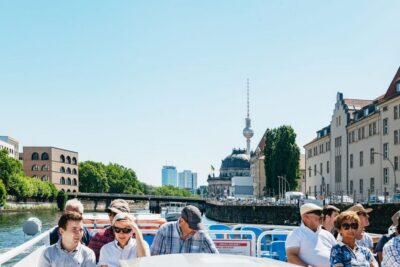
1-Hour City Tour by Boat with Guaranteed Seating
Read our review →
City History Canal Sightseeing Tour on a Motorboat
Read our review →
Browse the lists this tour appears in