
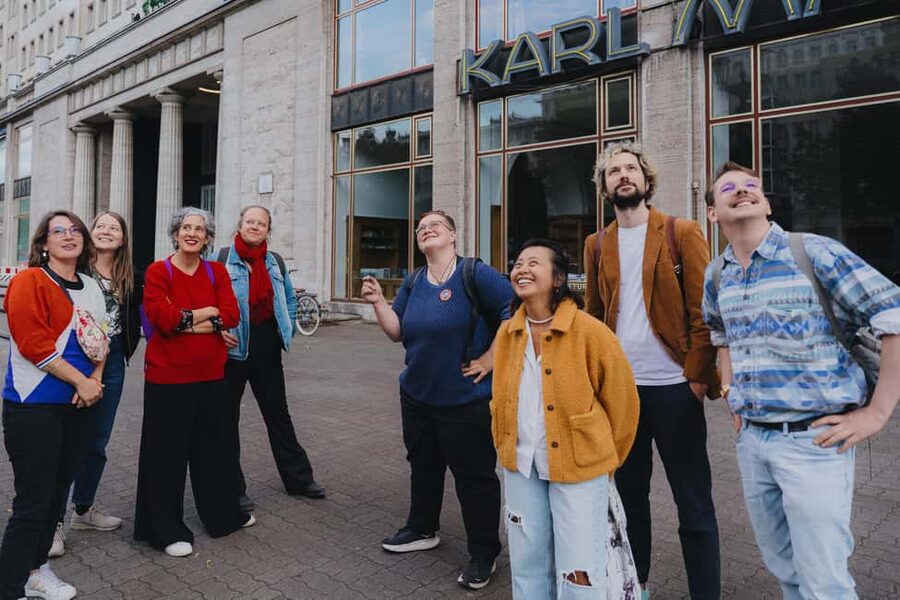
Reviewed · HISTORICAL TOURS
Karl-Marx-Allee Walking Tour: Berlin’s Socialist History
Berlin’s socialist street feels unreal at first. This guided walk through Karl-Marx-Allee turns big architectural statements into real human stories, from post-WWII ambition to Cold War control. You get to read East Berlin in layers, and you’ll keep noticing how ideology shows up in brickwork, street design, and daily life.
I particularly love the way the tour connects Cold War politics to what you can actually see on the ground. Second, I like the grounded, unsentimental focus on ordinary people, including what changed for East Berliners after the uprising of 1953.
One thing to plan for: parts of the story can feel heavy, since surveillance and suppression by the Stasi are central to what you’ll learn. If you want only light sightseeing, this may be more intense than you expect.
In This Review
- Key reasons this Karl-Marx-Allee walk works
- Turning Karl-Marx-Allee into a readable story
- Starting at Frankfurter Tor: a dramatic entry point
- Karl-Marx-Allee’s scale and Socialist classicism
- The ambitious project that nearly toppled the regime
- Stasi surveillance: control hidden behind everyday life
- Hidden layers: poplars, modernism, and changing meanings
- East Berlin beyond film facts: where stories connect
- The walk’s pace, timing, and what you’ll do in two hours
- Price and value: is $23 worth it?
- Who should book this socialist history walk
- Should you book the Karl-Marx-Allee Walking Tour?
Key reasons this Karl-Marx-Allee walk works

- You see ideology in architecture, not just in textbooks
- The 1953 uprising link explains why this street was never “just buildings”
- Stasi listening and wiretapping details show how control hid in plain sight
- Film location context helps The Lives of Others click into place
- The story connects past to now, including protests about gentrification
Turning Karl-Marx-Allee into a readable story
Karl-Marx-Allee can look like a single, grand set piece. But the best part of walking it is how it stops being scenery and becomes a timeline you can feel. One moment you’re staring at imposing facades; the next, you’re thinking about volunteers hauling their bodies toward a national reconstruction dream, and about what that dream cost.
What you’ll like most is that the tour does not treat the Socialist era like a museum exhibit behind glass. It talks about the Cold War idea that shaping cities could shape citizens. And it points out how the street’s “ideal life” messaging, cafes, restaurants, and well-stocked shops, helped hide the surveillance state that was doing the real work.
I also appreciate that it doesn’t end with the Wall. Berlin changes the meaning of places fast, and you’ll see how this avenue has become a stage for protests against gentrification and rising living costs.
More History Tours in Berlin
- Berlin: Natural History Museum Entrance Ticket
★ 4.6 · 3,382 reviews - Berlin: 3-Hour World Heritage Cruise to Potsdam
★ 4.5 · 1,569 reviews - Berlin: History of the Third Reich Guided Walking Tour
★ 4.7 · 791 reviews
Starting at Frankfurter Tor: a dramatic entry point
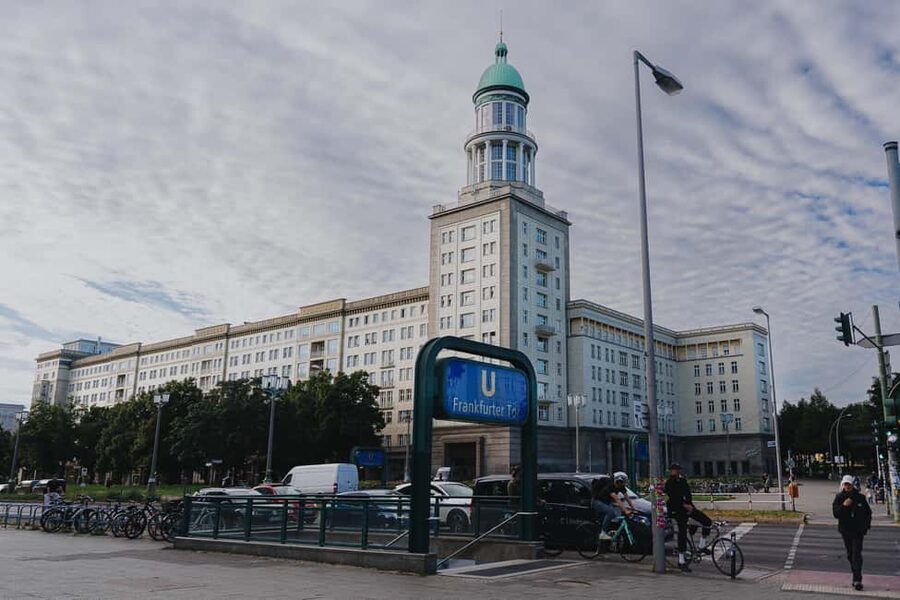
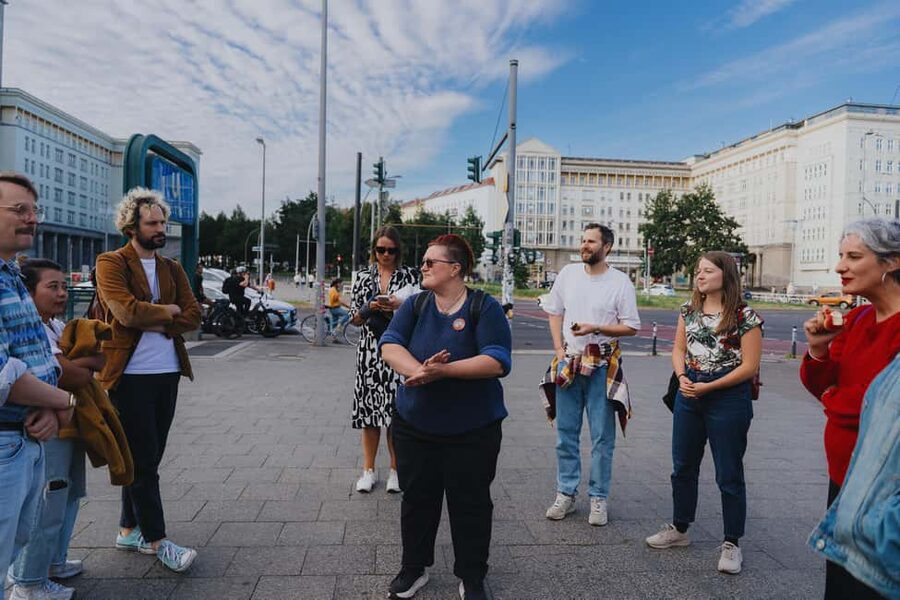
You begin at U Frankfurter Tor, meeting outside the station at the corner of Warschauer Straße and Karl-Marx-Allee. Your guide is easy to spot, holding an orange umbrella, and that small detail helps you get your bearings fast when you’re arriving with other trains and crowds.
Frankfurter Tor is a fitting starting point because it sets the tone: you’re entering an area where East and West Berlin history is impossible to separate. From here, the walk quickly builds momentum, and the architecture starts to feel less like “nice buildings” and more like a deliberate urban message.
If you’re the type who likes to orient quickly, this start helps. You get the street’s big scale early, so you’re not still trying to find your camera angle when the tour begins discussing what made this project so ambitious.
Karl-Marx-Allee’s scale and Socialist classicism
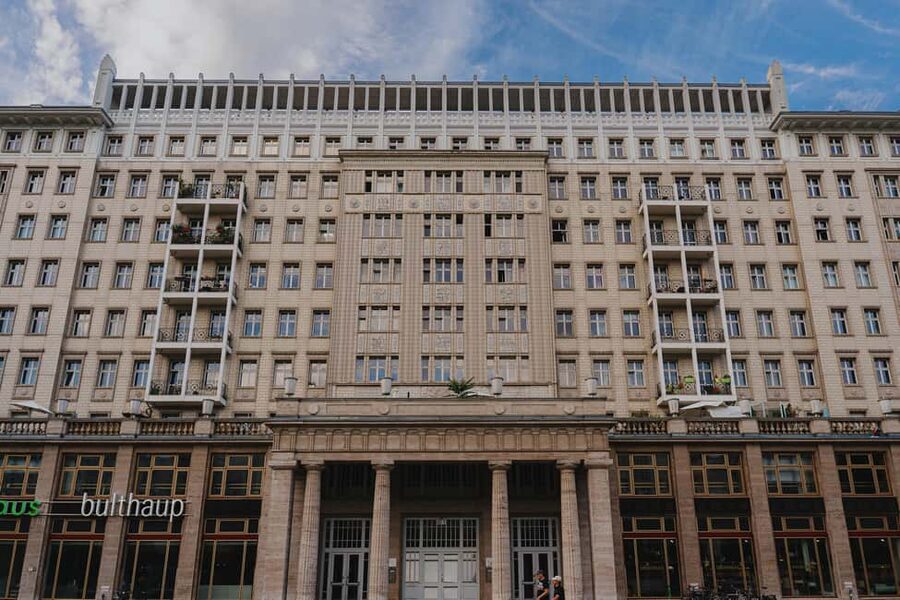
As you move along Karl-Marx-Allee, you’ll notice how the street feels designed to impress. The architecture leans into socialist classicism, a style meant to look monumental and solid, the kind of design meant to project confidence.
This was meant to be East Germany’s main reconstruction programme after WWII, built from ruins with the help of thousands of volunteers working day and night. The tour makes that effort more than a line of facts, because you’re walking beside the result, still visible decades later.
Here’s the practical takeaway: walking this avenue teaches you how political identity can be engineered into public space. The buildings weren’t just housing. They were part of a system trying to manufacture belief, and that’s why this street feels both grand and slightly chilling once you know the story behind it.
The ambitious project that nearly toppled the regime

One of the most important points you’ll carry with you is that building the street almost cost East Germany its existence. In June 1953, disgruntled workers launched a mass uprising that threatened the socialist government.
The tour uses this moment to sharpen your understanding of why architecture and control are linked here. If you think of these grand avenues as triumphant, the 1953 uprising adds the missing context: the state was building outward while facing pressure inward.
You don’t need to be a Cold War expert to get it. You just need to pay attention to how the tour ties human anger and political instability to the era’s public image. That contrast is the whole point of the walk.
More Walking Tours in Berlin
- Discover Berlin Half-Day Walking Tour
★ 5.0 · 9,624 reviews - Berlin: Third Reich and Cold War 2 Hour Walking Tour
★ 4.9 · 6,830 reviews - Berlin: Discover Berlin Walking Tour
★ 4.9 · 5,998 reviews - Berlin’s Best: 2 Hour Walking Tour Third Reich and the Cold War
★ 5.0 · 5,486 reviews
Stasi surveillance: control hidden behind everyday life

This is the part that makes Karl-Marx-Allee stop feeling abstract. The street’s “idyllic” picture included cafes, restaurants, and shops designed to suggest affluence. But the tour brings in the reality behind the facade: the surveillance state, run by the Stasi.
You’ll learn about wiretaps in flats and listening stations set up in attics. Hearing it explained while you’re standing in the real urban context makes it hit harder, because you start imagining what people could hear, what people could never say out loud, and how private life could be turned into public risk.
To keep it fair and balanced, the story is not presented as a Hollywood version of tyranny. It’s described as a system of suppression and monitoring that relied on secrecy and control, so you understand how it worked day to day, not only in dramatic moments.
Hidden layers: poplars, modernism, and changing meanings

Berlin loves a twist, and this avenue has one. The tour explains that earlier, more modernist post-WWII architecture and utopian urbanist ideas were part of what survived the rubble period. Later, the East German regime rejected the style and pushed a radically different vision of socialist living.
Even the landscaping becomes part of that story. Fast-growing poplar trees were used to hide the architecture from passersby. That detail is strangely vivid once you know what it was meant to accomplish.
Then time does what it does. After the fall of the Wall, this boulevard did not vanish completely, but it did lose its central role. It can feel like a leftover artifact until you notice people treating it as a living neighborhood again, including protests tied to gentrification and housing costs.
East Berlin beyond film facts: where stories connect

You’ll also get to connect the street with popular screens. The tour includes filming locations connected to The Lives of Others and The Queen’s Gambit, so you can see where cinematic scenes draw from real space.
For me, the value of this is not trivia. It’s pattern recognition. Once the guide explains what the camera and script choose to highlight, you’ll start noticing similar design choices and sightlines in the street itself.
If you’ve seen those works, this makes the city feel more coherent. If you have not, you still benefit, because the film context gives you an extra lens for understanding how secrecy and power look in public.
The walk’s pace, timing, and what you’ll do in two hours
The tour runs about 2 hours total, with guided time focused on the main stretch of Karl-Marx-Allee. That’s a good length for this topic. Long enough to build context and walk through the key visual points, short enough that you’re not stuck doing a lecture at walking speed for half a day.
A practical tip: bring comfortable shoes. Karl-Marx-Allee is wide and impressive, but you still cover real ground and you’ll want to stay nimble while your guide points out details.
As for group feel, this is a live guided walk run by Beyond and Beneath Tours, with English and German options. The best sign is that the guide interaction seems to matter, and one highlight in the experience is Martina, who is described as attentive and responsive, not just pushing through a fixed script.
Price and value: is $23 worth it?

At $23 per person for a guided, live walking tour, you’re paying for more than time on the sidewalk. You’re paying for interpretation, and interpretation is what makes architecture and Cold War sites meaningful.
If you self-guided Karl-Marx-Allee, you could admire the facades and take photos. You might even find basic background online. But you’d miss the thread that connects the street to the 1953 uprising, to the Stasi’s methods like listening stations in attics, and to the way the street’s “ideal life” presentation helped hide the darker reality.
This is also the kind of price that works even if you’re already spending on a Berlin itinerary. Two hours is manageable, and the guide adds value quickly, especially if you like understanding what you’re seeing instead of just seeing it.
Who should book this socialist history walk
This tour fits best if you like architecture, urban design, or history that explains how power works in everyday life. It’s also a great match if you enjoy Berlin’s “read the past, then look at the present” style of travel.
It is not suitable for children under 10, so plan accordingly if you’re traveling with younger kids. And since the topic includes surveillance and suppression, it’s smart to decide ahead of time how much intensity you want from a sightseeing day.
If you’re a movie fan, the film location ties add an extra layer, especially with The Lives of Others. If you’re not, you’ll still get the core value, which is turning a striking East Berlin avenue into a clear story of ambition, control, resistance, and change.
Should you book the Karl-Marx-Allee Walking Tour?
Book it if you want a guided walk that turns Karl-Marx-Allee into a meaningful timeline, with specific details about the 1953 uprising and the Stasi’s surveillance tools. The two-hour format is solid, the guide-led experience adds real value, and starting at Frankfurter Tor makes for an easy entry.
Skip it if you prefer history kept light and upbeat, or if you only want short, casual photo stops. This tour aims to make you think, not just look.
If you’re heading to Berlin and you want one experience that connects grand architecture to the people living under the system, this is a strong choice.
More Historical Tours in Berlin
- Berlin Historical Highlights Walking Tour
★ 4.9 · 657 reviews - Berlin: 1h Boutiquestyle-Cruise on the Historic HEMINGWAY
★ 4.6 · 563 reviews - Berlin Private Complete History All Day Walking Tour
★ 5.0 · 474 reviews - Berlin: Cold War Era History Guided Bike Tour
★ 4.8 · 413 reviews
Newest Berlin reviews on the site
- Jetbike Berlin fun bike beer bike★ 5.0 · 3 reviews
- Homeless on chic streets: city tour in Berlin from personal experience★ 4.6 · 3 reviews
- Berlin: Sachsenhausen Concentration Camp Guided Tour★ 4.9 · 42 reviews
- Historyof the Trans, Queer & Gay communities of Berlin tour★ 4.8 · 17 reviews
- Historic Berlin Pubs & History Tour★ 4.9 · 73 reviews
- Berlin: City Center Walking Tour★ 4.7 · 45 reviews
- Half-Day Berlin Highlights Segway Expedition★ 4.5 · 61 reviews
- Berlin: Cold War History and Berlin Wall Guided Walking Tour★ 5.0 · 33 reviews
Historical Tours, compared.
City History Canal Sightseeing Tour on a Motorboat
Read our review →

Browse the lists this tour appears in