
Reviewed · HISTORICAL TOURS
Berlin: Historic Jewish walking tour through the city center
Berlin changes when you follow its tailored threads. This one-hour walk through the city center connects Berlin’s former Jewish economic district to major shifts in politics, fashion, and daily life, from the Prussian Empire and the Roaring Twenties up to post-wall Berlin. I liked how the guide makes the Konfektion tailoring industry feel concrete, not abstract, and I also liked the way you see real streets and squares while learning. One thing to consider, though, is that the story includes serious topics and the walk is focused, so it is not a long, leisurely sightseeing day.
You meet at Hausvogteiplatz near the water fountain by the U2, and your guide carries a white side bag, so it is easy to spot them. I also appreciated the practical structure: a 30-minute guided segment, then short stops at Werderscher Markt and Jägerstraße, before returning to the start. If you prefer a very deep, museum-style experience, this may feel brief, but if you want a sharp city-center orientation with meaningful context, you will get your money’s worth.
In This Review
- Key things I’d plan around
- Where the tour starts at Hausvogteiplatz, near U2
- The first 30 minutes: Hausvogteiplatz and the Konfektion story
- Werderscher Markt: a short stop that adds context
- Jägerstraße: fashion, identity, and the post-wall shift
- Why the politics and the industry story belong together
- Price and value: $1.70 for a focused, guided hour
- Who this tour is best for
- Practical tips so the hour actually clicks
- Should you book this Berlin historic Jewish walking tour?
- FAQ
- Where do I meet the guide?
- How long is the tour?
- What is the tour route and which stops are included?
- What languages are available?
- Is the tour wheelchair accessible?
- Is it suitable for children?
- What do I get as part of the experience?
- How much does it cost?
- Can I get a refund if I cancel?
- Is there a pay later option?
Key things I’d plan around
- Konfektion tailoring as a focal point: you learn how a major Jewish-run industry powered the city before WWII.
- Prussian era to post-wall changes: the guide threads time periods through places you can actually walk past.
- Short, clear stops: 30 minutes of guided talk, then 15-minute visits at two key areas.
- Easy meeting point: Hausvogteiplatz near the U2, by the water fountain, with a guide carrying a white side bag.
- One-hour pace: great when you want history without giving up your whole day.
Where the tour starts at Hausvogteiplatz, near U2
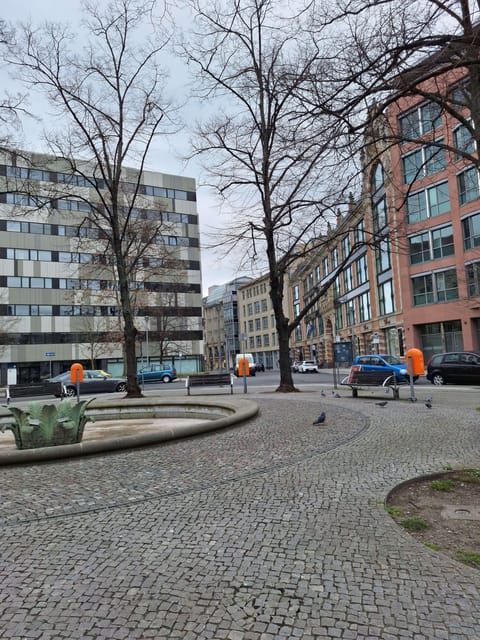
I like tours that help you get your bearings fast, and this one does. You meet in Hausvogteiplatz square near the water fountain, close to the U2 train station. Your guide will have a white side bag, which is a small detail but a big help when you are juggling trains, directions, and your morning coffee.
The whole experience runs for about an hour, and the schedule is simple. You start at Hausvogteiplatz, get guided during the first half, then you walk to two named stops for shorter visits, and you finish back at Hausvogteiplatz. That timing matters because Berlin can be big. A compact, central route makes it easier to fit into a busy itinerary, especially if you also want to explore neighborhoods on your own afterward.
The tour is in English, and it is wheelchair accessible. If you are traveling with someone who uses a wheelchair, that is a real plus in Berlin, where cobblestones and uneven sidewalks can otherwise be a headache. The tour is not suitable for children under 6, so plan accordingly if you are traveling as a family.
More History Tours in Berlin
- Berlin: Natural History Museum Entrance Ticket
★ 4.6 · 3,382 reviews - Berlin: 3-Hour World Heritage Cruise to Potsdam
★ 4.5 · 1,569 reviews - Berlin: History of the Third Reich Guided Walking Tour
★ 4.7 · 791 reviews
The first 30 minutes: Hausvogteiplatz and the Konfektion story
The heart of the tour begins with a 30-minute guided segment at Hausvogteiplatz. This is where the guide sets the frame: Berlin as an economic center, and how Jewish communities were part of that engine. The spotlight is on the Konfektion industry, often associated with tailoring and made-to-order fashion production.
I like the way this kind of tour works. Instead of listing dates only, it connects economic life to geography. You are not just hearing that something important happened in Berlin. You are learning that a specific industry shaped work, clothing, status, and business in the city center, including the places you can see today.
You also get a lesson in how political extremism can rewrite an entire industry. The tour is designed around a clear arc: Berlin’s earlier periods, the glamour and fashion side of urban life, then the brutal impact of regimes on economic life and on Jewish residents. The goal is not just tragedy. The guide also talks about how Jewish people developed and often thrived, and in some lucky cases even survived. That balance helps the story land with more humanity, not just shock.
In practical terms, this first segment is where you should pay close attention. If you treat the start as your “map of meanings,” the later stops feel less like sightseeing checkmarks and more like the continuation of one story across a few blocks.
Werderscher Markt: a short stop that adds context
After Hausvogteiplatz, you head to Werderscher Markt for a 15-minute visit. It is a shorter stop, so you will not get long, slow strolling. Instead, the guide uses the location to keep the timeline moving, linking back to Berlin’s earlier periods like the Prussian Empire and the Roaring Twenties.
What makes a stop like this valuable is the focus. In Berlin, it is easy to get lost in big landmarks and forget that everyday commerce and fashion culture happened in very specific city-center corners. Werderscher Markt is one of those points where the guide can connect “who lived here and how they worked” to the physical space.
If you are the type of person who likes to understand how a city functions, you will probably enjoy this. Think of it as filling in the background between the major “headline” sites. Even if you do not consider yourself a history nerd, the guide’s explanations can help you notice details you might otherwise walk right past.
The drawback is that the stop is brief. If you expected a long “square walk” with lots of free time for photos, you might feel a little rushed. But if you keep the tour’s one-hour structure in mind, Werderscher Markt works well as a quick context-builder.
Jägerstraße: fashion, identity, and the post-wall shift
Next comes Jägerstraße, another 15-minute visit. This is where the tour’s theme of change becomes very visible, at least in how the guide frames the street within Berlin’s story.
The tour connects early 20th-century fashion culture to the later rupture created by the wall-fall era and beyond. The guide does not just say Berlin changed. You hear how Berlin changed in the area’s development, and how people experienced those changes over time. That matters because it reminds you that history is not only about what happened in the past. It is also about what still shows up in how streets are used, how neighborhoods evolve, and what kinds of industries replace others.
I also like that this stop helps turn the tailoring story into something you can picture. Even if you never see a building that is labeled for tailoring, the guide helps you understand why fashion and work were so tied to place. You start to see the city center as a network, not a collection of isolated sights.
If you want to get extra value from this stop, ask yourself a simple question while you listen: what does it mean to keep a city running through economic life, and what happens when regimes attack that life? The guide’s emphasis on the brutal impact on Berlin’s economic history makes Jägerstraße more than a pretty street to photograph. It becomes a place where you can sense the stakes of the story.
More Walking Tours in Berlin
- Discover Berlin Half-Day Walking Tour
★ 5.0 · 9,624 reviews - Berlin: Third Reich and Cold War 2 Hour Walking Tour
★ 4.9 · 6,830 reviews - Berlin: Discover Berlin Walking Tour
★ 4.9 · 5,998 reviews - Berlin’s Best: 2 Hour Walking Tour Third Reich and the Cold War
★ 5.0 · 5,486 reviews
Why the politics and the industry story belong together
One of the most compelling parts of this tour is the way it ties industry to politics. The basic idea is straightforward: political extremism can restructure what a city does for a living, and who gets to participate in that life.
I appreciate that the guide frames this as an often overlooked story. You might have heard parts of Berlin’s Jewish history before, but this tour aims at the economic side, especially the tailoring and Konfektion world. That approach gives you a different lens. It is not only about persecution as a concept. It is about how an industry was built, what it meant for people’s daily work, and what happens when violence and repression disrupt a whole system.
The tour also covers the arc of Jewish life more fully than a simple tragedy narrative. You hear about development and thriving in earlier periods, and about survival in some cases. Then the guide brings in the brutal impact of regimes. For me, that combination matters because it avoids reducing people to a single page of history. It restores agency where it belongs, and it shows the scale of what was taken away when power turned deadly.
This is also why the walk through the center is a smart format. You get to connect ideas to space. When a guide points out historic buildings or historic areas, you are not just collecting trivia. You are building a mental map for how Berlin worked, and how that “work map” broke and later changed again after the wall fell.
Price and value: $1.70 for a focused, guided hour
The listed price is $1.70 per person, and that is hard to ignore. Even if you treat it as a budget-friendly way to learn from a live guide, the value comes from the structure. You get an English-speaking guide for about an hour, a walk through the city center, and a storyline anchored to a specific economic history.
Also, the experience includes practical extras. You receive a map and a list of activities in order, so you know where you are and what you are doing. The tour also explicitly includes mentions of historic buildings and areas, not just narration. That combination is what you want for city-center learning: guidance plus context plus a route.
One more note: the provider mentions booking tours on a donation-basis if you reach out. So depending on how you book, you may see different ways to support the work. Either way, the core value is the same: you are buying time with a guide who connects Berlin’s streets to the Jewish tailoring industry and to the bigger political shifts that reshaped the city.
Who this tour is best for
This walk is best for you if you want:
- A compact history tour that fits into a busy day
- A guide-led route focused on the city center, not a far-flung neighborhood marathon
- An angle on Berlin that centers the Jewish community’s economic and cultural role, especially tailoring
It is also a good choice if you like learning through walking. The stops are short and named, which makes it easier to remember what you saw later when you are planning your next day.
On the other hand, it may not suit you if you want a long, slow pace, or if you need a very family-friendly format for younger kids. The tour is also not suitable for children under 6, so plan around that.
Practical tips so the hour actually clicks
A one-hour tour is all about focus. Here are the things I would do to get the most from it:
- Wear comfortable shoes. You will be on your feet for the full hour, mostly outdoors.
- Arrive a bit early at Hausvogteiplatz near the U2 station, by the water fountain. That meeting-point clarity helps, but you still want time to settle in.
- Keep your questions ready, especially about how the Konfektion industry connects to Berlin’s political changes. This tour’s theme rewards curiosity.
- Use the map and the list of activities in order. Even a simple checklist can help you stay oriented.
- Expect a serious subject. The guide’s theme includes political extremism and the brutal impact of regimes, so mentally prepare for a heavier tone.
One more practical reminder: the provider notes verification of arrival by email or phone, including calls, messages, or WhatsApp. If you are the type who hates last-minute uncertainty, confirm your arrival ahead of time so you do not stress during your day.
Should you book this Berlin historic Jewish walking tour?
I think you should book this tour if you want a quick, meaningful, city-center experience. It is short enough to fit into almost any itinerary, and it focuses on a specific story, Jewish tailoring and the broader Konfektion industry, that you may not get from classic Berlin sightseeing routes. The combination of real streets, historic areas, and time periods from the Prussian Empire and Roaring Twenties through post-wall change gives you a clearer sense of how Berlin evolved.
Skip it if you already know every detail about Berlin’s Jewish history and you are hunting for a longer, museum-heavy deep study. Also skip if you are traveling with kids under 6, since the tour is not suitable.
If you are aiming for a guide-led walk where you learn something concrete while still seeing the city, this one is a strong pick.
FAQ
Where do I meet the guide?
Meet at Hausvogteiplatz square near the water fountain in the proximity of the U2 train station. The guide will have a white side bag.
How long is the tour?
The tour lasts about 1 hour.
What is the tour route and which stops are included?
You start and end at Hausvogteiplatz, with visits to Werderscher Markt and Jägerstraße along the way.
What languages are available?
The live tour guide speaks English.
Is the tour wheelchair accessible?
Yes, the activity is wheelchair accessible.
Is it suitable for children?
It is not suitable for children under 6 years.
What do I get as part of the experience?
You get a walking tour with mentions of historic buildings and areas, a look at the Konfektion industry, and you receive a map plus a list of activities in order.
How much does it cost?
The price is listed as $1.70 per person.
Can I get a refund if I cancel?
Free cancellation is available up to 24 hours in advance for a full refund.
Is there a pay later option?
Yes, you can reserve now and pay later, keeping your travel plans flexible.
More Historical Tours in Berlin
- Berlin Historical Highlights Walking Tour
★ 4.9 · 657 reviews - Berlin: 1h Boutiquestyle-Cruise on the Historic HEMINGWAY
★ 4.6 · 563 reviews - Berlin Private Complete History All Day Walking Tour
★ 5.0 · 474 reviews - Berlin: Cold War Era History Guided Bike Tour
★ 4.8 · 413 reviews
Newest Berlin reviews on the site
- Jetbike Berlin fun bike beer bike★ 5.0 · 3 reviews
- Karl-Marx-Allee Walking Tour: Berlin’s Socialist History★ 5.0 · 5 reviews
- Homeless on chic streets: city tour in Berlin from personal experience★ 4.6 · 3 reviews
- Berlin: Sachsenhausen Concentration Camp Guided Tour★ 4.9 · 42 reviews
- Historyof the Trans, Queer & Gay communities of Berlin tour★ 4.8 · 17 reviews
- Historic Berlin Pubs & History Tour★ 4.9 · 73 reviews
- Berlin: City Center Walking Tour★ 4.7 · 45 reviews
- Half-Day Berlin Highlights Segway Expedition★ 4.5 · 61 reviews
Historical Tours, compared.
City History Canal Sightseeing Tour on a Motorboat
Read our review →
Browse the lists this tour appears in