
Reviewed · HISTORICAL TOURS
Historical Walking Tour of Augsburg / Historische Führung
Augsburg gets clearer the moment you start walking. This 2.5-hour guided stroll links big landmarks with the people who shaped the city, from Renaissance leaders to artists like Bertolt Brecht and Mozart, all while you move through the old town’s real streets.
I love how the tour begins at Rathausplatz and frames Elias Holl’s Augsburg Town Hall as more than pretty buildings. I also love the way it connects the Fuggers to daily power and culture, then carries that story onward to the Brechthaus and Leopold Mozart Haus.
One watch-out: this is a German live guide, and the route assumes comfortable walking, so you’ll want good shoes and enough comfort with the language.
In This Review
- Key points to look for
- Rathausplatz to Hofgarten, a 2.5-hour Augsburg story-walk
- Augsburg Town Hall at Rathausplatz and the Goldener Saal
- Perlach Tower, the watchtower stop with real city views
- Fugger Square and the power story behind Europe’s merchant families
- Little Venice canals, then the Brechthaus for Bertolt Brecht
- Leopold Mozart Haus, tracing musical roots beyond Wolfgang
- Augsburg Cathedral (Dom) inside, with 12th-century stained glass and a bronze door
- Walking pace, German-only guide, and how to get the most from your 150 minutes
- Price and value at about $22 per person
- Who should book this Augsburg historical walking tour?
- Should you book this tour?
- FAQ
- What is the meeting point for the Augsburg walking tour?
- How long is the tour?
- What is the price per person?
- What does the tour include?
- Is food and drink included?
- What language is the live guide?
- Does the tour run in bad weather?
- Is photography allowed?
- Is this tour suitable for wheelchair users or mobility impairments?
Key points to look for
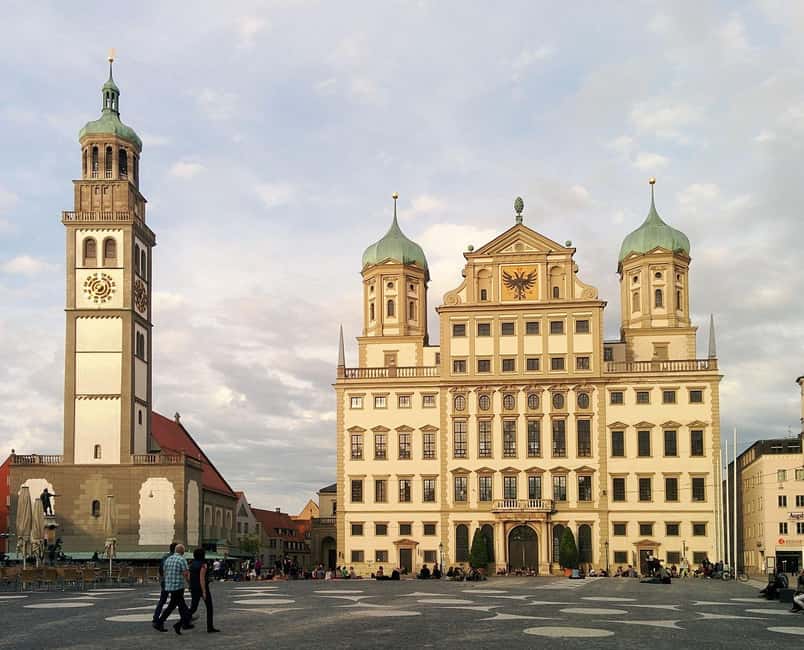
- Rathausplatz start with the Augsburg Town Hall and its Goldener Saal
- Perlach Tower for a watchtower vibe and panoramic views over town
- Fugger Square to understand the merchant families that drove Augsburg’s influence
- Little Venice canals, then the Brechthaus for Bertolt Brecht
- Leopold Mozart Haus to trace Mozart family roots, not just the famous son
- Augsburg Cathedral access where Romanesque and Gothic meet, plus 12th-century stained glass
Rathausplatz to Hofgarten, a 2.5-hour Augsburg story-walk
This tour works because it reads like a guided route through the city’s “why.” You start in the center at Rathausplatz, then gradually widen from civic power to private influence, and finally land at Augsburg Cathedral (Dom). By the time you finish at Hofgarten, you have a thread running through Renaissance politics, merchant wealth, and famous cultural figures.
The walk is moderate, and one practical detail I like is that it is not trying to punish you with marathon distances. Expect about 5 km, and plan on staying on your feet for the full 2.5 hours.
Timing is straightforward. You meet at 10:30am at Rathausplatz Augsburg, and you look for the yellow umbrella. From there, the pace is steady enough that you can enjoy the sights without feeling rushed.
A few more Augsburg walks and trips to compare
- Classic city tour in the World Heritage City of Augsburg
★ 4.0 · 41 reviews - Augsburg: Historical Highlights Private Walking Tour
★ 4.9 · 9 reviews - Leipzig: City History Canal Sightseeing Tour on a Motorboat
★ 4.7 · 7,671 reviews
Augsburg Town Hall at Rathausplatz and the Goldener Saal
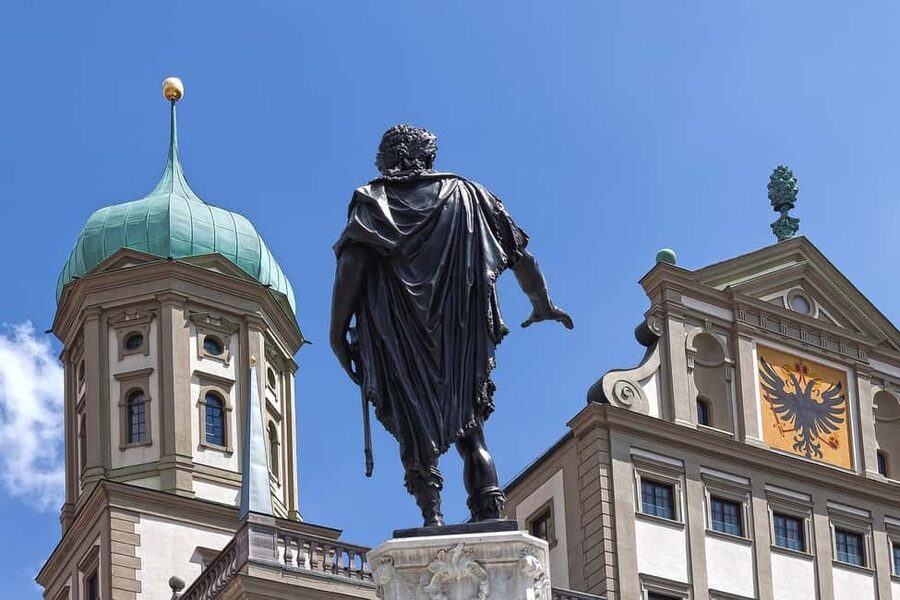
The Augsburg Town Hall is the kind of landmark that can either impress you silently or explain itself with the right guide. Here, it’s the first big anchor, and you get the story behind the building, including the fact it was designed by Elias Holl. That detail matters, because it turns the Rathaus from a photo stop into something with a maker and a purpose.
The highlight inside is the Goldener Saal, the famous golden hall associated with Augsburg’s civic status. Even if you are not a architecture person, you’ll likely enjoy how the guide connects art and power. This is one of those moments where you start thinking about wealth and influence as something you can literally see.
Practical tip: if you care about photos, have your camera ready early. Town halls are best photographed when you have a clean angle from the square, and it’s easy to miss the moment if you are still finding your footing.
Perlach Tower, the watchtower stop with real city views
After the Rathausplatz area, the tour heads toward Perlach Tower, a former watchtower. That is an old-school reminder that cities were once built for protection, not just convenience. As a stop, it gives you a change of rhythm, because you go from formal buildings and civic spaces to a structure designed for looking outward.
You also get panoramic views of Augsburg from up top, which is useful even if you think you already know the city. Seeing the layout helps the rest of the route make sense, especially later when you reach the cathedral and the canal-like area that locals call little Venice.
One more benefit: this tower break gives your legs a moment to reset. It’s still part of the walking tour, but the viewpoint makes it feel like a proper stop, not just a transfer.
Fugger Square and the power story behind Europe’s merchant families
Fugger Square is where the tour stops being only about beautiful landmarks and starts talking about how Augsburg got powerful. The Fuggers are described as Europe’s most powerful merchant families, and the tour treats them like a major theme, not a quick name drop.
What I like about this part is that the guide tends to connect wealth to outcomes you can still see in the city. You get a sense of why Augsburg mattered beyond its local borders. Instead of hearing history as a list of dates, you get history as a system: merchants who financed influence, then turned that influence into visible civic and cultural power.
If you want a personal payoff, aim to listen here for the “cause and effect” moments. This is where you start understanding how money moved in early modern Europe, and how that movement shaped public life.
More walking tours in Augsburg:
- Augsburg: Walking Tour with Fuggerei
★ 4.6 · 2,245 reviews - Augsburg’s Water Management System – City Walking Tour
★ 4.5 · 168 reviews - Augsburg: Illuminated Guided Evening Walking Tour
★ 4.6 · 67 reviews
Little Venice canals, then the Brechthaus for Bertolt Brecht
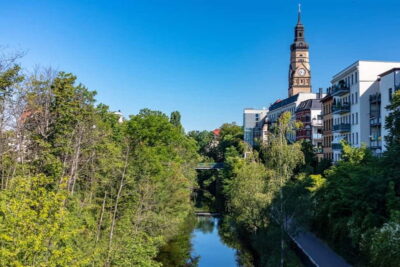
Next up is a contrast stop: little Venice. In Augsburg it’s a picturesque district known for canals that remind you of Venice, even though you are very much still in Bavaria. I like this section because it breaks up the heavy theme of power and makes the walk feel more like exploring a living city.
Then you continue to the Brechthaus, the birthplace of playwright Bertolt Brecht. The building now functions as a museum honoring his life and works. This matters because it shifts the tour from merchants and civic authority to ideas, language, and art as another kind of power.
If you’re the type who remembers stories better than facts, Brecht is a smart placement in the route. It gives the tour a human emotional angle after all the big-name economics.
Practical note: if you tend to enjoy museums, plan to linger at the Brechthaus a bit more than you think. Even if you do not go fully deep, the context is what makes the stop feel worthwhile.
Leopold Mozart Haus, tracing musical roots beyond Wolfgang
After Brecht, you move to the Leopold Mozart Haus, where Leopold Mozart, Wolfgang Amadeus Mozart’s father, was born. Again, this is not just a celebrity stop. It’s a museum setting that highlights the musical history of the Mozart family, and you get to see how family and environment fed the talent people later celebrated.
This is a good section if you like music history but find standard tours too focused on famous names alone. It gives you a different entry point, one that asks: where did the musical life begin for the family?
You might also enjoy how the guide uses these figures to show Augsburg’s cultural reach. The city isn’t only rich in money. It’s portrayed as a place where ideas and music mattered too.
Augsburg Cathedral (Dom) inside, with 12th-century stained glass and a bronze door
The tour’s final landmark phase is Augsburg Cathedral, the Dom. The guide highlights its mix of Romanesque and Gothic elements, which is one of those architecture facts that actually changes what you see. You’ll likely notice different vibes in different parts of the church, even if you are not studying style labels.
Inside, don’t miss the 12th-century stained glass windows. They’re old enough that you can feel the age in the light, and they create a visual break from the more civic stops earlier in the tour. The other must-see mentioned is the detailed bronze door, which is the kind of crafted detail that rewards slow looking.
One nice value detail: cathedral access is included. That means you are not scrambling with extra tickets during the tour window. It also helps the ending feel complete, not like another photo stop.
Finish at Hofgarten, which is a pleasant way to close. After history, you get a bit of breathing room to reset before you continue your day on your own.
Walking pace, German-only guide, and how to get the most from your 150 minutes
This is a walking tour, and comfort matters. Wear comfortable shoes, bring water, and dress for weather. The tour operates in all other weather conditions, but it does not run when it is raining or snowing, so check the day you go.
The guide is live and the tour is in German only. That can still be totally fine if you understand basic German or you are comfortable using context and listening. But if you need full translation, you may struggle, especially when the group moves quickly between stops.
One practical note from reported experiences: sometimes the guide can be a bit quiet, so you may want to position yourself so you can hear clearly. If you are in a small group, asking a quick question can also help you catch the detail you missed.
Good news: the route is not built around dry lectures. The best moments come when the guide keeps the information human and adds side angles that make people like Brecht and the Fuggers feel connected to real life.
Price and value at about $22 per person
At around $22 per person for 150 minutes, this tour is priced for people who want a structured overview without going full private guide mode. You pay for a guided walk plus included access to the Augsburg Cathedral, which is one of the clearer “value anchors” in the experience.
What makes it feel like good value is the spread of stops. You are not only seeing one category of sights. You get civic Augsburg (Town Hall and the square), defensive Augsburg (Perlach Tower), economic power (Fuggers), arts and ideas (Brecht and Mozart family), and a major religious site inside (Dom with stained glass and a bronze door).
If you are trying to maximize a short stay in Augsburg, this is a smart way to cover a lot without feeling like you are running from one unrelated postcard to the next.
Who should book this Augsburg historical walking tour?
This tour is a strong fit if you like guided storytelling and you want to connect Augsburg’s landmarks to the people behind them. It’s also a good choice for first-timers who want a coherent route through the old town, rather than picking sights randomly.
It may not be your best match if mobility is an issue. The tour is not suitable for people with mobility impairments and wheelchair users, and the walking component is part of the design.
If you’re traveling solo, a couple, or with friends who enjoy history and cultural sites, you’ll likely get more out of it. And if you like checking off places like Rathausplatz, the Dom, and specific birthplaces tied to major cultural names, this tour does that efficiently.
Should you book this tour?
Yes, I think you should book this Augsburg walking tour if you want a focused 2.5-hour overview that ties together Rathausplatz, Fugger power, and artist legacies, ending with Cathedral access. It’s the kind of experience that makes Augsburg feel readable fast, even if you start with little background.
I’d hesitate only if you rely heavily on English and you cannot comfortably follow German narration, or if walking a moderate route is not practical for you. If those two conditions are okay, this one is a solid value play for seeing Augsburg’s core stories in one go.
FAQ
What is the meeting point for the Augsburg walking tour?
You meet at Rathausplatz Augsburg at 10:30am. Look for the yellow umbrella.
How long is the tour?
The duration is 150 minutes, about 2.5 hours.
What is the price per person?
The price is $22 per person.
What does the tour include?
It includes a guided walking tour of Augsburg’s historic landmarks and access to Augsburg Cathedral.
Is food and drink included?
No, food and drinks are not included.
What language is the live guide?
The live tour guide speaks German.
Does the tour run in bad weather?
It does not operate when it is raining or snowing. It runs in all other weather conditions.
Is photography allowed?
Yes, photography is allowed.
Is this tour suitable for wheelchair users or mobility impairments?
No, it is not suitable for people with mobility impairments or wheelchair users.
Newest Augsburg reviews on the site
- Augsburg: Historical Highlights Private Walking Tour★ 4.9 · 9 reviews
- Augsburg: Express Walk with a Local★ 4.8 · 3 reviews
- Augsburg: Illuminated Guided Evening Walking Tour★ 4.6 · 67 reviews
- Augsburg’s Water Management System – City Walking Tour★ 4.5 · 168 reviews
- Classic city tour in the World Heritage City of Augsburg★ 4.0 · 41 reviews
- Augsburg: Walking Tour with Fuggerei★ 4.6 · 2,245 reviews
Historical Tours, compared.
City History Canal Sightseeing Tour on a Motorboat
Read our review →
Browse the lists this tour appears in