
Reviewed · HISTORICAL TOURS
Augsburg – Private Historic Tour
Augsburg has layers, and this tour helps. I love how the guide pulls together standout stops like Fuggerei and the Schaezlerpalais into one readable story, so you are not stuck doing homework all day. One thing to plan for, a couple of interiors cost extra once you are there.
This is also a smart way to tour when you want real back-and-forth. You get a private setup for your group (up to 15), with flexible timing, and guides like Kristen and Stephanie are the kind who meet you at the start, then make sure you are actually settled and oriented before you walk on. Starting at Augsburg Town Hall and ending near the Fuggerei keeps the route efficient on foot.
In This Review
- Key things I’d circle before you book
- Why Augsburg clicks with a private guide
- Getting your bearings at the Rotes Tor and St. Ulrich and Afra
- Schaezlerpalais: the baroque palace stop worth planning for
- Hercules’ Fountain and the bronze moment in 1597
- Goldener Saal in the Augsburg Town Hall
- Perlach Tower: an old watchtower with modern perspective
- Augustusbrunnen and St. Anne’s Church, two different kinds of charm
- Augsburg Cathedral: 11th century roots with 14th century additions
- Fuggerei: the world’s oldest social housing complex, still going
- Price and what you actually get for $417.72 per group
- How the route feels in real life (and who it fits best)
- A quick word on the guides and the private advantage
- Should you book this private Augsburg historic tour?
- FAQ
- How long is the Augsburg private historic tour?
- How many people are in a group?
- What is included in the tour price?
- What sights are covered during the tour?
- Are there entrance fees during the tour?
- Where do we meet, and where does the tour end?
- Is this a private tour or shared group?
- What is the cancellation policy?
Key things I’d circle before you book
- Fuggerei, still in use as the world’s oldest social housing complex tied to the Fugger family
- A baroque highlight at Schaezlerpalais (1765), a major historical monument with paid entry
- Real conversation time thanks to a private group format and flexible pacing
- A guided route that stitches Augsburg’s story across medieval, civic, and Renaissance eras
- Iconic landmarks with simple viewing beats like Hercules’ Fountain and the Perlach Tower
Why Augsburg clicks with a private guide
Augsburg can feel like a city that rewards slow wandering. But if you only have a few hours, you need help connecting the dots. That is where a private historic tour shines, because the guide gives you the timeline in plain language, then walks you from site to site so you can actually see what they are talking about.
I like that this tour does both: it hits the big names, but it also explains what those places mean. You will move through Augsburg’s older layers, from medieval church origins to civic treasures and famous Renaissance statuary, ending with a living slice of social history.
The other value piece is the private format. When you can ask questions, you stop guessing. You also avoid the common problem of arriving at a beautiful building and realizing you have no idea what you are looking at.
A few more Augsburg walks and trips to compare
- Historical Walking Tour of Augsburg / Historische Führung
★ 4.7 · 41 reviews - Classic city tour in the World Heritage City of Augsburg
★ 4.0 · 41 reviews - Augsburg: Historical Highlights Private Walking Tour
★ 4.9 · 9 reviews
Getting your bearings at the Rotes Tor and St. Ulrich and Afra
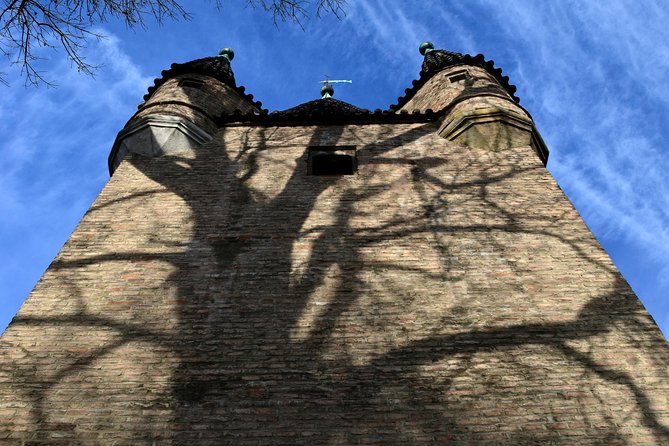
Most tours start in a place that looks impressive. This one starts in a place that sets the tone. You begin at Rotes Tor, the Red Gate tower that was renovated in the 20th century. It is a quick stop, and it helps you orient the whole walk, because it gives you an entry point into the city’s older street-and-gate logic.
From there, you go to the Basilica of SS. Ulrich and Afra. The key story here is that the church traces its origins to the Roman tomb of St. Afra, who was martyred in 304. You get a strong “how did this place begin?” moment right away, rather than treating the basilica like just another façade.
Practical tip: even if you only spend a short time at each stop, do not rush your looking. In churches like this, the details tend to reward a slow glance upward, then a quick scan for any place where the guide’s explanation points you.
Schaezlerpalais: the baroque palace stop worth planning for
Next comes the Schaezlerpalais, an artistic palace with a magnificent baroque style originating in 1765. This is one of those stops where it helps to have someone explain why it matters, because palaces can feel decorative if you do not know what role they played.
This stop is also a reality check for budgeting. Entrance is not included, and it costs €7 per person. On the plus side, you are paying for a specific interior experience, not just another outside viewpoint.
If you love architecture, this is the one place you will probably be glad you made time for. The baroque style is the star, and the palace status as an important historical monument makes it feel like more than a photo stop.
Hercules’ Fountain and the bronze moment in 1597
After the palace, you shift to something more street-level and easier to read. You walk by Hercules’ Fountain, Augsburg’s third famous fountain, made in 1597. The bronze sculpture shows Hercules killing the hydra, a seven-headed Greek mythology monster.
This stop is short, and it is free, so think of it as a palate cleanser between bigger sights. What makes it useful is symbolism. You see how Renaissance and early modern Europe loved mixing classical mythology with public art, and you start to understand why Augsburg’s civic spaces looked the way they did.
Quick advice: when you are looking at fountains like this, angle your body slightly rather than craning straight up. You will usually catch more of the sculpture’s shape, especially the drama of a multi-figure scene.
Same city, a different way to spend the afternoon:
- Augsburg: Walking Tour with Fuggerei
★ 4.6 · 2,245 reviews - Augsburg’s Water Management System – City Walking Tour
★ 4.5 · 168 reviews - Augsburg: Illuminated Guided Evening Walking Tour
★ 4.6 · 67 reviews - Pubcrawl Augsburg: Tour through best Bars and Clubs in Town
★ 4.4 · 13 reviews
Goldener Saal in the Augsburg Town Hall
Then you reach one of the civic power plays: the Goldener Saal in the Augsburg town hall. It is famous for ceiling paintings and golden wall decoration, and it was completed in 1643. That is already impressive, but the story around it gives the room extra weight.
In 1944, the town hall and the Goldener Saal were destroyed by an air raid. They were reconstructed after the war, so the space is not only about art, it is also about recovery and continuity.
As with Schaezlerpalais, entry is paid and not included, €2.5 per person. If you are trying to keep costs down, this is the second interior stop you will want to weigh. Still, the combination of baroque-era artistry cues plus the reconstruction history makes it feel like more than a quick peek.
Perlach Tower: an old watchtower with modern perspective
Next up is the Perlach Tower, the 70 meter Perlachturm in Augsburg’s central district. You are visiting it as a watchtower that goes back to the 10th century, even though it looks like it belongs to later centuries. That mix is common in older European cities, and Augsburg is no exception.
This is a free stop and a short one. You will not spend all day on a tower, but it is a great anchor point because it reinforces the idea of Augsburg as a city built for watching, defending, and managing.
If you like urban history, ask your guide what the tower would have meant at the time. Even without a full viewpoint climb, it can change how you see the streets around you.
Augustusbrunnen and St. Anne’s Church, two different kinds of charm
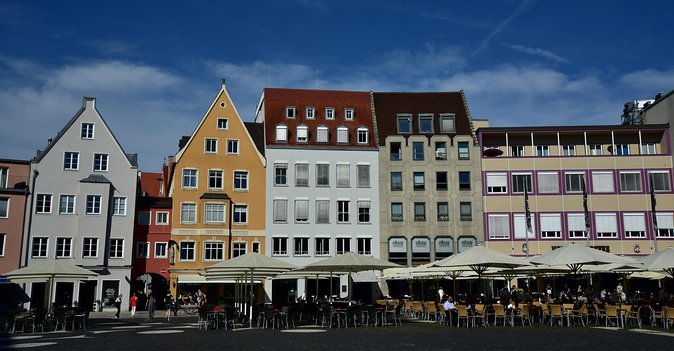
From the tower, you move to Augustusbrunnen, a fountain cast between 1588 and 1594 and located in the town hall square. It is another free stop, and it helps you keep seeing Augsburg as a place where public art and civic space go together.
Then you shift into medieval faith and design at St. Anne’s Church. Built in 1321, it was originally part of a monastery, and it is known for elaborate interior decoration. This is the kind of church stop where a little explanation makes a big difference, because you can look at ornament and wonder what you are really seeing.
If you are short on time, focus on the interior elements your guide highlights. A 15 minute stop can still feel meaningful when you know where to look.
Augsburg Cathedral: 11th century roots with 14th century additions
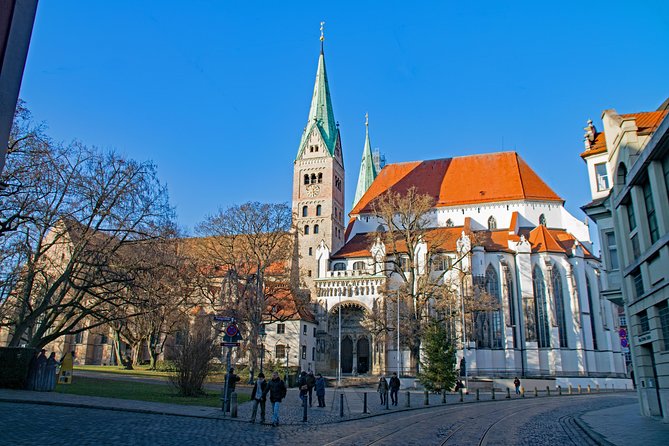
After St. Anne’s, you continue to Augsburg Cathedral, a Roman Catholic church. It was founded in the 11th century, then received Gothic additions in the 14th century. The tower is about 62 meters high, which makes it one of the strongest vertical landmarks you will encounter on the walk.
This is free to view, and it works as a capstone to the religious portion of the tour. The cathedral stop helps you see how different architectural eras overlap in one place. You might notice the way later Gothic touches can feel like a redesign on top of the original structure.
Practical tip: when you are inside or at the edge of a big cathedral space, let the size reset your eyes. You want to see proportions first, then details second, otherwise the decorations can blur together.
Fuggerei: the world’s oldest social housing complex, still going
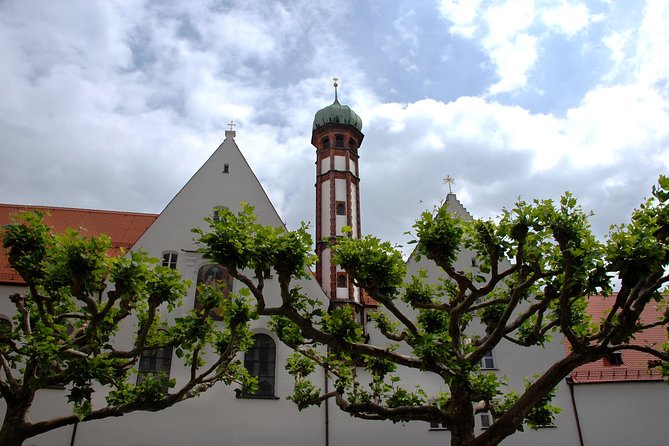
You finish with Fuggerei, named after the Fugger family and founded in 1516. This is described as the world’s oldest social housing complex that is still in use. That one fact changes the whole feeling of the stop, because you are not just looking at history behind glass.
You walk through a place where Augsburg’s needy citizens could be housed, and it still functions today as a real, lived part of the city. This makes the ending feel grounded, not just scenic.
If you care about how European cities worked socially, this is one of the most compelling moments of the day. It answers the question many people ask during historic sightseeing: who benefited, who lived there, and how did the city organize help and responsibility?
Price and what you actually get for $417.72 per group
The price is $417.72 per group, up to 15 people, for about 3 hours. That pricing can look high if you compare it to a bus tour. But this is private, and you are buying time with an official guide plus a route designed to cover major sights without you needing to research each one beforehand.
Here is the value logic I use: the cost per person drops quickly as the group gets fuller. If you have a small group, it can work out like a premium guided experience. If you have a group closer to 15, it is far more comparable to what you might pay for a good guided experience per person, and you still keep the private benefit of asking questions and setting the pace.
Also, note that most major stops here are free, which helps. The two paid interior entrances are Schaezlerpalais (€7) and Goldener Saal (€2.5). That means you can get a large amount of sightseeing value while still budgeting for only two ticketed interiors.
One more practical point: the tour is typically booked about 13 days in advance on average. Augsburg is not a huge tourist magnet compared to some cities, but this is popular enough that you should not wait until the last minute if you want a specific day.
How the route feels in real life (and who it fits best)
This tour is built like a walking loop through Augsburg’s key anchors. You start at Augsburg Town Hall, Rathausplatz 2, and end in the Fuggerei area near Jakobskirche, 86152 Augsburg. That start and finish pairing is handy because both are central, and you can usually connect the rest of your day to nearby food and transport.
Duration is about 3 hours, which is a sweet spot for people who want a structured overview. It is long enough to cover many top sights, but not so long that you feel like you are stuck in a fog of monuments.
Who it suits best:
- Couples and small families who want fewer surprises and more context
- Solo travelers who do not want to guess their way through Augsburg’s eras
- Anyone who loves architectural details but also wants the story explained in a straightforward way
Who might find it less perfect:
- People who want only free exterior sightseeing and do not care about interiors at all. You still see plenty outside, but you will likely bump into the two paid stops.
A quick word on the guides and the private advantage
The reviews mention guides like Kristen and Stephanie, and both stand out for welcome and tailoring. That matters because a good historic guide does more than list dates. They help you understand why a place exists, what to notice, and where to put your attention during short stops.
In a private setting, that flexibility is not just a marketing line. It is what lets you linger when something clicks, or move on when you are not feeling the interior pace.
Should you book this private Augsburg historic tour?
If you want to see Augsburg’s biggest landmarks in a short, well explained walk, I think this is an easy yes. It is structured enough to save you research time, but private enough that you can steer the conversation.
Book it if:
- You want Fuggerei and you want context, not just a quick stop
- You care about baroque and civic art, especially Schaezlerpalais and the Goldener Saal
- You like asking questions and getting clear answers on the spot
Skip it or pair it differently if:
- You only want outdoor sights and do not want to pay any entrance fees
- Your schedule is so tight that a 3 hour walking loop is hard to fit
If you do book, do yourself a favor and bring comfortable shoes. Augsburg’s old streets reward walking, and this route is designed for it.
FAQ
How long is the Augsburg private historic tour?
It runs for about 3 hours.
How many people are in a group?
The tour is private for your group, with a group size of up to 15.
What is included in the tour price?
The tour includes an official tour guide.
What sights are covered during the tour?
You will visit key Augsburg landmarks including Rotes Tor, the Basilica of SS. Ulrich and Afra, Schaezlerpalais, Hercules’ Fountain, the Goldener Saal, Perlach Tower, Augustusbrunnen, St. Anne’s Church, Augsburg Cathedral, and Fuggerei.
Are there entrance fees during the tour?
Yes. Schaezlerpalais has an entrance fee of €7 per person, and the Goldener Saal has an entrance fee of €2.5 per person. Other stops listed are free.
Where do we meet, and where does the tour end?
You meet at Augsburg Town Hall, Rathausplatz 2, 86150 Augsburg, Germany. The tour ends in the Fuggerei area near d. Jakobskirche, 86152 Augsburg, Germany.
Is this a private tour or shared group?
This is a private tour/activity. Only your group will participate.
What is the cancellation policy?
This experience is non-refundable and cannot be changed for any reason. If you cancel or ask for an amendment, the amount you paid will not be refunded.
Newest Augsburg reviews on the site
- Pubcrawl Augsburg: Tour through best Bars and Clubs in Town★ 4.4 · 13 reviews
- LETTL Museum of Surreal Art Entry Ticket★ 5.0 · 9 reviews
- Historical Walking Tour of Augsburg / Historische Führung★ 4.7 · 41 reviews
- Augsburg: Historical Highlights Private Walking Tour★ 4.9 · 9 reviews
- Augsburg: Express Walk with a Local★ 4.8 · 3 reviews
- Classic city tour in the World Heritage City of Augsburg★ 4.0 · 41 reviews
- Augsburg: Illuminated Guided Evening Walking Tour★ 4.6 · 67 reviews
- Augsburg’s Water Management System – City Walking Tour★ 4.5 · 168 reviews
Historical Tours, compared.
City History Canal Sightseeing Tour on a Motorboat
Read our review →
Browse the lists this tour appears in