Reviewed · GUIDED
Berlin Self-Drive Trabi Tour with Guide
Berlin deserves a weird mode of transport now and then. This Self-Drive Trabi tour puts you behind the wheel of a Trabant in a small convoy, so you learn the city fast while hearing stories tied to the streets you actually drive. The route loops through major landmarks like Potsdamer Platz, Brandenburg Gate, Unter den Linden, East Side Gallery, Oberbaum Bridge, and Checkpoint Charlie.
I especially liked the mix of hands-on driving and real orientation for first-timers. You get a short briefing on the car, then the guide keeps the pace calm enough to process what you’re seeing, from cobblestones to wall murals.
One thing to weigh: this experience is for people who can handle a manual gearbox (or plan ahead for an automatic by prior consultation). If driving a clutch and stick shift feels stressful, you might not love this.
In This Review
- Key things to know before you drive
- Why a Trabi tour is the fastest way to get your bearings in Berlin
- Price, timing, and what your hour and change really buys
- Getting ready: stick shift practice, driver rules, and safety reality
- Where you meet and how the tour is organized
- The Trabi route in one sweep: from Potsdamer Platz to the Brandenburg Gate
- Unter den Linden, the cathedral area, and that calm but focused pace
- East Side Gallery: the Wall turned into street art
- Oberbaum Bridge and the drive toward the border-memory sites
- What the Trabi is like to drive, and why the senses matter
- Guides set the tone: calm driving, funny stories, and real tips
- Who should book this, and who should skip it
- Should you book the Berlin Self-Drive Trabi Tour?
- FAQ
- Do I need a driver’s license to drive the Trabi?
- Is an automatic Trabi available?
- Where do we start and where does the tour end?
- How many people are allowed per car, and what is the tour group size?
- Are children allowed?
- Is food included?
- What are the main stops on the route?
- What should I know about accidents?
Key things to know before you drive
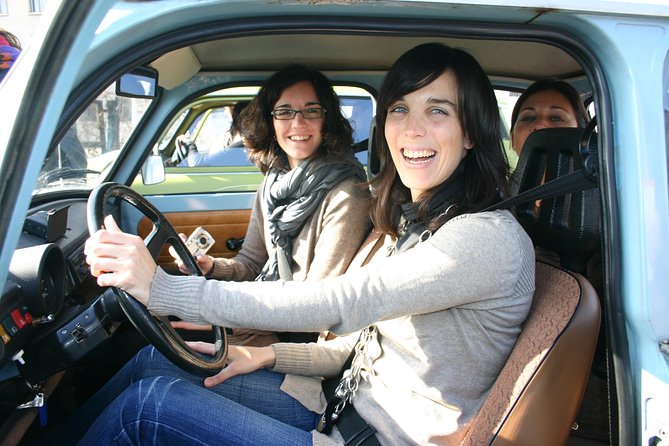
- A convoy with a live English guide so you’re not guessing where to go or what you’re looking at
- Manual driving training first, with a chance to get comfortable before the city starts moving around you
- Central Berlin landmarks in a tight loop, including East Side Gallery and Checkpoint Charlie
- Short, focused stops (like East Side Gallery) while most of the time is spent driving and learning
- Small group sizes (max 12 on the tour, max 4 per vehicle) which keeps the experience friendly and organized
Why a Trabi tour is the fastest way to get your bearings in Berlin
Berlin can feel huge until you see it from street level. In a Trabi, you slow down in the most literal way possible. The car is small, the driving is hands-on, and the streets come at you in a way that sticks.
The guide’s commentary helps you connect the dots. You’ll hear what matters at major squares and landmarks as you pass them, not just in a museum context. That matters if you’re the type who needs geography to make history make sense.
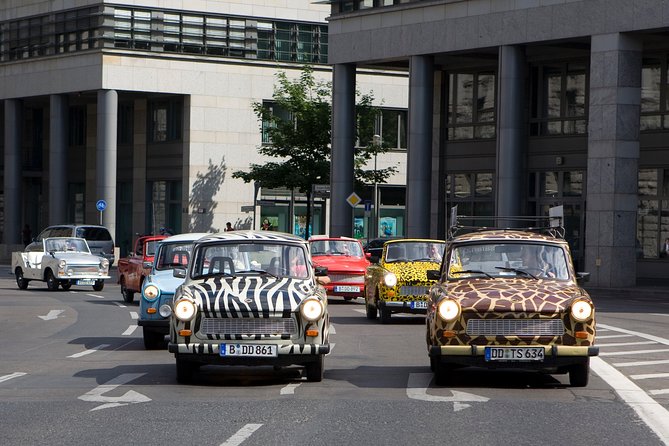
And yes, it is a little ridiculous in the best way. You become part of the show as pedestrians smile, point, and take photos. One review described the experience as a moving photo magnet, and it makes sense. A tiny East German icon rolling through central Berlin is hard to ignore.
A few more Berlin walks and trips to compare
- Berlin: Reichstag, Dome and Government District Guided Tour
★ 4.7 · 18,288 reviews - Berlin: 1-Hour City Tour by Boat with Guaranteed Seating
★ 4.3 · 16,993 reviews - Berlin: TV Tower Standard Entrance Ticket
★ 4.4 · 15,883 reviews
Price, timing, and what your hour and change really buys
The price is $95.58 per person for about 1 hour 15 minutes (approx.). That’s not cheap compared to a walking tour, but you are paying for the real core experience: the car, the guide, and the route built around driving.
Also, pay attention to the vibe of the time. Reviews mention guides delivering commentary for up to two hours in total experience time, which suggests the schedule can feel longer than the “about 1 hour 15 minutes” headline. Either way, the value comes from doing something active, not just watching traffic from the sidewalk.
A practical tip: arrive early if you can. One person missed the timing and the team still scrambled to get them into a car quickly, but it turned into stress. You want your nerves low before you touch the clutch.
Food and drinks are not included, so plan to grab a snack before or after. The tour ends back at the meeting point, so it’s easy to continue on foot or by public transport.
Getting ready: stick shift practice, driver rules, and safety reality
This tour is built around you driving a Trabant with a standard gearbox. Automatic gearbox is listed as available only after prior consultation. So if you cannot drive a manual, you’ll need to ask ahead rather than hope.
Before you set off, you get a briefing and instruction on operating the manual gearbox and the four-stroke engine. This is not a “figure it out” situation. The guide controls the group and gives you the steps you need.
Still, be honest with yourself. Reviews show two extremes:
- Some people found the car easier than they expected and said a simulator or practice helped.
- Others found it genuinely tricky and even stopped early when it wasn’t working for them.
The best move is to come with basic stick shift competence. If you’ve driven one before, you’ll likely be fine. If you’ve never used a clutch, this can become a stressful task while trying to read Berlin and listen to the guide.
Safety and liability are serious here. In the case of an accident, the operator requires a EUR 850 co-payment. That’s a cost you should understand before you drive. If that makes you nervous, this is your signal to reconsider.
Where you meet and how the tour is organized
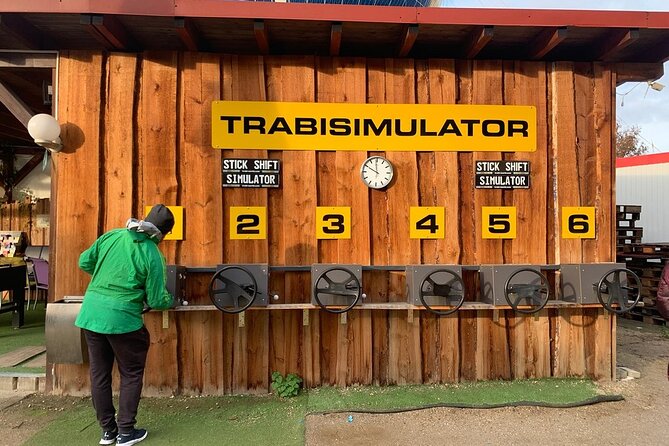
You meet at TrabiWorld Berlin, Zimmerstraße 97-100, 10117 Berlin. The tour ends back at the same place.
The group size is capped at 12 travelers, and each vehicle can take up to 4 people. That matters for comfort. You are not stuck in a huge group with a single slow explanation. It also means the guide can manage the convoy without the whole route turning into chaos.
The meeting point is near public transportation, so you’re not forced into a taxi to start. And it’s walking distance to Checkpoint Charlie, scenic squares, and an important art museum. That’s a gift. You can come early for a quick walk, then return after the ride to explore more slowly.
Same city, a different way to spend the afternoon:
- Berlin: Boat Tour Along the River Spree
★ 4.4 · 11,252 reviews - Discover Berlin Half-Day Walking Tour
★ 5.0 · 9,624 reviews - Berlin: Government District around the Reichstag Guided Tour
★ 4.7 · 8,447 reviews - Berlin: Reichstag, Plenary Chamber, Cupola & Government Tour
★ 4.6 · 8,422 reviews
The Trabi route in one sweep: from Potsdamer Platz to the Brandenburg Gate
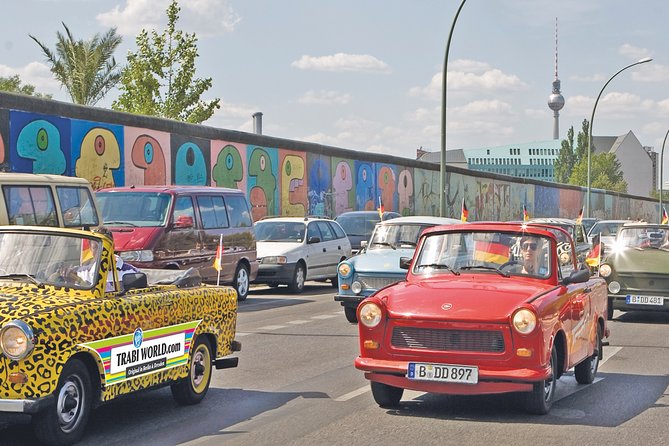
Stop 1 is your welcome and briefing at TrabiWorld Berlin. That briefing takes about 10 minutes, and the admission ticket is listed as free for the briefing portion.
Once you roll, the route starts by hitting Berlin’s major “you can’t miss it” spaces. Expect to pass:
- An important public square and traffic intersection in central Berlin (Potsdamer Platz fits this description)
- A famous 18th-century neoclassical monument (Brandenburg Gate)
- A grand boulevard (Unter den Linden)
- The Berlin Cathedral area
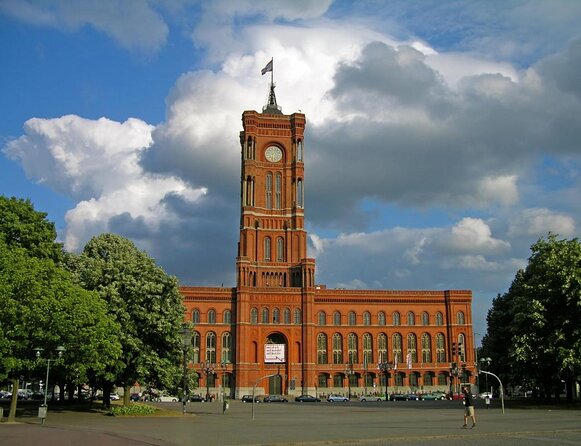
- Rotes Rathaus (the red town hall from 1870)
- The Berlin TV Tower area
Why this arc works: you’re driving a car that feels slow and old through the most recognizable modern-meets-historic corridors. The result is a quick mental map of central Berlin. You’ll also understand how the street grid connects the landmarks, instead of seeing each one as a separate postcard.
If you love classic cars, this segment also gives you time to settle into the car’s quirks. The convoy format helps too. You’re not constantly making independent decisions. The guide leads, and you follow.
Unter den Linden, the cathedral area, and that calm but focused pace
Berlin sightseeing often comes with a trade-off. Either you move fast and miss context, or you go slow and run out of energy. This tour lands in the middle.
As you pass Unter den Linden and the cathedral area, the guide is giving you the “why” behind what you see. It’s not just naming monuments. It’s explaining what people associated with these places, and how the story connects to what Berlin became.
Rotes Rathaus and the TV Tower are next in the line-up. These are also great for orientation because they anchor the view lines. Even if you don’t stop for a long photo break, you can still “place” them in your mental map for later.
One review mentioned the easy pace, and that’s the real point. You’re driving an antique-feeling car, so the tour isn’t about speed. It’s about letting the city land on you.
East Side Gallery: the Wall turned into street art
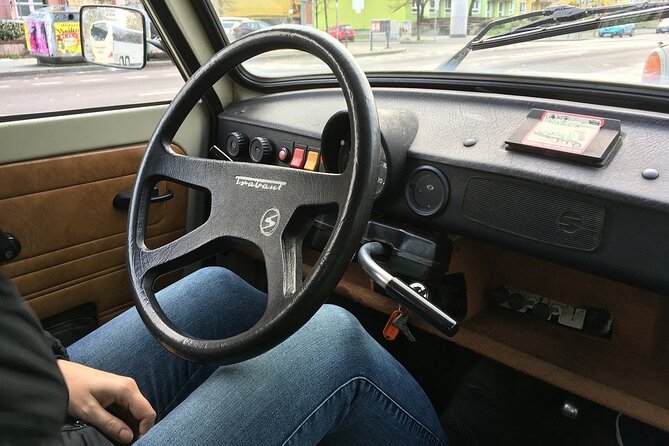
Then you reach Stop 2: the East Side Gallery, an open-air gallery with murals painted directly on a 1,316 m long remnant of the Berlin Wall. The stop time is listed as 5 minutes, and admission is listed as free for that stop.
Five minutes is short, but it’s also honest. This is not a full walking tour of the gallery. It’s a drive-by moment designed to give you the historical punch and let the murals hit you while you’re already in the right place.
In practical terms, do what you can in that brief stop:
- Look for the murals you recognize from photos
- Take a couple of steady photos, not 40 shaky ones
- Then get back in the car and keep going, because the convoy keeps you moving through the Cold War geography of the city
For many visitors, this stop is the emotional center of the tour. It gives context to everything that comes before it and everything you’ll see next.
Oberbaum Bridge and the drive toward the border-memory sites

After East Side Gallery, the route continues toward major river crossing views, including the double-deck bridge over the Spree, described on this tour as Oberbaum Bridge.
Oberbaum matters because it’s a visual break in the story. You feel like you’re crossing between worlds, not just driving to another landmark. That’s exactly what Berlin often feels like, especially when you’re learning the city through its borders, corridors, and transformations.
This is also where you start to appreciate the convoy experience. Other people take photos of your car line. You’ll also notice how drivers make room for the odd procession. It becomes a social moment, not just a sightseeing task.
Then, later in the loop, you’ll reach Checkpoint Charlie. That stop connects the Wall-era story to the everyday traffic reality of Berlin. It’s not a museum-style exhibit. It’s a reminder that borders were once lived, and now you ride right through the surrounding streets.
What the Trabi is like to drive, and why the senses matter
The Trabi experience is full sensory. Reviews mention the sound and vibration, and the unmistakable smell. One review even described it as a full-sensory experience with the crackling communication and the engine noise as part of the point.
Here’s what that means for you:
- The car is loud and vibrates noticeably, so you’ll feel the city in your hands and feet
- The engine noise can make it hard to hear commentary at times
- Your attention will split between driving, watching the road, and picking up stories through a radio system
The radio system detail is important. One review explained you cannot talk back, so you’re listening only. If you’re hoping for a two-way chat, plan to ask questions during the briefing or when you’re stopped.
If you can drive a stick shift, this tour becomes a joyride through history. If you cannot, the challenge can steal the fun. That’s the honest trade-off.
Guides set the tone: calm driving, funny stories, and real tips
Good guides make or break this kind of activity. The reviews point repeatedly to guides who stay calm and keep everyone safe while still making the stories fun.
Names you might hear include Thomas, Matthias, Axel, and George. People praised Thomas for being safety-first and for delivering engaging commentary for the full time. Matthias was described as patient when driving felt tricky. Axel and George were also mentioned as friendly, informative, and trustworthy.
What you should take from this as a visitor: don’t underestimate the value of listening to the guide’s driving instructions. This is not just “how to operate the car.” It’s how to survive Berlin streets while staying relaxed.
Who should book this, and who should skip it
You’ll likely love this tour if you:
- Can drive a manual gearbox, or you’ve already arranged automatic options through prior consultation
- Want a practical way to learn central Berlin faster than walking only
- Enjoy hands-on travel, even when the car is loud, old-feeling, and quirky
- Like classic, iconic machines and don’t mind being the person others photograph
You might want to skip if:
- You’re a beginner driver and manual transmission training won’t reduce your stress
- You want a quiet, museum-like experience with lots of walking time
- You expect long stops at every landmark (this is a drive-and-learn format with short photo moments)
Children are allowed with an adult, and the minimum age is 18 years for drivers. Also, you might find this a hit for families because kids often love the novelty and the convoy energy, as reflected in multiple reviews.
Should you book the Berlin Self-Drive Trabi Tour?
If your goal is to see Berlin and also do something memorable, I think this is an easy yes. The price buys a lot: the car experience, the guide, a tight loop through landmark Berlin, and a quick grasp of how the city fits together.
My main advice is driver-focused. If you’re comfortable with a stick shift, the whole thing clicks. If you’re not, handle the automatic consultation question early, and be realistic about whether you want to fight the clutch while you’re trying to enjoy the sights.
So, should you book? Book it if you want a fun, slightly chaotic-feeling slice of Berlin history with real street-level context. Skip it if you want low-effort sightseeing, or if the manual driving part would ruin your mood.
FAQ
Do I need a driver’s license to drive the Trabi?
Yes. The tour data says evidence of a driver’s license for non-automatic cars is required from all drivers.
Is an automatic Trabi available?
Automatic gearbox is listed as only available after prior consultation. If you need an automatic, you should arrange that before the tour.
Where do we start and where does the tour end?
You start at TrabiWorld Berlin, Zimmerstraße 97-100, 10117 Berlin, Germany. The tour ends back at the same meeting point.
How many people are allowed per car, and what is the tour group size?
Each vehicle can have a maximum of 4 people, and the overall tour has a maximum of 12 travelers.
Are children allowed?
Children must be accompanied by an adult. The minimum age is 18 years, and children up to 17 years accompanied by at least one adult are free of charge.
Is food included?
No. Food and drinks are not included.
What are the main stops on the route?
The tour includes a briefing at TrabiWorld Berlin and then key sightseeing driving through central Berlin. It also includes a stop at the East Side Gallery, with short stop time listed for that stop.
What should I know about accidents?
In the case of an accident, the local tour operator requires a co-payment of EUR 850.
Newest Berlin reviews on the site
- Jetbike Berlin fun bike beer bike★ 5.0 · 3 reviews
- Karl-Marx-Allee Walking Tour: Berlin’s Socialist History★ 5.0 · 5 reviews
- Homeless on chic streets: city tour in Berlin from personal experience★ 4.6 · 3 reviews
- Berlin: Sachsenhausen Concentration Camp Guided Tour★ 4.9 · 42 reviews
- Historyof the Trans, Queer & Gay communities of Berlin tour★ 4.8 · 17 reviews
- Historic Berlin Pubs & History Tour★ 4.9 · 73 reviews
- Berlin: City Center Walking Tour★ 4.7 · 45 reviews
- Half-Day Berlin Highlights Segway Expedition★ 4.5 · 61 reviews
Guided, compared.

Reichstag, Dome and Government District Guided Tour
Read our review →

Government District around the Reichstag Guided Tour
Read our review →

1-Hour Boat Tour with Bilingual Guide (Ger/Eng)
Read our review →