
Reviewed · HISTORICAL TOURS
Where It All Began: Berlin’s Queer & Trans History Tour
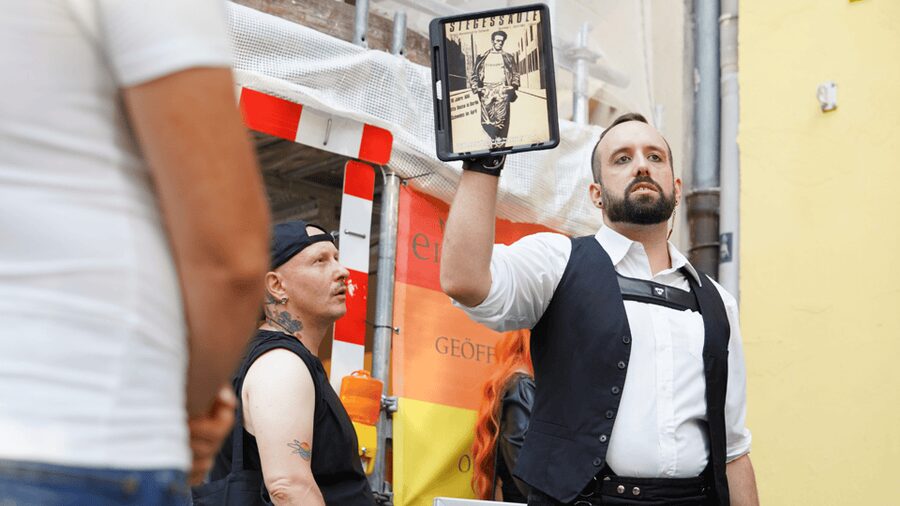
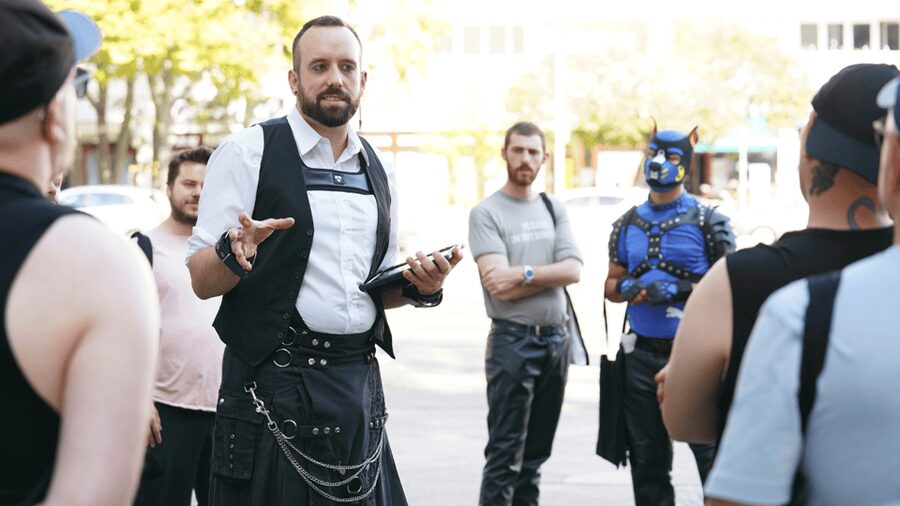
Berlin’s queer history comes with GPS for your eyes. This BerlinGuide.de tour uses an AR iPad and a small group capped at 10 led by Jeff to connect LGBTQ+ and trans sites with real, human stories you would not piece together alone. You also get a lot of built-in media, plus fun ways to save what you see.
There is one tradeoff to know up front: the walk tackles some brutal chapters, from Nazi persecution to the AIDS crisis, and it depends on good weather since it is a walking route.
In This Review
- Key things I’d focus on before you go
- What this tour is really for, and who it suits best
- AR iPad and Mixies photos: why the tech actually matters
- The value angle: $83.13 for 3.5 hours with real depth
- Meeting point and end: what your route sets you up for
- Stop by stop: how each place changes the story
- Karl-Heinrich-Ulrichs-Straße 1: the early public push for decriminalization
- Nollendorfplatz: persecution under the Nazis, from politics to the pink triangle
- Schwerinstraße 13: lesbian life, cabaret culture, and resistance through space
- Nollendorfstraße 17: Christopher Isherwood and how art traveled into public culture
- Magnus-Apotheke: Hirschfeld, the Institute for Sexual Science, and Paragraph 175
- Denns BioMarkt (former Eldorado): drag nightlife and the contradictions of the era
- Prinz Eisenherz: post-war activism and Charlotte von Mahlsdorf’s preservation work
- Connection: trans community in West Berlin and the Chez Romy Haag effect
- Internationale Stele GEGEN DAS VERGESSEN: the AIDS crisis and survival organizing
- Metropol: queer nightlife, Pride, and fighting gentrification
- Pacing and practical tips so you enjoy the walk
- Should you book this Berlin queer and trans history tour?
- FAQ
- How long is the tour?
- What is the group size?
- Is the tour offered in English?
- What is included with the tour?
- Where do I meet and where does it end?
- What happens if the weather is bad or I need to cancel?
Key things I’d focus on before you go
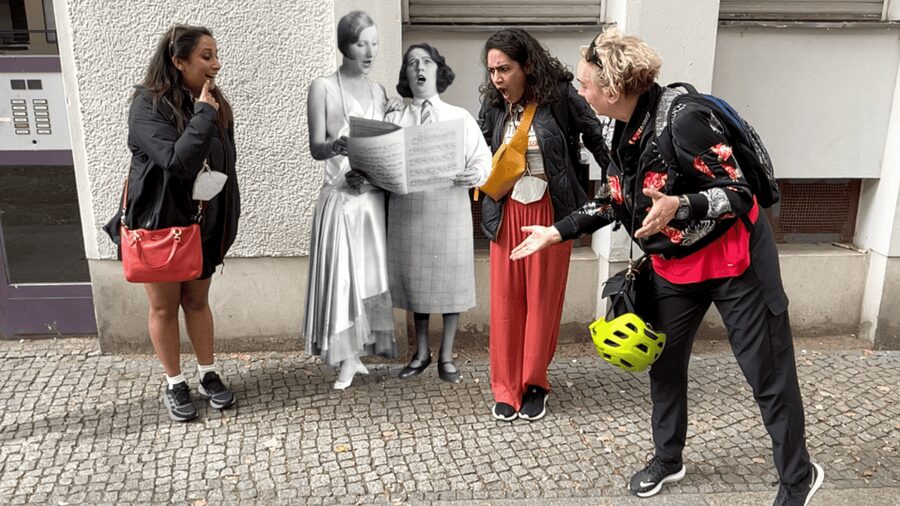
- AR iPad on-site so old photos and scenes line up with where you are standing now
- Mixies AR photos for quick, personalized group memories
- Jeff’s storytelling style brings humor, clarity, and emotion without turning it into a lecture
- A tightly capped group of 10 that keeps the pace humane and questions welcome
- A route through eras from early gay rights activism to post-war organizing, trans nightlife, and today’s activism
- It ends at Metropol, so the tour naturally links history to the Berlin club scene
What this tour is really for, and who it suits best
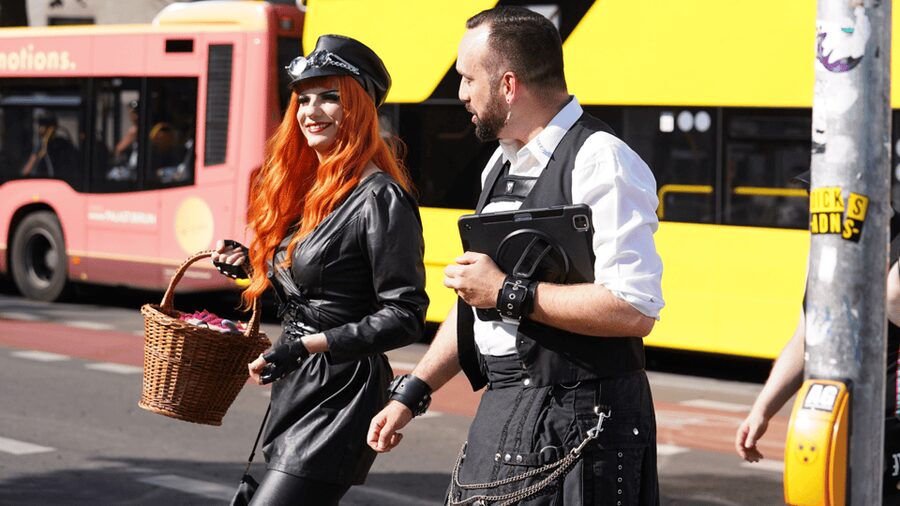
This is a Berlin queer and trans history walking tour built around one idea: place matters. Standing at Karl-Heinrich-Ulrichs-Straße 1 or at Nollendorfplatz, you are not just looking at “a street name.” You are seeing how public advocacy, repression, nightlife, and community organizing all happened in specific neighborhoods.
You will get value if you want context and continuity. The route moves across time, but it keeps making connections: early activism feeds later rights movements, and club spaces often become safety networks, not just entertainment. If you like tours that are both practical and story-driven, you will probably feel like you’re getting Berlin’s “hidden map” without needing to research for days first.
This tour also fits well if you care about modern Berlin culture. It is not only about the past; it closes with queer nightlife, Pride events, and the ongoing fight for an affordable city, which is the kind of link that makes history feel usable.
More History Tours in Berlin
- Berlin: Natural History Museum Entrance Ticket
★ 4.6 · 3,382 reviews - Berlin: 3-Hour World Heritage Cruise to Potsdam
★ 4.5 · 1,569 reviews - Berlin: History of the Third Reich Guided Walking Tour
★ 4.7 · 791 reviews
AR iPad and Mixies photos: why the tech actually matters
A lot of tours say “AR” and then give you a gimmick. Here, the AR iPad is used to do something specific: show historical photographs in the spot where you are standing today, and then layer your group into that scene. That means you are not just hearing names like Magnus Hirschfeld, Dora Richter, or Lili Elbe. You are seeing evidence of what came before and how the city looks now.
You also get Mixies, which are fun, personalized photos with AR elements. If you like having something to bring home that is not only your own memory, this helps. It also gives you a reason to pause, look, and take in details you might otherwise race past on a walking tour.
And then there is the media bundle: you receive 200+ rare historical photos, videos, and archival materials. That is useful on two levels. First, it helps you follow the stories while you are walking. Second, it gives you a way to keep learning after the tour ends.
The value angle: $83.13 for 3.5 hours with real depth
At $83.13 per person for about 3 hours 30 minutes, the price can feel steep if you compare it to a basic free walking tour. But the deal is not only the guide. You are paying for the small group limit, the AR on iPad, the Mixies photo feature, and the heavy historical grounding that stays anchored to actual sites.
Two practical value points for you:
- You’re buying time and focus. Instead of piecing together LGBTQ+ and trans history across Berlin neighborhoods, you get a planned route where each stop has a point and a theme.
- You’re buying preservation and memory tools. The historical media and AR photo matching help you “remember with your eyes,” not only your mind.
One more sign you should not wait too long: the tour is typically booked about 36 days in advance. That usually means the group format stays comfortable, but it also means popular dates can vanish.
Meeting point and end: what your route sets you up for
You meet at Alnatura Super Natur Markt, Else-Lasker-Schüler-Straße 18, 10783 Berlin. The tour starts at 2:00 pm and ends at Metropol, Nollendorfpl. 5, 10777 Berlin. Ending at Metropol matters because it closes the loop between “what was built” and “what still exists.”
You will likely find it easier to plan around this schedule than a tour that starts in the morning. A 2:00 pm start gives you time to arrive, grab a snack, and do an early neighborhood wander without feeling like you must sprint.
A few more Berlin walks and trips to compare
- Berlin Historical Highlights Walking Tour
★ 4.9 · 657 reviews - Berlin: 1h Boutiquestyle-Cruise on the Historic HEMINGWAY
★ 4.6 · 563 reviews - Berlin Private Complete History All Day Walking Tour
★ 5.0 · 474 reviews - Berlin: Cold War Era History Guided Bike Tour
★ 4.8 · 413 reviews
Stop by stop: how each place changes the story
Karl-Heinrich-Ulrichs-Straße 1: the early public push for decriminalization
You begin at Karl-Heinrich-Ulrichs-Straße 1, named for the man often called one of the world’s first gay rights activists: Karl Heinrich Ulrichs. The core idea here is that queer identity and advocacy existed long before modern labels and before today’s political language. Ulrichs publicly argued for decriminalization and helped define queer identities at a time when even basic public discussion could be dangerous.
Why this first stop works: it sets a foundation. If you start with later oppression, the story can feel like it begins with victimhood. Starting with early advocacy shows that LGBTQ+ history in Berlin is not only a reaction to persecution. It is also a record of people trying to shape law, culture, and public understanding.
Nollendorfplatz: persecution under the Nazis, from politics to the pink triangle
At Nollendorfplatz, the tour turns sharply and stays there. You hear about Adolf Brand and right-wing gay activists, and you also get into the complicated, unsettling reality of openly gay Nazis, including Ernst Röhm.
This stop covers Hitler’s stance on homosexuality and how it fueled mass persecution. It also touches the Night of the Long Knives, when Röhm and other queer people within the Nazi apparatus were executed. Then the story extends into concentration camp life, including the pink triangle that people were forced to wear, and the resilience of those who resisted oppression.
Practical note for you: this is not a light stop, and it is the kind of content where you might want to give yourself a moment before moving on. If you tend to get overwhelmed by historical violence, this is the place to slow down and let the facts land.
Schwerinstraße 13: lesbian life, cabaret culture, and resistance through space
At Schwerinstraße 13, the focus shifts to lesbian life in 1920s Berlin. You visit the site of Toppkeller, a famous lesbian bar. The point is bigger than one venue. Places like this provided community and safety, especially for queer women in a society that offered few reliable protections.
You also hear about culture and defiance through performers, including Claire Waldoff, whose cabaret songs became anthems of resistance. The tour also brings in Josephine Baker, discussed here as a bisexual performer and a sex symbol across genders.
Why I like this stop: it adds “daily life” to the narrative. Oppression and activism matter, but Berlin’s LGBTQ+ history was also made of music, laughter, flirting, and belonging, all under pressure.
Nollendorfstraße 17: Christopher Isherwood and how art traveled into public culture
At Nollendorfstraße 17, you connect queer life in 1920s Berlin to writing and the future of mainstream storytelling. The tour looks at the homosexual department of the Berlin police force, which is a surprising element that helps you understand how the state tried to classify and control people.
Then it highlights Christopher Isherwood and how his Berlin experience inspired the later Cabaret musical and film. You also learn about his relationship with Heinz Neddermeyer and how they escaped Nazi Germany as queer refugees.
This stop is a useful reminder: queer history often travels through art and personal writing, not only through legal movements. If you have seen Cabaret, this gives you a real address for where that cultural material came from.
Magnus-Apotheke: Hirschfeld, the Institute for Sexual Science, and Paragraph 175
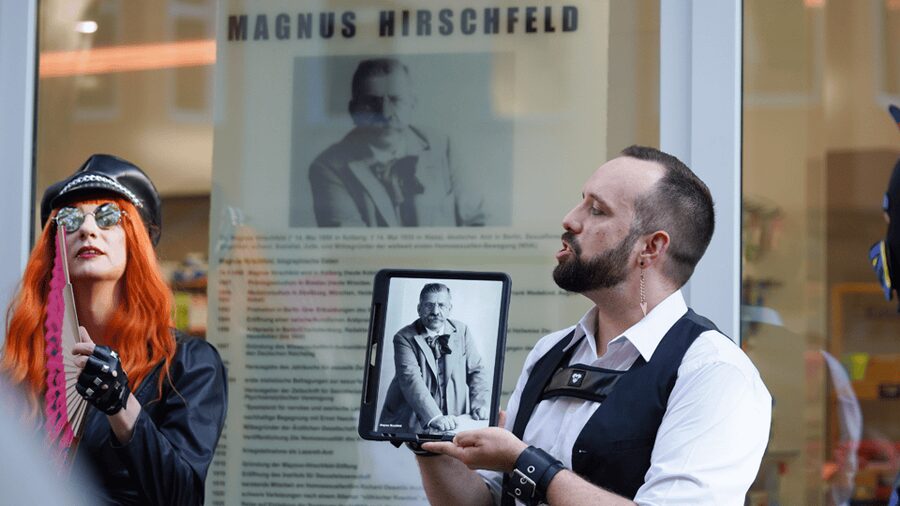
The stop at Magnus-Apotheke centers on Magnus Hirschfeld and his groundbreaking activism. You hear about the Institute for Sexual Science, along with the Scientific-Humanitarian Committee, described here as the world’s first organization dedicated to queer rights and gender studies.
The tour also explains some of Hirschfeld’s theories, including the concept of Berlin’s third gender, ideas about “sexual intermediaries,” and the world’s first gender-affirming surgeries performed on people including Dora Richter, Lili Elbe, and Karl M. Baer.
Then it gets political again, with the fight against Paragraph 175, the law that criminalized homosexuality, and the destruction of the Institute by the Nazis. This combination is powerful. You see how scientific study, activism, and legal reform collided with authoritarian violence.
If you want a single stop that makes the whole tour feel urgent and important, it is often this one. It shows both what progress looked like and how easily it can be erased.
Denns BioMarkt (former Eldorado): drag nightlife and the contradictions of the era
At Denns BioMarkt, you stand where Eldorado once operated, one of Berlin’s most famous 1920s drag bars. Eldorado is described as a hotspot for gender-nonconforming people and queer performers.
There is also an uncomfortable detail: high-profile Nazis, including Ernst Röhm, reportedly frequented the club, despite later participating in a regime that persecuted LGBTQ+ people. That contradiction is part of what the tour wants you to notice. Berlin did not always sort people into clean moral categories. It was messier than that, and the city’s nightlife reflected that.
This stop also helps you understand why drag and nightlife are not side stories. They can be community infrastructure.
Prinz Eisenherz: post-war activism and Charlotte von Mahlsdorf’s preservation work
At Prinz Eisenherz, the tour shifts to post-war LGBTQ+ activism in Berlin. You hear about Homosexuelle Aktion West-Berlin, one of the early queer rights organizations after WWII, and the founding of SchwuZ, one of Berlin’s iconic queer clubs.
Then you get a powerful East Berlin angle through Charlotte von Mahlsdorf, a trans woman who preserved Berlin’s queer history and created safe spaces for the community in East Berlin.
This is where the tour shows you a different kind of activism: not only protests, laws, and clubs, but also preservation. If you care about how communities keep their memory alive, this stop lands.
Connection: trans community in West Berlin and the Chez Romy Haag effect
The stop at Connection focuses on West Berlin’s trans community in the 1970s and 1980s. You explore the impact of Chez Romy Haag, described as a legendary trans-led nightclub that revolutionized Berlin nightlife.
The emphasis here is on gender-diverse people being able to exist freely, and how that helped set the stage for the city’s queer club culture today. If you have ever felt that modern Berlin nightlife has a “history of resistance” baked into it, this stop explains where that vibe comes from.
Internationale Stele GEGEN DAS VERGESSEN: the AIDS crisis and survival organizing
At Internationale Stele GEGEN DAS VERGESSEN, the tour addresses the AIDS crisis in Berlin and the way it affected a divided city. You hear how the queer community organized to fight for survival, and you learn about the activism of Rita Süssmuth, described as one of the few politicians advocating for AIDS awareness.
There is also a stark metaphor about the Berlin Wall being called the condom of the GDR, highlighting differences in how East and West Berlin handled the crisis. This stop is emotional by nature, but it is also practical in the way it connects crisis to organizing and advocacy.
Metropol: queer nightlife, Pride, and fighting gentrification
Your final stop is Metropol, which brings the tour back to something you can still experience. You learn about the club’s role in early gay community and the techno scene, and its connection to today’s world-famous venues including Berghain and Lab.Oratory.
The tour also covers other important nightlife and activism markers: SO36 and its legendary queer nights, Folsom Europe as Europe’s biggest fetish festival, Kreuzberg Pride, the Dyke March, and the ongoing fight for an affordable city through the radical Tuntenhaus squat.
This last stop helps you take the history with you. You are not ending with a dead end. You are ending with Berlin in motion.
Pacing and practical tips so you enjoy the walk
This is a 10-stop walking route with roughly 15 to 20 minutes at many stops, and a shorter first stop. That means you get enough time to absorb details, but it is still moving. Comfortable shoes matter.
Bring a charged phone even though you get iPad AR features. You might want to look up names afterward, or save directions to continue exploring. Also, because the tour depends on good weather, check the forecast and dress for walking, not for sitting.
If you want photos, plan on it. The AR features and Mixies photos are designed for on-the-spot use, so try not to treat this like a “listen-only” experience.
Should you book this Berlin queer and trans history tour?
I think you should book if you want more than a list of landmarks. This route connects LGBTQ+ and trans history across key moments: early activism, Nazi persecution, queer nightlife and community spaces, post-war organizing, and later trans-led club culture, then lands on modern Pride and activism.
It is also a smart choice if you like interactive learning. The AR iPad and the way historical photos match the exact place you stand is the kind of tool that actually improves understanding, not just entertainment. And with a max of 10 people, the pace stays human.
Only skip it if you strongly prefer light, upbeat tours. The content includes heavy topics, including persecution and the AIDS crisis, and the tour runs outdoors, so weather matters. If you can handle serious history, this tour is one of the best ways to get oriented in Berlin’s queer and trans story.
FAQ
How long is the tour?
The tour is about 3 hours 30 minutes.
What is the group size?
The tour has a maximum of 10 travelers.
Is the tour offered in English?
Yes, the tour is offered in English.
What is included with the tour?
It includes a guided walking tour led by a queer activist and gender scholar, augmented reality (AR) elements with an iPad, Mixies personalized AR photos, 200+ rare historical photos, videos, and archival materials, and insider tips on modern queer nightlife and events.
Where do I meet and where does it end?
You start at Alnatura Super Natur Markt, Else-Lasker-Schüler-Straße 18, 10783 Berlin, and the tour ends at Metropol, Nollendorfpl. 5, 10777 Berlin.
What happens if the weather is bad or I need to cancel?
The experience requires good weather. If it is canceled due to poor weather, you are offered a different date or a full refund. You also get free cancellation, with a full refund if you cancel up to 24 hours in advance of the start time.
Newest Berlin reviews on the site
- Your ticket to The Wall Museum Berlin★ 3.0 · 60 reviews
- Rickshaw Tours Berlin – Groups of up to 16 people with several rickshaws★ 4.0 · 97 reviews
- Love and War in Berlin: Self-Guided Story Puzzle Walk★ 5.0 · 7 reviews
- Warnemuende Shore Excursion: Berlin Private Sightseeing Tour from Rostock★ 5.0 · 4 reviews
- eSIM for Germany and 34 European Countries★ 4.5 · 16 reviews
- Karl-Marx-Allee Tour: Life and Architecture in East Berlin★ 5.0 · 19 reviews
- Warnemuende Shore Excursion: Private Berlin Tour★ 4.5 · 27 reviews
- Walking on the Wall: 3-Hour Tour in Berlin★ 4.5 · 34 reviews
Historical Tours, compared.
City History Canal Sightseeing Tour on a Motorboat
Read our review →
Browse the lists this tour appears in