
Reviewed · CITY TOURS
Rickshaw Sightseeing City Tours Berlin – Rikscha Tours
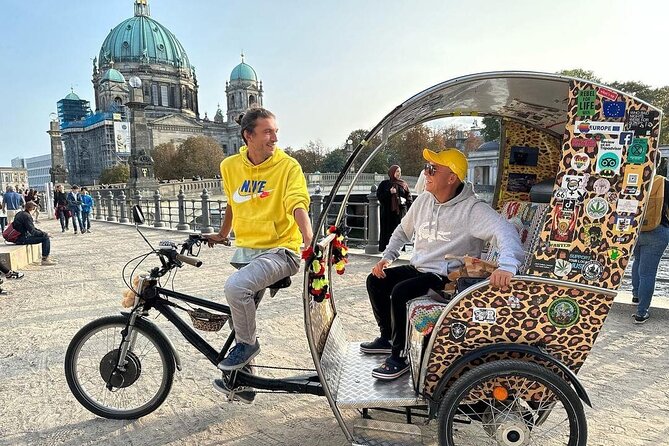
Berlin looks different when you glide. A rickshaw tour lets you pause for details and get eye level with big landmarks, without the stiff shuffle of a bus stop.
I especially loved the close-up viewing. You pass landmarks like the Brandenburg Gate, the Reichstag, and the Berlin Wall sites in a way that feels much more personal than sitting behind glass. The other standout for me was the way Leo builds the experience around you, including narration and a photographer who will take pictures with your camera, plus music on request.
One thing to think about: several stops are quick, and for some of the major sites you will not be going inside because admission tickets are not included for certain attractions. Also, read the no-show stories carefully and plan to confirm the day-of, since a few guests report serious communication problems when the tour did not start.
In This Review
- Key things I’d zero in on
- Why a rickshaw works so well for Berlin
- The price makes sense when you think “per group”
- A route that moves through eras, fast
- Brandenburg Gate, built like a finale
- Reichstag and the marks of catastrophe
- German Chancellery, government architecture with an unusual feel
- Memorials and the mid-day shift: Tiergarten to Potsdamer Platz
- Soviet War Memorial Tiergarten, with T 34 tanks
- Potsdamer Platz, where Berlin rebuilt itself
- WW2 to the Wall: the stops you’ll remember for years
- Topography of Terror, the machinery behind the crimes
- Gropius Bau, art as a counterweight
- Berlin Wall memorial area, then Checkpoint Charlie
- Gendarmenmarkt and the museum core: pretty, but not shallow
- Gendarmenmarkt and Deutscher Dom
- Konzerthaus and classicist architecture
- Bebelplatz, the book burning memorial
- Neue Wache, a memorial for war and tyranny
- Museum Island and the cathedral area
- Synagogues, old neighborhoods, and the living city
- New Synagogue and Oranienburger Strasse
- Nikolaiviertel, Alexanderplatz, and East Side Gallery
- What Leo does that makes the tour feel personal
- The main catch: time limits and a few reliability red flags
- Should you book this rickshaw tour?
- FAQ
- How long is the rickshaw city tour?
- Is there pickup, and where does it start?
- What’s included during the tour?
- Do I need to buy tickets to visit stops?
- Is the tour private?
- What weather does the tour require?
Key things I’d zero in on
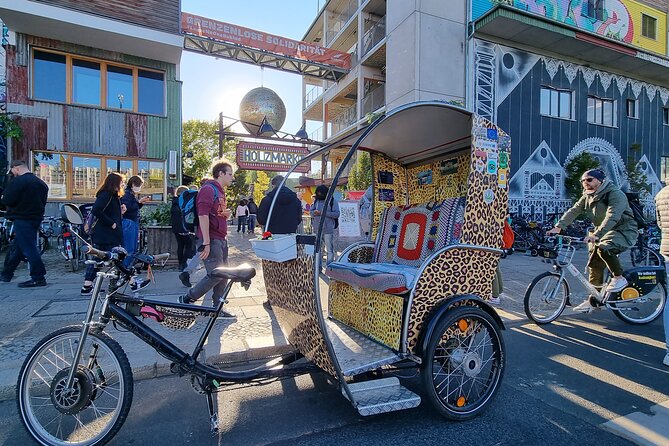
- Up-close landmark views that are hard to get from a bus
- Onboard Wi-Fi so you can check maps or look up context while you ride
- Warm blanket for chilly evenings, plus music if you ask
- Photo support included, with the guide acting as a photographer
- Private group up to 2 for a more flexible pace than a big group tour
- A route that stitches German classics, WW2 sites, and Cold War history into one ride
Why a rickshaw works so well for Berlin
Berlin is a city of big statements. Stone domes, long government buildings, and memorials that demand your attention. A rickshaw tour helps because you are not stuck at the back of a bus, and you can actually see the texture of places as you pass them.
This is the kind of tour that makes the city’s history feel less like a textbook list. You roll from classic architecture, to the machinery of the Nazi era, to Cold War border culture, and then on to modern Berlin street life. The pace matters here. When you only have a few hours, walking can turn into stop-start fatigue. The rickshaw keeps you moving while still letting you look closely.
You also get practical comfort. There is onboard Wi-Fi, which is rare on smaller city tours, and you get a warm blanket for colder weather. Add in music on request and you have a ride that feels lighter, even when the stops are heavy.
A few more Berlin walks and trips to compare
- Berlin: Reichstag, Dome and Government District Guided Tour
★ 4.7 · 18,288 reviews - Berlin: 1-Hour City Tour by Boat with Guaranteed Seating
★ 4.3 · 16,993 reviews - Berlin: TV Tower Standard Entrance Ticket
★ 4.4 · 15,883 reviews
The price makes sense when you think “per group”

The tour price is $105.72 per group up to 2, with 1 to 4 hours available. That pricing structure is important: you are not paying per person like many “hop-on hop-off” style tours. For a couple, or a pair of friends, that can make the math work fast.
So what are you really buying with that group price?
- Transport + narration focused on a tight set of landmarks
- Wi-Fi onboard
- Warm blanket
- A photographer component
- A private format, so your guide can tailor what you prioritize
Is it “cheap”? Not exactly. But it’s closer to paying for a guided experience that saves time. With rickshaws, you also tend to get viewpoints that buses do not. If you care about photos, accessibility to close viewing, and not spending half your day in transit, the value can be strong.
A route that moves through eras, fast
What makes this tour compelling is how it stitches together Berlin’s turning points without forcing you to choose one theme. You start with the grand civic architecture and move into the history that shaped the 20th century.
Brandenburg Gate, built like a finale
The ride begins at Brandenburg Gate (near the Unter den Linden boulevard). This isn’t just a photo stop. The gate is described as a major creation of German classicism, built from 1788 to 1791 based on designs by Carl Gotthard Langhans the Elder. It was tied to a royal idea of giving Unter den Linden a worthy architectural ending, and it draws inspiration from the propylaea of the Athens Acropolis.
From a rickshaw, this moment works well because you can see how the gate sits in the wider boulevard space, not just as a single isolated monument. It also sets the tone: before you hit the WW2 and Cold War stops, you understand what Berlin looks like at its most formal.
Same city, a different way to spend the afternoon:
- Berlin: Boat Tour Along the River Spree
★ 4.4 · 11,252 reviews - Discover Berlin Half-Day Walking Tour
★ 5.0 · 9,624 reviews - Berlin: Government District around the Reichstag Guided Tour
★ 4.7 · 8,447 reviews - Berlin: Reichstag, Plenary Chamber, Cupola & Government Tour
★ 4.6 · 8,422 reviews
Reichstag and the marks of catastrophe
Next is the Reichstag/Bundestag area. This stop is built around key turning points:
- On November 9, 1918, SPD politician Philipp Scheidemann called the Republic from the west portal balcony.
- The Reichstag fire on February 27, 1933, destroyed the plenary hall and the dome.
- On April 30, 1945, a red flag of the Soviet Union was raised by two Red Army soldiers as a symbol of victory over the Third Reich.
The practical part: admission is not included for any entry-focused experiences here. So treat this as an exterior-and-story stop unless you already have plans to visit on your own.
German Chancellery, government architecture with an unusual feel
At the German Chancellery, the highlight is the building’s transparency and lightness. The description focuses on how the 36-meter high structure rises between admin wings, with large glass surfaces cut into the concrete. The idea is that it looks open rather than heavy, and the side wings are arranged around glazed atriums.
For your day, this matters because it gives a modern counterpoint. You are not only seeing memorials and ruins. You are also watching how Berlin’s political identity is expressed in design.
Memorials and the mid-day shift: Tiergarten to Potsdamer Platz
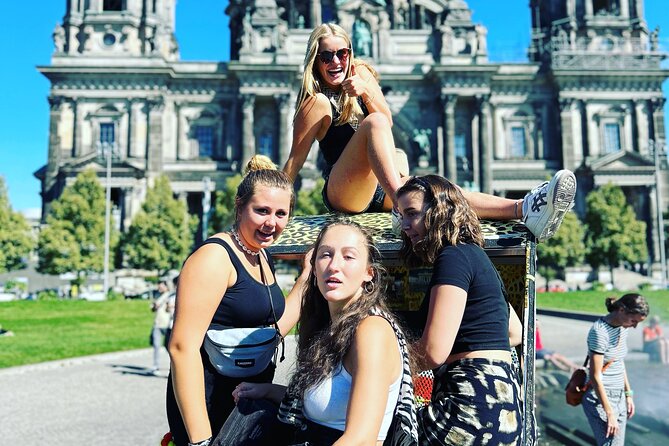
After the government buildings, the tour shifts into spaces designed for memory and reflection.
Soviet War Memorial Tiergarten, with T 34 tanks
The Soviet War Memorial in Tiergarten is flanked by two T 34 tanks. In the middle, there is a bronze statue of a Red Army soldier carrying his rifle. Behind is a set of names for fallen Soviet soldiers, and the rear part includes graves of around 2,500 soldiers.
This stop tends to hit harder when you slow down and actually read. In a rickshaw, you can do that because your guide can stop and reset your view without turning it into a sprint.
Potsdamer Platz, where Berlin rebuilt itself
Then comes Potsdamer Platz, described as an entire district planned by architects, with cafés, cinemas, shops, and high-rise buildings. The point of this stop is that Berlin is not just past conflict. It also tells a story of redevelopment in a relatively concentrated space.
If you only have one ride through central Berlin, this is a smart transition stop. You go from memorial mood into streets full of daily life, so your brain gets a breather.
WW2 to the Wall: the stops you’ll remember for years
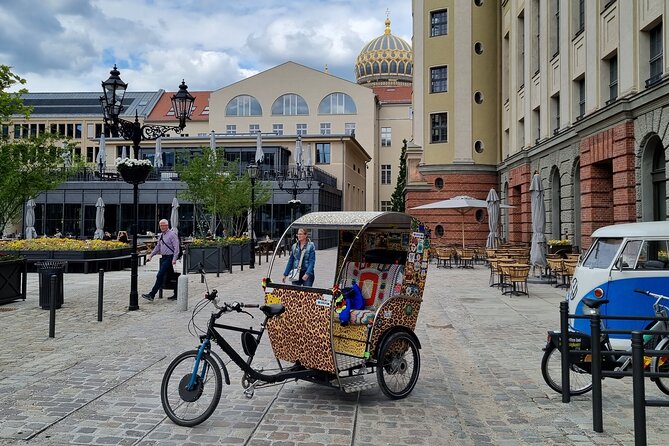
This is the heavy-history segment, and it is one reason the tour is popular for a short visit.
Topography of Terror, the machinery behind the crimes
The Topography of Terror area is central to Nazi crime planning and control. It was known by that name in 1987 and, from 1933 to 1945, held key institutions of the SS and police, including the Secret State Police Office, the Reichsführung SS, and the Reich Security Main Office.
Even if you do not go inside, the location is a reminder that this was not abstract evil. It was paperwork, organization, and operational control in a physical place.
Gropius Bau, art as a counterweight
Next up is Gropius Bau (Martin-Gropius-Bau), which is dedicated to cultural history, contemporary art, and photography. This stop can feel like a palate cleanser after the darker sites.
If you are an art and photo person, you might enjoy how the tour doesn’t treat history like a single mood. It moves from state violence to the world of cultural memory and representation.
Berlin Wall memorial area, then Checkpoint Charlie
From there, you reach a Memorial of the Berlin Wall area and then Checkpoint Charlie, the famous border crossing for the Americans next to Glienicke Bridge during Berlin’s division. The other border points are noted as Checkpoint Alpha (Helmstedt-Marienborn) and Checkpoint Bravo (Dreilinden-Drewitz). The crossing rules were strict, with access for foreigners, certain employees, and GDR officials.
This segment is valuable because Berlin Wall stories are easy to turn into generic “Cold War vibes.” Here, you get the operational details of the crossings, not just the imagery. And since the rickshaw can keep you close to the street-level context, you will get a more grounded sense of where history happened.
Gendarmenmarkt and the museum core: pretty, but not shallow
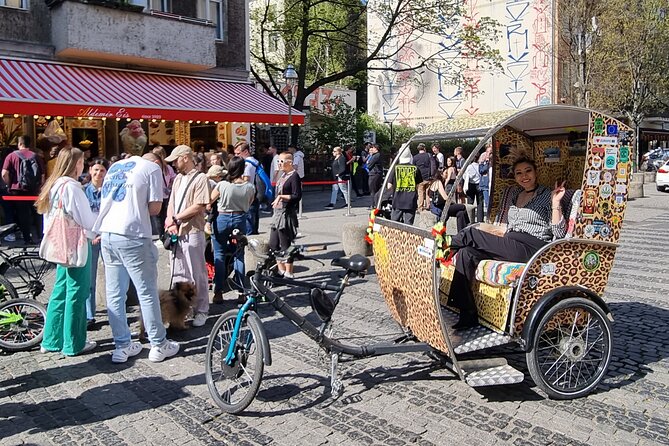
After the Wall era sites, the route becomes more architectural and strolling-friendly. This part helps you see Berlin’s elegance without losing the historical threads.
Gendarmenmarkt and Deutscher Dom
The tour moves to Gendarmenmarkt, created at the end of the 17th century based on plans by Johann Arnold Nering. It was shaped by French immigrants, mainly French Protestants (Huguenots). The square changed names multiple times and was renamed Gendarmenmarkt in 1799, connected to the guard and stables of the Gens d’armes ward regiment.
Then there is the Deutscher Dom, home to the permanent exhibition Ways – wrong trails – detours, which covers the historical development of liberal parliamentary democracy in Germany across five floors.
Again, admission is not included here. But even from outside, the square layout gives you a sense of how Berlin’s civic identity is built around institutions and public space.
Konzerthaus and classicist architecture
Next is the Konzerthaus am Gendarmenmarkt, described as a masterpiece of classicist architecture and one of Karl Friedrich Schinkel’s main works. There was a comedy house opened in 1776 at the instigation of Frederick the Great, later becoming the Royal National Theater in 1787.
This is a “slow down and look” stop. From a rickshaw, you can get a clear view of the building’s presence in the square.
Bebelplatz, the book burning memorial
At Bebelplatz, the story turns dark again. The Nazis burned books here on May 10, 1933, and the memorial marks the desecration. The information includes over 20,000 books, with authors named such as Erich Kästner, the Mann family, Magnus Hirschfeld, Lion Feuchtwanger, Karl Marx, Else Lasker-Schüler, and Heinrich Heine, plus others.
This stop is one I’d recommend taking seriously. It’s short in time, but it’s packed with meaning. If you have any interest in how societies control ideas, this is worth the mental pause.
Neue Wache, a memorial for war and tyranny
Near the Zeughaus is Neue Wache, built between 1816 and 1818, designed by Karl Friedrich Schinkel. Since 1993, it has been a central memorial of the Federal Republic of Germany for victims of war and tyranny.
This is another stop where the exact exterior view matters less than the weight of the setting.
Museum Island and the cathedral area
The tour heads into Museum Island, described as one of the most outstanding museum complexes in Europe and a UNESCO World Heritage Site. Then you pass the Berlin Cathedral, described as a must for church lovers.
Nearby, you also see the Lustgarten, once part of the Berlin City Palace, now a popular square. Together with Museum Island and the cathedral, it’s a cluster where Berlin’s public life and cultural identity feel braided.
Synagogues, old neighborhoods, and the living city
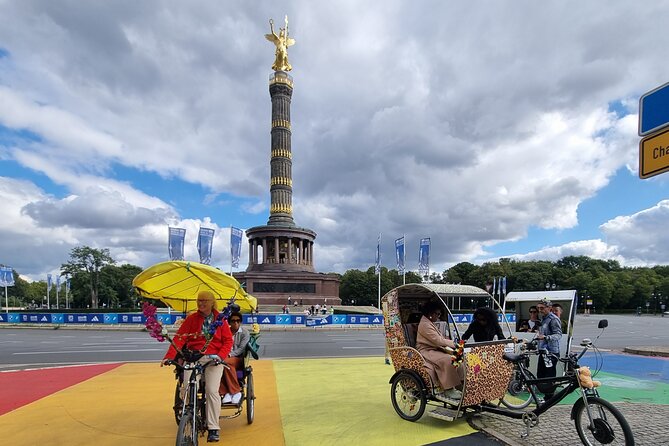
The last stretch moves from institutional Berlin into human-scale neighborhoods and street energy.
New Synagogue and Oranienburger Strasse
The tour includes the New Synagogue on Oranienburger Strasse, described as once the largest and most important synagogue in Germany. That makes this stop meaningful, not just architectural.
Admission is not included for this segment, so think of it as an exterior moment within your guided storyline.
Nikolaiviertel, Alexanderplatz, and East Side Gallery
You then pass Nikolaiviertel, Berlin’s first and oldest residential area, with Nikolaikirche and old-town flair including historic houses, restaurants, and coffee shops. After that comes Alexanderplatz, known as one of the liveliest places in Berlin, and then the East Side Gallery, a remnant of the Berlin Wall where artists created the longest open-air gallery in the world.
For this late-stage part of the ride, the rickshaw format really shines. You are moving from history to everyday life without getting worn out, and you end with a landmark that feels visually fun even though it carries heavy context.
What Leo does that makes the tour feel personal
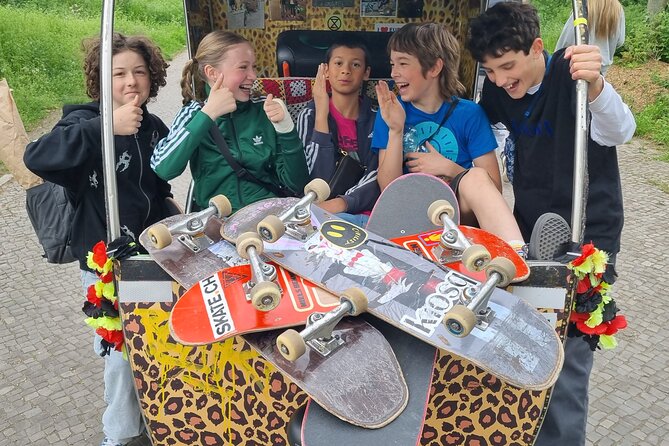
A lot of tours promise narration. This one has an advantage: the guide, Leo, comes through in ways that affect your day.
In the best experiences, he is:
- Interactive, not just reading facts
- Funny, with a tone that keeps the mood from getting too heavy
- Practical about getting closer, maneuvering along narrower pathways when needed
- A personal photographer, taking pictures of you with your camera
- Able to tailor what you see, including adding a particular place if you tell him you have a priority
If you want the ride to feel like it’s about you, this is where you should speak up early. A good tactic is to name one or two must-sees and one photo you want, then ask if the route can support that.
Also, you can use Wi-Fi onboard to quickly check hours or look up context if a stop sparks a question.
The main catch: time limits and a few reliability red flags
Two considerations to keep it real.
First, many stops are positioned as quick looks. Some are timed at only a few minutes, and admission is not included for several major attractions. So you should expect exterior viewing plus stories, not full museum-style visits.
Second, the review record includes multiple no-show complaints. That does not mean every tour fails, but it does mean you should treat confirmation seriously. If you are flying in for this, I would not plan your entire afternoon around the assumption it will definitely start on time. If something feels off, contact the provider promptly.
Should you book this rickshaw tour?
If you want Berlin in a short window, with close-up landmarks, comfort for chilly weather, and real photo help, this tour is a strong choice. It’s especially good for couples and small groups, because the price is per group up to two and the ride stays personal.
I would book it if:
- You want to cover WW2, Cold War, and iconic sights without spending your whole day walking
- Photos matter and you want a guide to help you get them
- You like a friendly, interactive guide like Leo, and you can communicate your must-sees
I would hesitate if:
- You cannot deal with a possible start problem, like limited backup time
- You expect to enter every major site during the ride, since admission is often not included
If you do book, come with a short list of priorities. That turns a good tour into your tour.
FAQ
How long is the rickshaw city tour?
The duration is listed as approximately 1 to 4 hours, depending on the option you choose and how your guide structures the route.
Is there pickup, and where does it start?
Pickup is offered within a 2 km radius from Brandenburgertor. If you are more than 2 km away, an extra fee is listed as €10 per km.
What’s included during the tour?
Included features are a warm blanket, music on request, a photographer, and Wi-Fi on board.
Do I need to buy tickets to visit stops?
Admission ticket details vary by stop. Some stops note admission ticket not included, while others are listed as free. Plan on paying for entry yourself if you want to go inside any paid attractions.
Is the tour private?
Yes. It is a private tour/activity, meaning only your group participates.
What weather does the tour require?
The experience requires good weather. If it is canceled due to poor weather, you will be offered a different date or a full refund.
Newest Berlin reviews on the site
- Your ticket to The Wall Museum Berlin★ 3.0 · 60 reviews
- Rickshaw Tours Berlin – Groups of up to 16 people with several rickshaws★ 4.0 · 97 reviews
- Love and War in Berlin: Self-Guided Story Puzzle Walk★ 5.0 · 7 reviews
- Warnemuende Shore Excursion: Berlin Private Sightseeing Tour from Rostock★ 5.0 · 4 reviews
- eSIM for Germany and 34 European Countries★ 4.5 · 16 reviews
- Walking on the Wall: 3-Hour Tour in Berlin★ 4.5 · 34 reviews
- Karl-Marx-Allee Tour: Life and Architecture in East Berlin★ 5.0 · 19 reviews
- Warnemuende Shore Excursion: Private Berlin Tour★ 4.5 · 27 reviews
City Tours, compared.
1-Hour City Tour by Boat with Guaranteed Seating
Read our review →
City History Canal Sightseeing Tour on a Motorboat
Read our review →
Browse the lists this tour appears in