
Reviewed · HISTORICAL TOURS
Private Taxi Tour City East & West History and Architecture 3-4h
Berlin in a single, warm taxi loop. This private East and West tour strings together landmarks, from Prussian-era stonework to Cold War grit, with lots of short stops where you can actually see what you are hearing. I especially like how the private taxi keeps you comfortable and moving, and how Gunter Bauer ties the buildings to real stories you can remember. The main drawback is time: many sights are quick looks, not long museum sessions.
What makes this tour work is that it is driver-led and people-focused. In past bookings, Gunter has handled changes smoothly, sent photos afterward, and adjusted the pace so older guests and kids could enjoy it without feeling steamrolled. You will likely get more out of the day if you are the type who likes asking questions and trading quick opinions with a very funny, very prepared guide.
In This Review
- Key things to know before you go
- Why a private taxi tour fits Berlin (and not just on paper)
- Price and value for a 3 to 4 hour, two-sided Berlin day
- West Berlin first: Kaiser Wilhelm Memorial Church and the Ku’damm show
- Berlin Zoo stops: animal gates, historic buildings, and scale
- KaDeWe and the fast taste of luxury you can afford
- Theater des Westens: why West Berlin had room for grandeur
- Sound, shopping, and Cold War modernism: the Memorial Church to ICC arc
- Parliament and government buildings: glass views, committee reality
- East Berlin on wheels: Hackesche Höfe, Friedrichstraße, and quick history
- Brandenburg Gate and the book-burning square feeling
- Gendarmenmarkt, memorial sculpture, and the Unter den Linden classic walk
- Humboldt Forum: the grand rebuild and what you can actually do
- East-side “old Berlin” reconstruction: Nikolaiviertel and the Spree lock story
- Alexanderplatz and the Red City Hall: socialist planning at full scale
- Stauffenberg, embassies, and Topography of Terror in one fast sweep
- Checkpoint Charlie, DomAquarée, and the photo stops that make sense
- Tips to get the most from Gunter Bauer’s approach
- Should you book this private taxi tour?
- FAQ
- What is the duration of the private taxi tour?
- How much does the tour cost?
- Is pickup included?
- Is the tour private?
- What language is the tour offered in?
- Are any entry tickets included?
- What is included in the price?
- Can I cancel and get a full refund?
- Is a child seat available?
Key things to know before you go
- Private, door-to-door pickup inside the S-Bahn ring, plus an air-conditioned taxi and WiFi on board
- Gunter Bauer is the driver-guide, and the tour is responsive to what you want to see
- A fast highlights sweep, with multiple photo stops plus a few short entry moments like KaDeWe and the Humboldt Forum
- East and West Berlin in one ride, so you stop feeling like you are doing two separate trips
- Plenty of architecture and city-planning context, not just dates and names
- Photo-friendly stops at major landmarks, with scaffolding and quiet interiors explained clearly
Why a private taxi tour fits Berlin (and not just on paper)
Berlin is big, spread out, and constantly changing. A taxi tour helps because you stop wasting time crossing the city. In this experience, the vehicle includes pickup within the S-Bahn ring, air-conditioning, WiFi, and parking fees, so you can focus on the sights and the conversation instead of logistics.
The private part matters. With your own group, you can slow down when a building catches your eye, or move on quickly when you want more time at another stop. Gunter’s style from the get-go is practical, and he tends to connect what you see to how Berliners think about it, whether that is pride, criticism, or plain stubborn humor.
The other advantage is comfort in ugly weather. Reviews mention it works well when it is cold, because you spend much of the time inside the taxi while still getting frequent stop-and-see breaks. If your Berlin plan is short, this is a smart way to build a mental map fast.
More History Tours in Berlin
- Berlin: Natural History Museum Entrance Ticket
★ 4.6 · 3,382 reviews - Berlin: 3-Hour World Heritage Cruise to Potsdam
★ 4.5 · 1,569 reviews - Berlin: History of the Third Reich Guided Walking Tour
★ 4.7 · 791 reviews
Price and value for a 3 to 4 hour, two-sided Berlin day

This tour costs $150.18 per person for about 3 to 4 hours. That price includes the taxi ride according to the tariff and the city tour, with both parts of VAT included. In plain terms, you are paying for a packaged guide plus the car time, not piecing it together yourself while trying to coordinate routes and parking.
You also get mobile ticketing and WiFi on board, which sounds small until you are actually in Berlin trying to keep directions, notes, and map views straight. For first-time visitors, the real value is not any single building. It is the way the day connects architecture, politics, and urban planning into a storyline you can carry into your next self-guided walk.
The cost can feel high if you only want one or two major stops. But if you want a broad overview of East and West Berlin highlights, and you like learning while you move, it starts looking like good use of limited time.
West Berlin first: Kaiser Wilhelm Memorial Church and the Ku’damm show
The day’s West Berlin tone is set by the Kaiser Wilhelm Memorial Church area. You see the famous church tower and preserved western portal as a reminder of how Berlin chose to keep scars visible. What I like here is the nuance: many people assume the memorial theme is about war memory, but the story you hear connects the church to Wilhelm I and how the Hohenzollerns and their memorial plan shaped what you see.
The “other side” stop later helps too. The modern church hall built around the preserved tower uses a design concept Berliners have nicknamed like makeup accessories. Then you get a bonus: inside, it is surprisingly quiet. The explanation focuses on construction choices, including a soundproof air layer that softens the surrounding traffic.
Next comes the boulevard energy of Kurfürstendamm, known locally as Ku’damm. This stretch was modeled on Paris’s grand avenues, and you get reminded of that influence through details like the candelabra styling. Today it is more shopping mile than elegant villa boulevard, with modern flagship stores mixed into the old glamour. At night it can feel quieter and emptier than the daytime buzz you might expect, which is useful to know if you plan to shop or people-watch late.
Berlin Zoo stops: animal gates, historic buildings, and scale
Berlin Zoo is not just a popular outing, it is a piece of city identity. You are told it is one of Germany’s oldest zoos, with around 16,000 animals across about 1,600 species. The historical driver behind it is King Friedrich Wilhelm IV, who shifted animals from earlier royal grounds near Pfaueninsel and used part of his private hunting area to build what became a public-facing zoo.
What makes the stop more than a quick postcard is the architectural approach. The buildings were designed in styles linked to the animals’ origins, so the zoo reads like an outdoor map of global influences. Even after war damage, parts of that look survive, so you are not just looking at cages. You are looking at design decisions.
You also get hints that Berlin’s zoo story is larger than one gate. The experience points out that Berlin now treats the zoo near Friedrichsfelde Palace as part of the same bigger animal ecosystem. For a first-timer, this is a good orientation, because it prevents you from thinking Berlin has only one “zoo option.”
A few more Berlin walks and trips to compare
- Berlin Historical Highlights Walking Tour
★ 4.9 · 657 reviews - Berlin: 1h Boutiquestyle-Cruise on the Historic HEMINGWAY
★ 4.6 · 563 reviews - Berlin Private Complete History All Day Walking Tour
★ 5.0 · 474 reviews - Berlin: Cold War Era History Guided Bike Tour
★ 4.8 · 413 reviews
KaDeWe and the fast taste of luxury you can afford
One of the most practical stops is Kaufhaus des Westens (KaDeWe). The building is huge, cited as about 60,000 m², described as the largest single department store on continental Europe. The value here is simple: you get the wow factor of West Berlin retail culture without committing to hours of shopping.
The KaDeWe stop is also listed as having free admission time to enter. That matters because so many department stores have strict viewing limits or require you to spend to justify entry. Here, you can walk in, look around, and pick up the vibe, including the famous gourmet floor talk. The commentary about champagne, oysters, and an enormous range of chocolate and bread is basically your cue for what kind of shopping ritual KaDeWe symbolizes in the city.
If you do not care about shopping, you can still use this stop as a culture lesson. West Berlin luxury did not just happen because people had money. It was a deliberate counterpoint to how the city felt elsewhere.
Theater des Westens: why West Berlin had room for grandeur
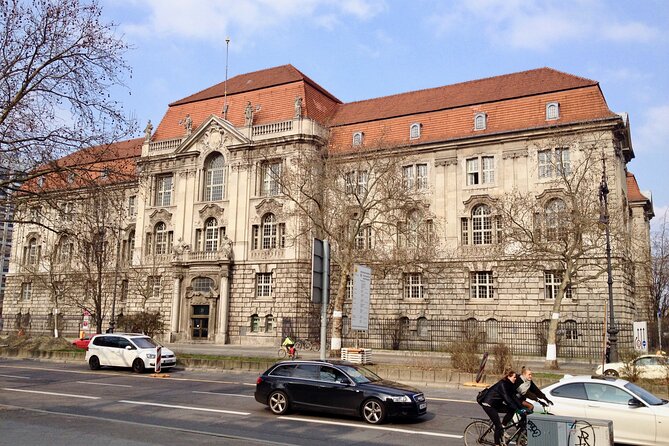
The exterior stop at Theater des Westens gives you a quick feel for how West Berlin expanded outward from the crowded center. Early 20th-century planning pushed major attractions into the greener West, where there was space for villas and bigger buildings. You get the idea that this theater, now used as a musical theater, was built to match that taste for visible spectacle.
The story also includes an imperial box inside, which is the sort of detail that helps the building click. It stops being just a pretty facade and becomes part of a political and social world that wanted to show status.
You can see this kind of building best when you are not trying to “tour” it like a museum. Instead, treat it as a landmark for what Berlin wanted its West image to feel like.
Sound, shopping, and Cold War modernism: the Memorial Church to ICC arc
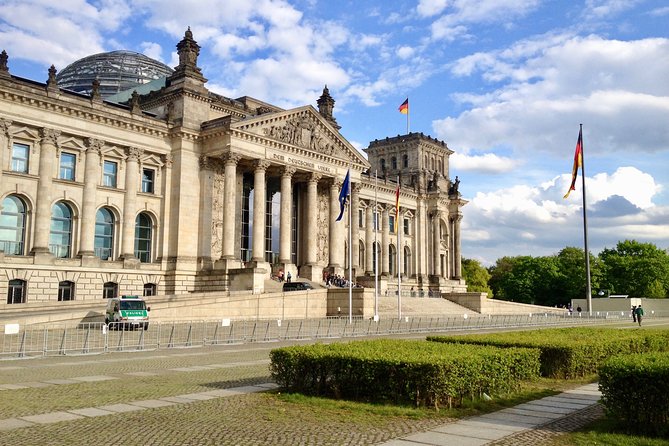
One of the most interesting parts of the day is how the stops keep linking design with politics and everyday experience.
After you revisit the Memorial Church from another angle, you hear why the new hall is not only pretty. Thousands of glass stones made in France create an interior glow, while a construction trick helps keep noise down even at one of the city’s busiest places. You also get a real-world downside: the concrete structure is described as fragile and often needs scaffolding, along with the reason being exposure to traffic emissions.
The tour then moves toward modern Berlin’s big civic forms, including a stop near the ICC area. The “Pregnant Oyster” nickname comes up for the curved-roof congress hall, and you learn why it is both celebrated and criticized. It also had a roof collapse in 1980 and was rebuilt, later becoming the House of World Cultures. If you have only read one or two things about Berlin architecture, this is the kind of stop that gives you a fuller picture of how bold designs were treated.
That pattern continues: memorial, modern structure, war impacts, then rebuilding. Berlin’s architecture rarely sits still.
Parliament and government buildings: glass views, committee reality
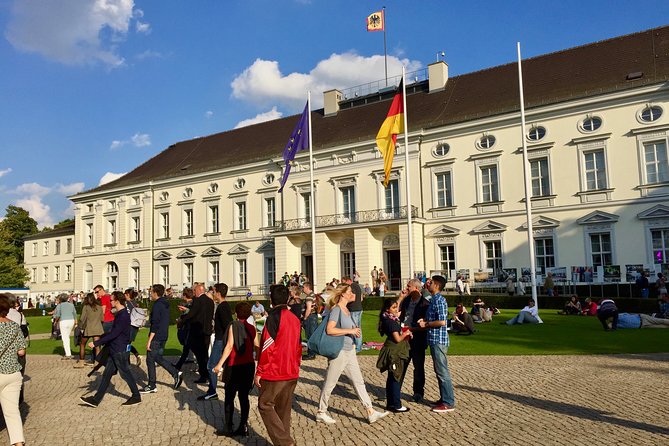
As you move from civic squares into the government zone, the tour makes a point that is easy to miss when you read guidebooks. In Berlin, a lot of the real work happens in committee spaces, not in the big public rooms. The stop describing the parliament “engine” explains that only certain speeches happen in the main chamber, while voting and discussion are handled in committees.
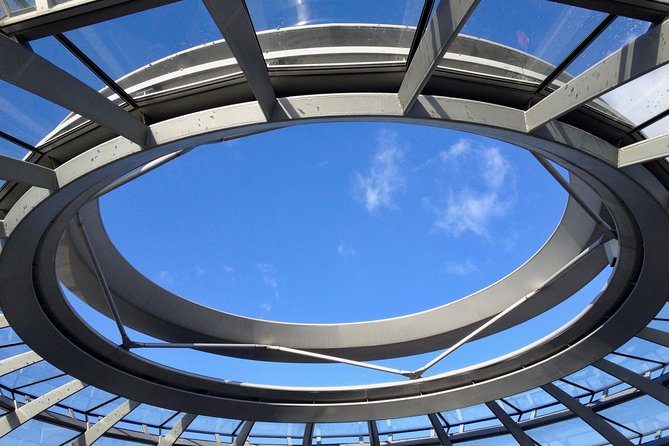
Then there is the visual payoff: Berlin’s parliament is designed to be seen as a glass parliament from the outside. You also get the reminder that some committee work is not public-facing, including the mention of EU and secret committee areas.
Next comes the chancellor’s office area and nearby official government structures, described with size comparisons and a clear layout. You hear that the chancellor’s official apartment exists inside the building footprint but is not used, and that journalists work from a blue backdrop area visible from a distinctive facade window. Again, the value is not just “look at big building.” It is understanding how political power is staged in space.
East Berlin on wheels: Hackesche Höfe, Friedrichstraße, and quick history
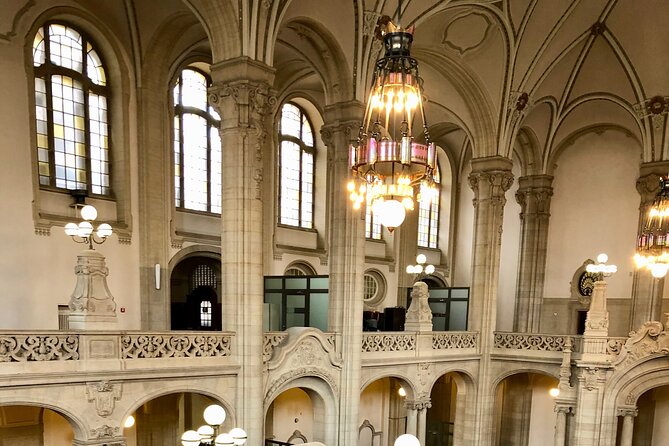
Moving east, you hit Die Hackeschen Höfe, a courtyard ensemble restored after the Wall. The tour frames it as an early showcase area from 1908, designed for a blend of work and life with workshops and green atria. Even if the workshops are gone and replaced by shops, the Art Nouveau courtyard feel remains the star.
Then comes the vibe shift on Friedrichstraße. You are reminded this is one of Berlin’s most famous long streets, once famous for its different sections. The commentary also points out how areas around it have changed, with the Tacheles area mentioned as an example of a site that moved through different uses as department-store style came and went.
The experience also includes a key Cold War transport point at Friedrichstraße station, described as the only crossing where passengers could go East to West during Wall years, and associated with escape attempts and customs checkpoints. If you like history with a sense of logistics, this is a standout, because Berlin’s division was enforced through systems you could physically see.
Brandenburg Gate and the book-burning square feeling
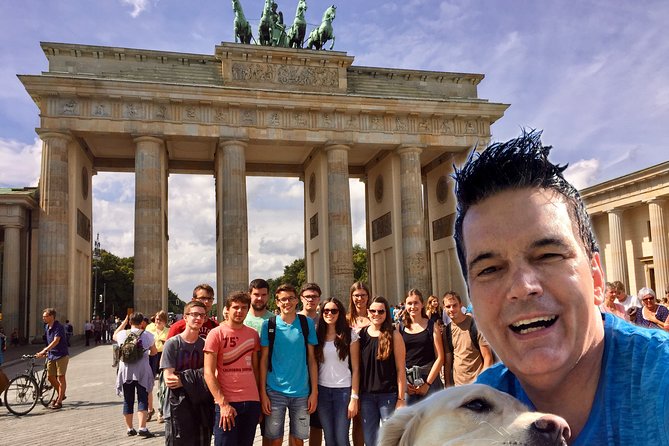
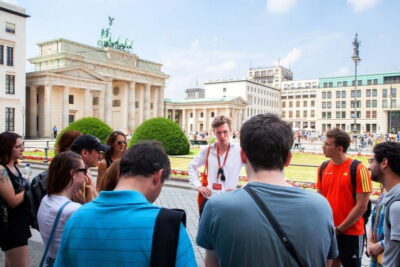
The tour’s “parlor” moment is Brandenburg Gate, reached via Pariser Platz. You get the reminder that much around it was destroyed and later rebuilt in modernized form. The focus is on how the Gate became a kind of isolated icon, similar in feel to Paris’s Arc de Triomphe, because walls and barriers shaped how people could approach it.
From there, the story expands to the Soviet-era foreign representation building on Pariser Platz, built to signal who was in charge when other Western embassies sat in ruins. It is framed as a palace-like design with an inner courtyard, even including the speculation that Stalin might never have visited.
A very human-feeling stop follows at the Forum Fridericianum area, with Humboldt University opposite. You hear about the naming ties to August Bebel and the SPD-KPD forced unification context, then the square event connected to May 10, 1933, when books deemed unsuitable by the Nazis were burned. The tiny glass window in the floor pointing to an empty library area turns an abstract atrocity into a place you can stand in.
Gendarmenmarkt, memorial sculpture, and the Unter den Linden classic walk
Gendarmenmarkt is treated like Berlin’s most beautiful square by many, and the explanation is practical. You learn the German and French “cathedrals” are actually meetinghouses with cathedral-like towers, created under Frederick the Great’s influence. One side houses a museum for German parliamentary history, while the other stays in active use for a Reformed congregation, with services in French and a small Huguenot museum behind it.
Near by, the story pivots to memory and grief at the Neue Wache area. The experience discusses the sculpture by Käthe Kollwitz and the way this site has become a place for victims of war and tyranny, with wreaths placed after remembrance days.
Then comes a classic Berlin walk vibe: Unter den Linden. You hear it started as a bridle path that became a boulevard, and the linden tree planting decision is a quirky detail that helps you remember it. Along the avenue, major institutions are named in sequence, and you get the idea that the street’s identity changed over centuries.
Humboldt Forum: the grand rebuild and what you can actually do
A major stop here is the Humboldt Forum, described as a reconstruction of the old Berlin Palace area that had been empty for decades. The earlier state was a parking lot and temporary uses, then the palace itself burned during the war but never went away as a silhouette, and later became politically contested.
The tour frames the demolition decision in East Berlin as politically motivated, then emphasizes reconstruction accuracy, including the Schlüter inner courtyard reconstruction and the plan to combine the Humboldt University collections with non-European art collections. The listed timing says admission is included, with an expected stop time around 30 minutes.
This is a good stop if you want to understand why Berlin argues with itself. The building’s existence is not neutral. It is a visible debate about what the city should preserve and how.
East-side “old Berlin” reconstruction: Nikolaiviertel and the Spree lock story
If you want a change of pace from big civic buildings, the tour includes Nikolaiviertel with Nikolaikirche and Knoblauchhaus. This area is described as a reconstruction from the 1980s when only a handful of original houses remained, and the look was intentionally restored. That means you should go in with the right expectation: it is history-as-a-city-set, but still a meaningful one.
The Nikolaikirche is described as the oldest church in Berlin and is now a city museum. Knoblauchhaus is also highlighted as a preserved original with a Biedermeier style interior and information on family life for a cloth maker household, with this stop also listed as free admission time.
You then get the older origin story of Berlin at the Spree lock and Cölln area. The tour connects settlement origins to a ford where people could cross the river and to later canal and mill systems. It makes the point that Berlin’s “old core” was shaped by water control long before cars showed up.
Alexanderplatz and the Red City Hall: socialist planning at full scale
On the East side, Alexanderplatz gets a context reset. The tour notes the square’s earlier name and role beyond just the famous GDR era look. It also describes the GDR redesign concept, with wide space intended for marching and modern socialist architecture around it, including a roster of major buildings and the television tower as proof of socialist engineering.
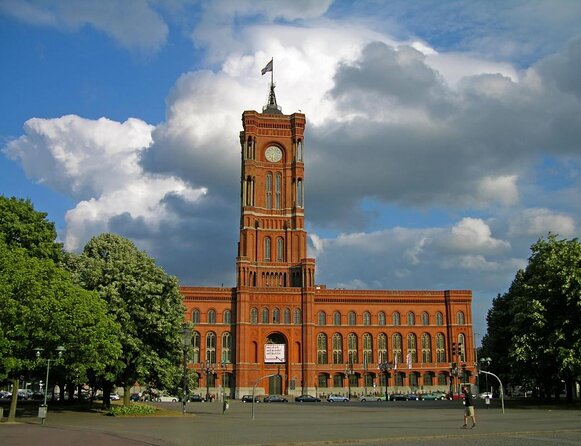
Then the tour points you toward the Red City Hall. It is described as neo-Gothic and visitable for free, with interesting rooms. The commentary also links it to how East Berlin governance sat there, while West Berlin ruled from Schöneberg Town Hall, helping you feel how divided administration was mapped onto real buildings.
If you only associate Alexanderplatz with modern crowds, this stop helps you remember it was also a stage built for political theater.
Stauffenberg, embassies, and Topography of Terror in one fast sweep
Near the end of the day, the tour compresses some heavy twentieth-century history into short, clear stops.
At Topography of Terror, the experience frames it as a layered site showing imperial and Nazi-era building traces, plus uncovering of torture cells in the 1980s and an ongoing documentation center. The time listed is short, about 15 minutes, but it functions as a reset button for understanding what the last century did in Berlin.
You also get related context around the Stauffenberg assassination attempt area, where the building story includes where Claus Schenk Graf von Stauffenberg was shot after the July 20 plot failed, with nearby details about the later ministry use. Even when you only stand for a moment, the guide’s linking of place and event helps it stick.
The tour also mentions an embassy-lined area, where you can see how many foreign missions sit along major corridors, including references to Nordic embassies and the presence of a high-security InterContinental-style building. It is less about checking off countries and more about understanding how modern diplomacy lives in older power spaces.
Checkpoint Charlie, DomAquarée, and the photo stops that make sense
The experience includes Checkpoint Charlie, but with an honest explanation that the most famous structures people photograph are replicas. The story clarifies what the replica checkpoint is meant to represent and how the real museum context explains it better, including references to the October 1961 tank confrontation as a key moment.
This is useful guidance. It keeps you from thinking you saw the one-and-only real hut. Instead, you know the photo is a prompt, not a time machine.
A final light note appears with a stop by DomAquarée, including the idea that you walk under aquatic animals and end up in a South Sea section, plus the hotel lift connection in the lobby. It is a change of mood that helps the day land on something Berlin-goofily practical, not only heavy memorials.
Tips to get the most from Gunter Bauer’s approach
The strongest theme in the reviews is that Gunter handles the day like a real conversation, not a scripted lecture. He has been described as extremely informative and also personable and chatty, which matters because Berlin history can get heavy if the guide never lets you breathe.
A few practical tips based on what the experience is set up to do:
- Email or message ahead with what matters to you most. Gunter has a track record of using your interests to shape the day.
- Bring a bottle of water, since you will do frequent short stops in a city that can surprise you with walking even when you are mainly in the taxi.
- Ask for the meaning behind the details. For example, on the Memorial Church stops, you will get more than the view if you ask what Berlin chose to preserve and why.
- Wear shoes you can handle for short curb-to-entry moments. This tour mixes taxi time with quick walks, like at KaDeWe areas, courtyards, and square stops.
One more small note from review experiences: Gunter has been willing to help with practical issues during the day, like train ticket troubleshooting. That is not what you should count on, but it tells you the service style.
Should you book this private taxi tour?
Book it if you want a first-pass map of Berlin that covers East and West without spending half your vacation trapped in transit. This is especially strong for you if your schedule is tight, weather is uncertain, or you want comfort without giving up the chance to get close to major architecture.
Do not book it if you want museum-dense days. This tour is a highlights and storytelling day. Even when there are free-entry stops, you will still likely need follow-up time for anything you really want to study.
If you like learning through place, not just through facts, this one works. A private taxi plus a guide who can connect design choices, political eras, and everyday sounds gives you a Berlin you can remember, not just a Berlin you pass through.
FAQ
What is the duration of the private taxi tour?
The tour lasts about 3 to 4 hours.
How much does the tour cost?
The price is $150.18 per person.
Is pickup included?
Yes, pickup within the S-Bahn ring is included. Pickup outside the ring or from BER airport is available for an extra charge.
Is the tour private?
Yes. It is a private tour/activity, and only your group participates.
What language is the tour offered in?
The tour is offered in English.
Are any entry tickets included?
Yes. Admission is included for the Humboldt Forum stop. Other stops are noted as admission free, such as KaDeWe, Brandenburg Gate, Gendarmenmarkt, Topography of Terror, Checkpoint Charlie, Die Hackeschen Hoefe, Nikolaiviertel, and the Red City Hall.
What is included in the price?
Private transportation is included, along with WiFi on board, air-conditioned vehicle, parking fees, pickup within the S-Bahn ring, and both the taxi ride and city tour including VAT.
Can I cancel and get a full refund?
Yes, you can cancel for a full refund up to 24 hours in advance.
Is a child seat available?
Yes. A child seat for toddlers from six months to three years is available, and a booster seat for older children is also available. A baby seat can be brought on request.
Newest Berlin reviews on the site
- Your ticket to The Wall Museum Berlin★ 3.0 · 60 reviews
- Rickshaw Tours Berlin – Groups of up to 16 people with several rickshaws★ 4.0 · 97 reviews
- Love and War in Berlin: Self-Guided Story Puzzle Walk★ 5.0 · 7 reviews
- Warnemuende Shore Excursion: Berlin Private Sightseeing Tour from Rostock★ 5.0 · 4 reviews
- eSIM for Germany and 34 European Countries★ 4.5 · 16 reviews
- Walking on the Wall: 3-Hour Tour in Berlin★ 4.5 · 34 reviews
- Karl-Marx-Allee Tour: Life and Architecture in East Berlin★ 5.0 · 19 reviews
- Warnemuende Shore Excursion: Private Berlin Tour★ 4.5 · 27 reviews
Historical Tours, compared.
City History Canal Sightseeing Tour on a Motorboat
Read our review →
Browse the lists this tour appears in