Reviewed · BERLIN TOURS
Path of Resistance: Berlin’s Hidden Holocaust Stories
A short walk, and Berlin’s hardest truths have a human face. This small-group tour connects major wartime landmarks with lesser-told stories of people who resisted Nazi rule, from synagogue walls to street protests. I like that it uses then-and-now photos and maps to make the past readable, and I also like how the guide-led pace keeps the story moving without feeling like a lecture. One thing to plan for, it is a lot of standing and walking on foot.
You’ll see a tight route across central Berlin, finishing at S+U Friedrichstraße where you can hop to the next stop easily. The guide quality seems to be the big strength, with standouts like Johan, Jochen, Scott, Jorg, and Benjamin showing up in guides’ names on this tour.
In This Review
- Key Things You’ll Notice on This Berlin Resistance Walk
- Why This Tour Centers Resistance, Not Just Tragedy
- Start at Oranienburger Straße: Neue Synagoge and Centrum Judaicum
- Jüdisches Gymnasium Moses Mendelssohn: When Education Turns into a Transit Trap
- The Jewish Cemetery and Holocaust Memorial: Destruction, Then Burials Again
- Museum Blindenwerkstatt Otto Weidt: Small Courtyard, Big Moral Risk
- Denkmal Rosenstraße: The Protest That Forced a Release
- Lustgarten: How Nazis Took Over Public Space
- Zeughaus: The Gersdorff Plot and the Weight of “Next”
- Neue Wache and Bebelplatz: Memorial Stone and the Sound of Burned Books
- Trains to Life Trains to Death: Ending With Two Fates
- Price, Duration, and Value at About $48
- What Guides Add: The Names You Might Hear
- Who This Tour Fits Best
- Should You Book This Berlin Resistance Walk?
- FAQ
- Is the tour offered in English?
- How long is the tour?
- What is the starting point and the end point?
- Is the group small?
- Do I need to pay for admission at the stops?
- Is food included?
- Does the tour include hotel pickup or drop-off?
- Is it accessible?
- Are service animals allowed?
- What if the weather is bad?
Key Things You’ll Notice on This Berlin Resistance Walk
- Small group format (max 15) keeps you close to the action and makes questions easier to ask.
- Then-and-now photos and maps help you place each site fast, so you are not lost in dates and names.
- A resistance lens means you focus on survival, defiance, and rescue, not only on what was taken away.
- A set of major memorials and sites on foot lets you connect places that are far apart in the mind.
- A guide you can trust: multiple highly rated guides on this route are praised for careful, expert explanation.
- Admission is free at the stops listed, so you can control costs once you arrive.
Why This Tour Centers Resistance, Not Just Tragedy
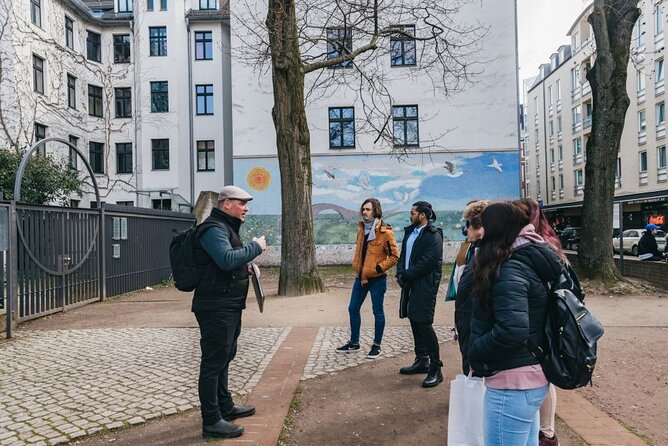
Berlin under the Nazis can feel like a wall of events. This walk breaks that wall by focusing on resistance and on the people who tried to save others, protect neighbors, or simply refuse to disappear quietly. You still learn what happened, but the story is built around agency, risk, and moral choices.
That approach matters because it changes how you remember the sites. Instead of passively observing stone, you start linking locations to decisions made by real individuals, like schoolteachers, wives at a street protest, and workers trapped in a transit system.
And yes, the tone is serious. This tour is meant to honor the victims and to pay tribute to those who resisted, including people who paid with their lives.
A few more Berlin walks and trips to compare
- Berlin: Reichstag, Dome and Government District Guided Tour
★ 4.7 · 18,288 reviews - Berlin: 1-Hour City Tour by Boat with Guaranteed Seating
★ 4.3 · 16,993 reviews - Berlin: TV Tower Standard Entrance Ticket
★ 4.4 · 15,883 reviews
Start at Oranienburger Straße: Neue Synagoge and Centrum Judaicum
You begin at Oranienburger Str. 36 at the Neue Synagoge Berlin, also tied today to the Centrum Judaicum foundation. The building’s backstory already carries a punch: it was constructed in 1866 and was once the largest and most magnificent synagogue in Berlin, reflecting a Jewish community of around 160,000 people.
Then the Nazis enter the timeline. The synagogue survived the Kristallnacht pogrom without being vandalized, but it was later confiscated in 1940 and used to store military uniforms. In November 1943, it suffered major damage from an Allied bombing raid, and after the main hall was torn down in 1958, the building was partly rebuilt in 1988 and officially reopened in 1995.
Today the space is about preservation and memory. For me, that is a key value of this tour: it does not only point at what was destroyed. It shows how Berlin later chose to carry forward Jewish memory and tradition.
Practical note: this first stop includes about 10 minutes here, and the tour provides context, maps, and “then and now” images to help the building make sense quickly.
Jüdisches Gymnasium Moses Mendelssohn: When Education Turns into a Transit Trap
Next you stop at the site of the Jüdisches Gymnasium Moses Mendelssohn, founded in 1779. It is described as the first Jewish school in Germany without fees, and it had an unusual openness for its time, including students of all faiths. It also promoted liberal Jewishness, and it accepted female students in 1931.
The timeline turns cruel in fall 1941. Deportations to territories conquered to the east led to Jewish schools being banned, and by 1942 the building was repurposed by the SS’s Reich Main Security Office into a transit camp. Windows were barred, and people were crammed inside while they awaited deportation.
This stop can be emotionally heavy, but it is also one of the most educational because it shows how Nazi policy dismantled everyday life in stages. You can look at a school building and understand how quickly normal structure became a holding area.
This is also where the walking format helps. Seeing the shift from school to camp in a single block of time makes the policy feel immediate rather than abstract.
The Jewish Cemetery and Holocaust Memorial: Destruction, Then Burials Again
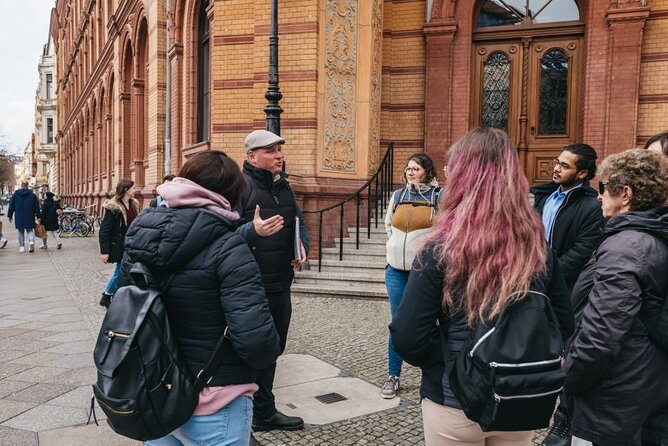
You then move to the Jewish cemetery and Holocaust memorial. From 1672 to 1827, about 12,000 Jewish community members were buried there, so this is not only a memorial site. It is a place that once held family lines and long lives.
In 1943, the Gestapo ordered the SS to destroy the cemetery. Thousands of gravestones were smashed, remains were thrown away, and it is described as SS guards playing football with skulls, an act meant to degrade the dead and terrorize the community.
Then April 1945 brings a different layer. Burials took place again, and the mass graves include almost 2,500 German soldiers and Berlin civilians who were killed during the fighting or shot by the SS for hanging white flags from windows.
I appreciate that this stop does not rush past the aftermath. It makes you understand the cemetery as both target and aftermath, and it connects the Holocaust to broader wartime terror in Berlin.
If you are sensitive to graphic details, you might want to pace yourself here. The tour time at this stop is short, about 15 minutes, but the story is dense.
Same city, a different way to spend the afternoon:
- Berlin: Boat Tour Along the River Spree
★ 4.4 · 11,252 reviews - Discover Berlin Half-Day Walking Tour
★ 5.0 · 9,624 reviews - Berlin: Government District around the Reichstag Guided Tour
★ 4.7 · 8,447 reviews - Berlin: Reichstag, Plenary Chamber, Cupola & Government Tour
★ 4.6 · 8,422 reviews
Museum Blindenwerkstatt Otto Weidt: Small Courtyard, Big Moral Risk
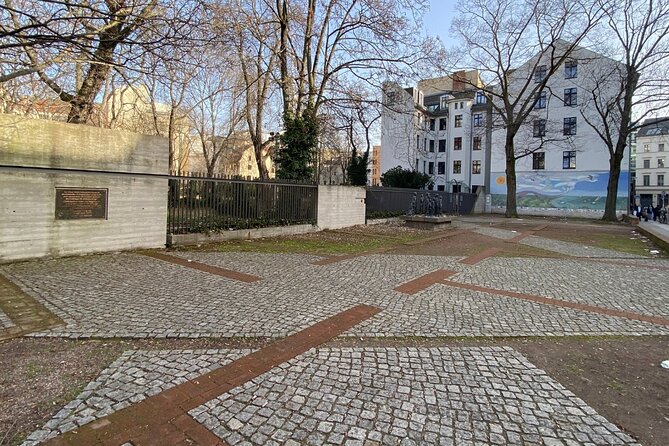
One of the tour’s most moving stops is the Museum Blindenwerkstatt Otto Weidt in a hidden courtyard. Otto Weidt and his wife Else employed more than 30 blind and deaf Jewish workers from 1940 to 1945.
What you learn here is not just “they helped.” You learn how dangerous that help was and how it was carried out. Weidt aimed to protect his employees from persecution and deportation, regularly bribing Gestapo officers and falsifying documents. The story even includes Weidt traveling to Auschwitz concentration camp to try to break one of his employees out.
That combination, paperwork, bribes, and direct action, is why this stop hits so hard. Resistance was not always a dramatic act with a clear headline. Often it was a steady grind of risk management, done day after day.
This stop is about 10 minutes, so the guide’s pacing matters. The tour’s format works well here because you get the story without losing time to guesswork in a museum setting.
Denkmal Rosenstraße: The Protest That Forced a Release
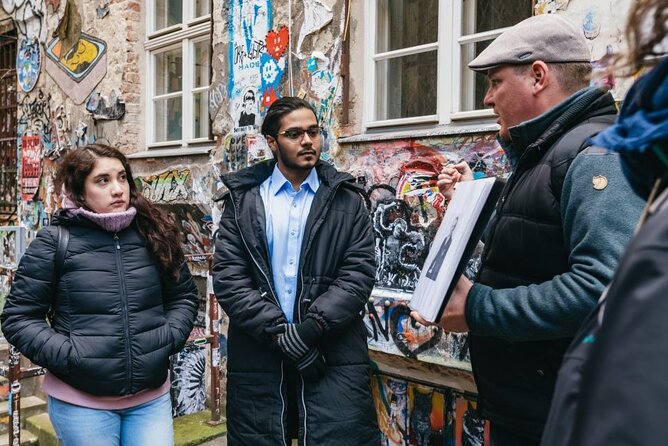
At Denkmal Rosenstraße, you focus on a specific 1943 event from Feb 27. The Gestapo, Waffen-SS, and Berlin police arrested 2,000 Jewish men who were married to non-Jewish German women. That choice mattered, because it pulled the protest into the open.
The wives gathered and protested, with crowds numbering in the hundreds. The Nazis threatened to shoot the women if they did not disperse. They scattered briefly, then returned in larger numbers and kept protesting as pressure built.
The turn comes when Goebbels authorized the prisoners’ release. For me, this is one of the clearest examples in the route of resistance by collective action, resistance that was not only about hiding but about showing up and refusing to let authorities define the outcome.
It is listed as about 10 minutes at the stop. You will likely want to linger mentally afterward, because the stakes are easy to grasp even if you only hear the story once.
Lustgarten: How Nazis Took Over Public Space
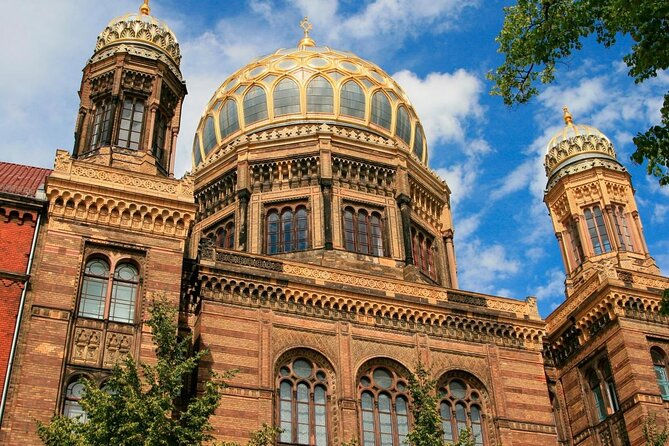
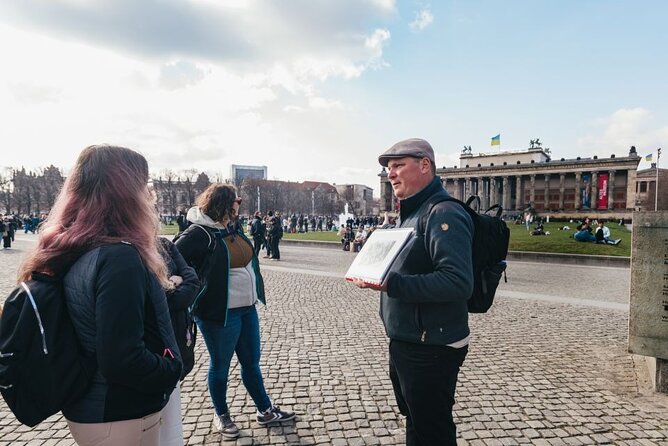
You then step into the Lustgarten, framed on three sides by the Berlin Cathedral, the Altes Museum, and the Zeughaus. Before the Nazis, this was a favorite location for protests and speeches.
Right after Hitler became Chancellor, one week later, 200,000 Berliners protested the new government. Later, Nazi regulations restricted Germans’ right to protest, with heavy fines and arrests making public opposition dangerous. In 1934, the Lustgarten was paved over to make way for Nazi propaganda rallies, swearing-in ceremonies, and military parades.
This stop is useful because it shows you the mechanics of control. It is not only what happened to people. It is how public space was redesigned to shape behavior and silence dissent.
On foot, you get a sense of the scale. The guide’s maps and then-and-now images help connect that sense of space to what you are learning, so the square becomes something more than a photo backdrop.
Zeughaus: The Gersdorff Plot and the Weight of “Next”
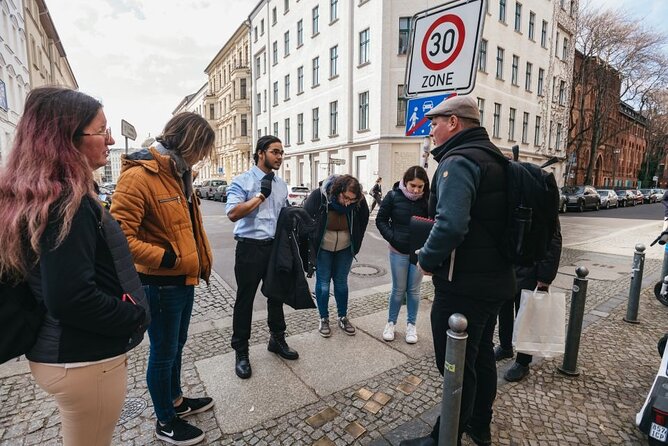
The tour continues at the Zeughaus on Unter den Linden, built in 1730 as an artillery arsenal. It is described as the oldest building along this avenue.
On March 21, 1943, the Zeughaus was chosen to exhibit captured Soviet weapons. Major General Rudolf Christoph Freiherr von Gersdorff, a member of the Wehrmacht resistance, was selected to lead the exhibit. You also hear about the broader context, including 27 failed assassination attempts against Adolf Hitler.
Then comes the key story. Gersdorff planned to blow himself up with Hitler using two concealed British clam mines, arranged to work through a close encounter. A coup d’état plan was also in place, and the guide ends this segment by teasing what happens next on the tour.
Even without spoiling the rest here, the value is clear: this is where you see resistance inside the machinery of the Nazi state, not outside it. It is also where the guide’s storytelling style matters, because you are balancing architecture, military context, and personal risk.
This stop is about 10 minutes, but it can feel longer because the story carries momentum.
Neue Wache and Bebelplatz: Memorial Stone and the Sound of Burned Books
At Neue Wache, you encounter a monument described as Germany’s central memorial for the victims of war and tyranny. It stands in the middle of a busy area, which changes how it lands. You cannot treat it like a quiet chapel in the corner. It becomes a reminder amid daily movement.
From there you walk to Bebelplatz and the Book Burning Memorial. On May 10, 1933, members of the Nazi German Student Union and their professors gathered here next to Humboldt University. They carried out a nationwide action against what they called un-German spirit, and they burned upward of 25,000 volumes of books labeled un-German.
This stop works well after Neue Wache because it shifts from the victims of violence to the victims of ideas being crushed. The physical act of burning is simple, but the consequences are cultural and long-lasting. When the tour connects these two memorial types, you start to see tyranny as both a weapon and an editorial policy.
Trains to Life Trains to Death: Ending With Two Fates
The walk finishes with Trains to Life, Trains to Death, a sculpture depicting two groups of Jewish children with contrasting outcomes during the Nazi era. One group is linked to survival through the Kindertransport to England. The other is linked to suffering after deportation to concentration camps.
The design adds an extra layer because the sculptor, Frank Meisle, is among those rescued by the Kindertransport who traveled from here to England in 1939. That detail gives the final site a different kind of closure. It is not just remembrance, it is survival turned into a message.
The tour lists this as about 10 minutes. It is short, but it functions like a closing note to the whole theme. You end where the story turns into “what could have been saved, what was not,” and you carry that contrast with you as you head to your next destination.
Price, Duration, and Value at About $48
At $48.01 per person for about 2 hours 30 minutes, this tour is priced to fit a classic Berlin day. What helps the value is that admission is listed as free for the stops included, so you are not dealing with a stack of extra entry fees along the way.
It is also small-group by design, with a maximum of 15 travelers. In this kind of history tour, that matters because you want a guide who can explain clearly and answer questions without the group turning into a human traffic jam.
You also get a mobile ticket and English language service. If you are trying to pack in major sites without losing time hunting for details, the structure does the work for you.
As for pace, expect walking and standing. The route is designed for on-foot storytelling, so comfort matters.
What Guides Add: The Names You Might Hear
One of the most praised aspects of this tour is the guide’s command of the material. You may be guided by Johan, Jochen, Scott, Jorg, or Benjamin, based on the guide names associated with highly rated experiences on this route.
What I think you are paying for here is not only facts. It is the ability to translate sites into story, and to keep the emotional tone respectful without getting so heavy that you cannot absorb the information.
If you like a guide who can handle tough questions, this tour format is set up for that. Small-group size plus a set route helps the guide stay grounded in the places you are standing in.
Who This Tour Fits Best
This is a strong choice if you want Berlin Holocaust sites without a purely sightseeing checklist. The resistance angle gives you a different lens on familiar landmark areas, and it adds stories of rescue, protest, and human risk.
It also suits travelers who want history explained in plain language, guided by maps and then-and-now visuals. If you already know some background, you may still find value in the specific names and the way each location changes meaning in the Nazi era.
It may be less ideal if you struggle with standing for long stretches. The tour notes that a good portion is time outdoors and on foot.
Should You Book This Berlin Resistance Walk?
If you want a focused, emotionally careful Berlin walk that honors resistance and survival, I would book this. The strongest reason is the way it connects sites to people who acted, including Otto Weidt’s life-saving efforts, the Rosenstraße protest that helped force releases, and the Kindertransport and deportation contrast in the final sculpture.
Choose it if you like small groups, guide-led context, and clear stop-by-stop storytelling at memorials and historic buildings. I would skip it only if you know you cannot handle standing and walking, or if you prefer a lighter, less intense tone.
FAQ
Is the tour offered in English?
Yes. The tour is offered in English.
How long is the tour?
It runs for about 2 hours 30 minutes.
What is the starting point and the end point?
The tour starts at Oranienburger Str. 36, 10117 Berlin, Germany. It ends at S+U Friedrichstraße, Berlin, near FriedrichstraßeGeorgenstraße 14/17, 10117 Berlin, Germany.
Is the group small?
Yes. The maximum group size is 15 travelers.
Do I need to pay for admission at the stops?
Admission tickets are listed as free for the stops in the itinerary you’ll visit.
Is food included?
No. Food and drinks are not included.
Does the tour include hotel pickup or drop-off?
No. Hotel pickup and drop-off are not included.
Is it accessible?
Yes. The tour is listed as accessible.
Are service animals allowed?
Yes. Service animals are allowed.
What if the weather is bad?
The tour requires good weather. If it is canceled due to poor weather, you will be offered a different date or a full refund.
Newest Berlin reviews on the site
- Your ticket to The Wall Museum Berlin★ 3.0 · 60 reviews
- Rickshaw Tours Berlin – Groups of up to 16 people with several rickshaws★ 4.0 · 97 reviews
- Warnemuende Shore Excursion: Berlin Private Sightseeing Tour from Rostock★ 5.0 · 4 reviews
- eSIM for Germany and 34 European Countries★ 4.5 · 16 reviews
- Love and War in Berlin: Self-Guided Story Puzzle Walk★ 5.0 · 7 reviews
- Walking on the Wall: 3-Hour Tour in Berlin★ 4.5 · 34 reviews
- Karl-Marx-Allee Tour: Life and Architecture in East Berlin★ 5.0 · 19 reviews
- Warnemuende Shore Excursion: Private Berlin Tour★ 4.5 · 27 reviews
Berlin Tours, compared.
Reichstag, Dome and Government District Guided Tour
Read our review →
1-Hour City Tour by Boat with Guaranteed Seating
Read our review →
Government District around the Reichstag Guided Tour
Read our review →
Reichstag, Plenary Chamber, Cupola & Government Tour
Read our review →