Reviewed · BERLIN TOURS
Explore Berlin: See All The Iconic Sights & Some Hidden Gems
Berlin can feel like 20 cities layered together.
This walking tour makes sense of the mess, tying WW2 and the Cold War into one clear route that ends at Brandenburg Gate. You start near Friedrichstrasse and work through the key places where ideology shaped daily life and borders decided who went where.
I especially like how the guide turns big landmarks into understandable stories, with clear, question-friendly explanations that people often credit to guides like Joseph, Klaus, Hannah, and Jimmy. I also like the practical mix of stops: memorials and viewpoints plus street-level moments at places such as Checkpoint Charlie and the surviving Wall sections at Topography of Terror.
The one real drawback is simple: it packs a lot into 3 hours, so you will do a solid walk and you will mostly see several major museums from the outside or with brief context, since some entry tickets are not included.
In This Review
- Key things to know before you go
- A 3-hour Berlin story walk, from Friedrichstrasse to Brandenburg Gate
- How the tour connects WW2 and the Cold War into one route
- Friedrichstrasse, Palace of Tears, and Neue Wache: starting with borders and consequences
- A small practical note
- Humboldt University, the cathedral area, and the “power through institutions” feeling
- The tradeoff
- Stadtschloss, Humboldt Forum, and Bebelplatz: ideology written into stone
- Theatre and tolerance at Staatsoper, Konzerthaus, and Gendarmenmarkt
- Checkpoint Charlie to Topography of Terror: the Wall in your line of sight
- The guide’s job here
- Hermann Göring’s airforce ministry to the Fuhrerbunker site: the WWII endgame gets real
- Walking the Holocaust Memorial and reaching the parliamentary quarter
- Brandenburg Gate and Pariser Platz: the finish line that turns memory into meaning
- Price and value: what $24.07 buys you in 3 hours
- Who should book this walking tour, and who might want another plan
- Should you book this walking tour?
Key things to know before you go
- A focused “timeline” tour that connects Nazi Germany, the divided city, and reunification themes
- Hitler-linked stops including the site of the Fuhrerbunker location
- Two major memory stops: the Memorial to the Murdered Jews of Europe and Neue Wache
- Cold War realism at Palace of Tears, Checkpoint Charlie, and a Wall section at Topography of Terror
- Lots of iconic architecture in a short time, from Brandenburg Gate to Gendarmenmarkt and major civic buildings
A 3-hour Berlin story walk, from Friedrichstrasse to Brandenburg Gate
If Berlin intimidates you, this kind of guided walk helps. In three hours you cover a stretch where the city’s past is not stuck behind glass. It is on street corners, in squares, on building facades, and at memorial sites where the point is to slow down and think.
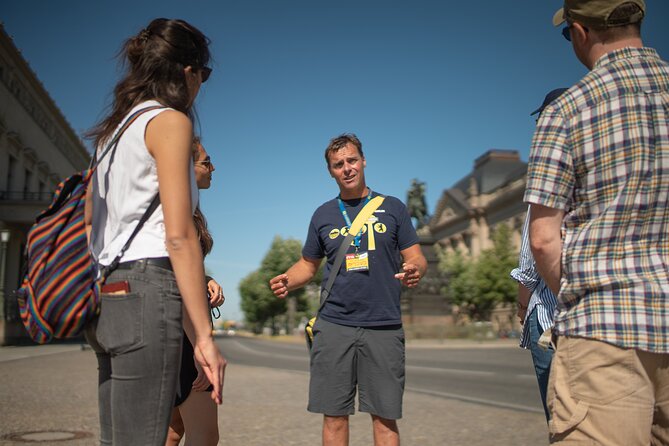
You will meet your local guide near Friedrichstrasse train station and head out on foot through the center. The tour is in English, and the pace includes short stops so you are not just marching straight through history like it is a theme park ride. With a maximum group size of 25 people, it is usually easier to follow along than with huge coach tours.
The ending matters, too. You finish at Brandenburg Gate in the Pariser Platz area, which is a good place to reconnect the story you just heard with what Berlin is today. This is one of those walks where the last stop feels like a conclusion, but in a smart way, not a lecturing way.
A few more Berlin walks and trips to compare
- Berlin: Reichstag, Dome and Government District Guided Tour
★ 4.7 · 18,288 reviews - Berlin: 1-Hour City Tour by Boat with Guaranteed Seating
★ 4.3 · 16,993 reviews - Berlin: TV Tower Standard Entrance Ticket
★ 4.4 · 15,883 reviews
How the tour connects WW2 and the Cold War into one route
This experience is designed around a human question: how does a city change when power changes? The guide’s narrative starts with life in the Third Reich, moves through the Nazi party and Adolf Hitler, then pivots to how Berlin got divided after the war.
A lot of Berlin sights are famous on their own, but the value here is the connecting tissue. You are not just collecting photos. You are getting an explanation for why a monument exists, why a border crossing mattered, and why certain places became memorials instead of just tourist stops.
You will also get moments that feel almost like time travel, without any sci-fi. The tour includes the remains of the Berlin Wall and the best-known civilian crossing, Checkpoint Charlie. That pairing alone makes the Cold War feel less abstract.
Friedrichstrasse, Palace of Tears, and Neue Wache: starting with borders and consequences
You begin at Berlin Friedrichstrasse Station, a central starting point that fits the tour’s theme. From here, the story turns immediately to borders, paperwork, and the everyday friction of a divided city.
Next is the Palace of Tears (also called Traenenpalast). This stop is there for a reason: it was a Cold War international checkpoint, and it became known as a place where separations happened at a human scale. Even if you do not go inside anywhere, the explanation helps you understand why the building has that nickname and why checkpoints were emotionally loaded.
Then you reach Neue Wache, a national memorial site reflecting on war and tyranny. This is one of those stops where the guide’s framing matters. It is not just about recognizing a site. It is about understanding what the memorial is asking you to remember.
A small practical note
This early stretch is a good moment to ask questions, since the tour is set up for that. If you want clarification on the timeline, this is where it pays off to speak up.
Same city, a different way to spend the afternoon:
- Berlin: Boat Tour Along the River Spree
★ 4.4 · 11,252 reviews - Discover Berlin Half-Day Walking Tour
★ 5.0 · 9,624 reviews - Berlin: Government District around the Reichstag Guided Tour
★ 4.7 · 8,447 reviews - Berlin: Reichstag, Plenary Chamber, Cupola & Government Tour
★ 4.6 · 8,422 reviews
Humboldt University, the cathedral area, and the “power through institutions” feeling
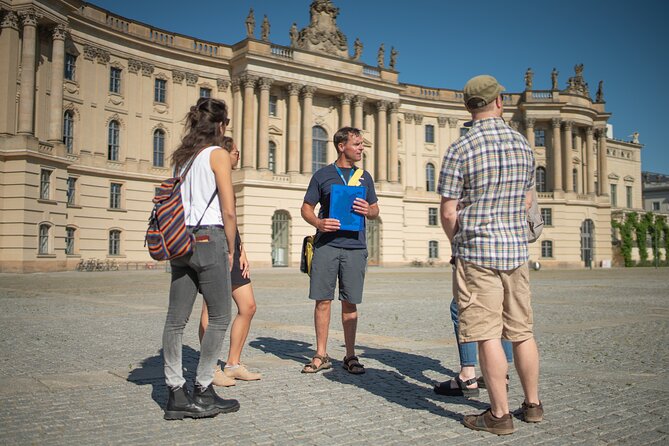
After memorials and checkpoints, the tour shifts toward institutions and learning. Humboldt University is a standout stop because it connects major intellectual figures to Berlin, with the tour highlighting that Marx, Engels, and Einstein studied and taught here. That is not a trivia detour. It is a reminder that ideas, education, and politics all lived close together in this city.
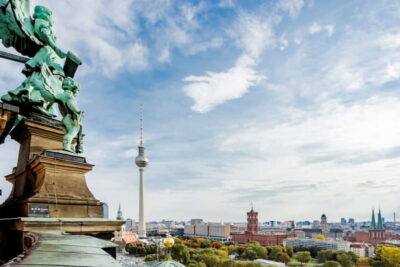
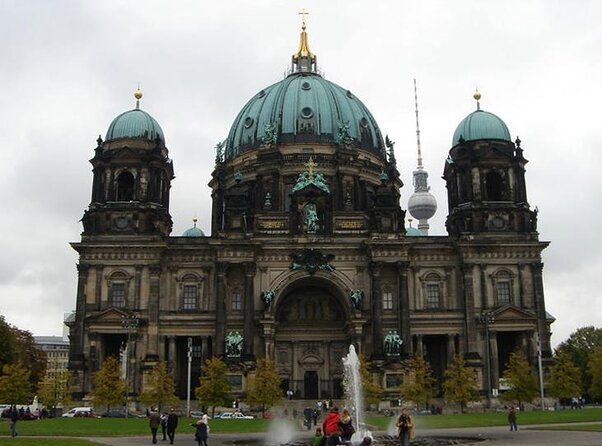
From there you head to the Berliner Dom area, which is the biggest church in Berlin. Your time here is not about buying a ticket and spending hours inside. It is more about orienting yourself to the setting, including the nearby Lustgarten, City Palace (Stadt Schloss), and the Humboldt Forum in the broader vicinity. If you want more than the outside views, you will need to plan on separate admission since ticket entry is not included at this stop.
Then the route threads through major museum territory in a fast, efficient way:
- Pergamonmuseum is presented through the lens of Islamic art and structures like the Ishtar Gate and the Market Gate of Miletus.
- Neues Museum gets attention for its Ancient Egyptian collection and its UNESCO World Heritage status.
- Altes Museum is linked to the fact that it was the first museum built in Berlin and to architect Karl Schinkel.
The tradeoff
You are learning enough context to understand what you are looking at, but you are not getting full museum immersion here. The “not included” note for these museum admissions is important. If you are the type who wants to spend real time inside, you will want to come back on your own afterward.
Stadtschloss, Humboldt Forum, and Bebelplatz: ideology written into stone
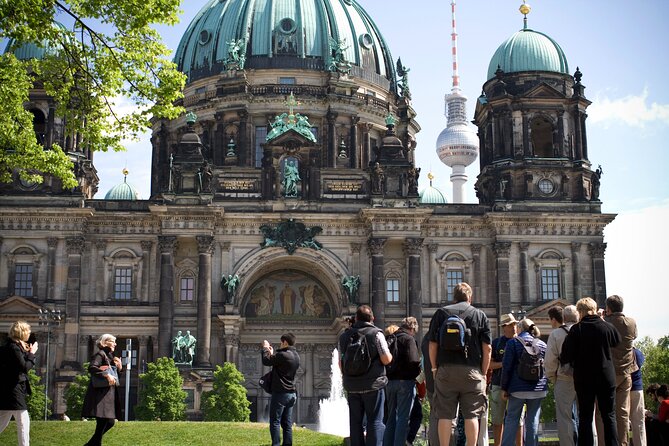
Next comes Stadtschloss Berlin, with a focus on the brand new Humboldt Forum and the reconstructed Hohenzollern family palace. This stop gives you an angle on how Berlin handles restoration and rewriting. The buildings may look “new,” but the stories connected to them are anything but.
Then you arrive at Bebelplatz, an 18th-century square that feels elegant and calm on the surface. But the tour keeps you anchored to the darker point of the stop: the Book Burning Memorial at Bebelplatz. This marks the location where Nazi forces burned tens of thousands of books in 1933.
That is one of the most powerful moments on the walk, because it takes an act of censorship and turns it into a place you can stand and picture. Architecture can be comforting. This site makes it hard to stay comfortable.
Theatre and tolerance at Staatsoper, Konzerthaus, and Gendarmenmarkt
The tour continues through some of Berlin’s best-known civic and cultural buildings. You will see:
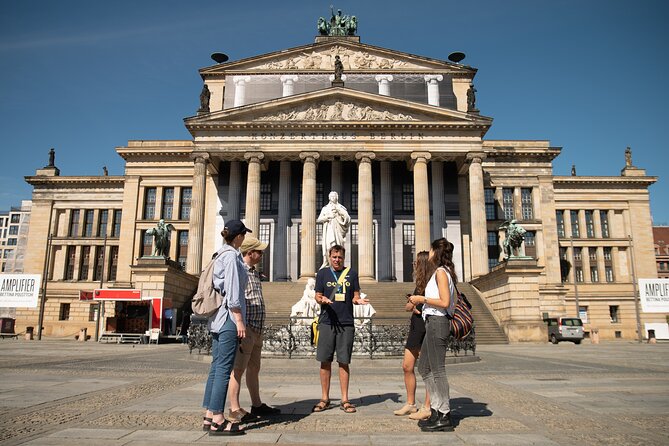
- Staatsoper, the opera house built under Friedrich the Great in 1743
- Konzerthaus, the spectacular Schinkel concert hall completed in 1821
- Gendarmenmarkt, where the tour highlights the French Cathedral and the German Cathedral, tied to Berlin’s period of religious tolerance
This section works well because it balances the heavy stops. You get a sense of how a city can build public institutions and cultural life, even as political control can later turn those institutions into instruments or targets.
You also end up with great photo angles. That matters, because when you return later, you will remember where the buildings were, not just that they look impressive.
Checkpoint Charlie to Topography of Terror: the Wall in your line of sight
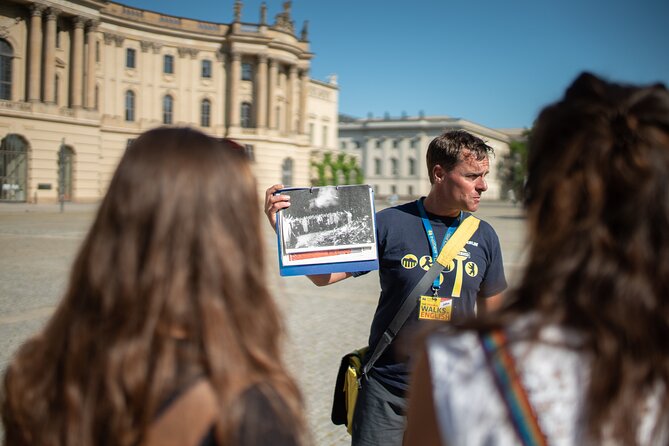
At Checkpoint Charlie, the tour gets very concrete. The highlight here is the Cold War civilian and military checkpoint and the mention of the tank stand-off in 1961 between Soviet and American armed forces. Even without being in a museum, the explanation helps you picture how tense this place was.
Then you go to Topography of Terror, where you can see a 200-meter piece of the Berlin Wall. This is the closest thing on the route to “proof” that history happened right here. It also helps you understand the Wall as more than a barrier. It was also a system that shaped daily decisions: travel, work, contact, and survival.
The guide’s job here
This is where a good guide makes or breaks the experience. You need someone who can connect a physical remnant of the Wall to the human consequences. Based on what people praise most about the guides who lead this walk, that is exactly what the better sessions focus on: clear explanation, enough time for questions, and pacing that keeps you from feeling rushed.
Hermann Göring’s airforce ministry to the Fuhrerbunker site: the WWII endgame gets real
Next is a stop tied to power structures under the Nazis: Aviation Ministry of Berlin, including the connection to Hermann Göring’s airforce ministry. The tour also mentions the East German house of ministers and the German Finance Ministry in the area, which hints at how the same spaces can carry different regimes over time.
After that comes the heaviest moment in the route: Fuhrerbunker. This is where the tour focuses on the location where Hitler spent the last days of WW2, essentially the site of his bunker. Standing in the right spot and hearing the story framed carefully changes the atmosphere. It stops being architecture and becomes a time marker.
This stop is not for casual skimming. If you are sensitive to heavy topics, take your time and let the guide’s pacing help you settle in rather than rushing to the next photo.
Walking the Holocaust Memorial and reaching the parliamentary quarter
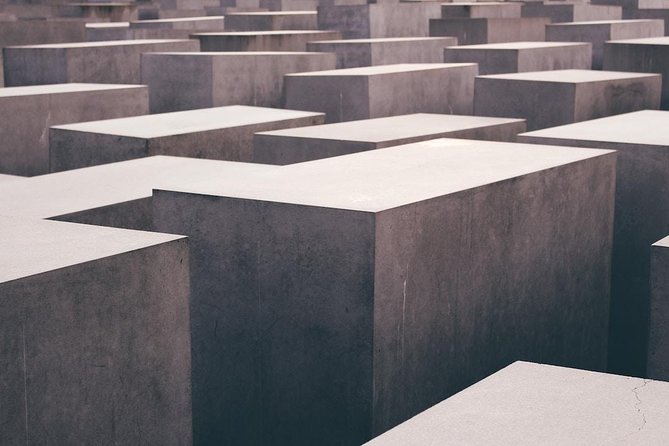
Right after the Fuhrerbunker site, the tour moves to the Holocaust Memorial – Memorial to the Murdered Jews of Europe. The walk through the memorial is an intentional shift from the site of late-war leadership to the scale of victims. The guide’s framing is key here, and it is exactly the kind of moment where people often mention the tour’s emotional impact.
From there, you reach the German house of Parliament and government quarter and then the endpoint zone.
Brandenburg Gate and Pariser Platz: the finish line that turns memory into meaning
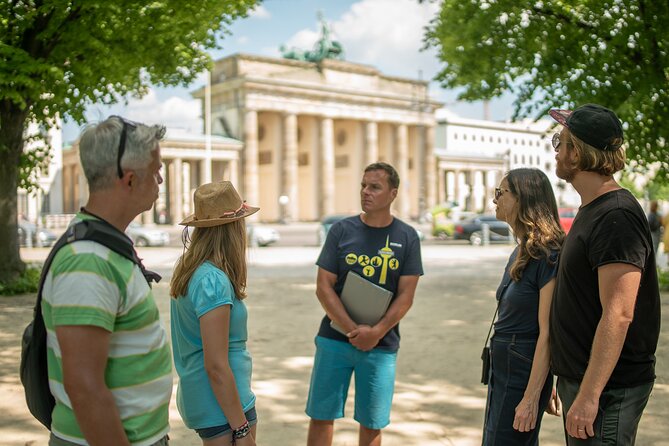
Your final stretch is the part most first-timers recognize instantly. You walk under the Brandenburg Gate, described here as once a symbol of division during the Cold War and now a national symbol of peace and unity.
As you approach, you also get views tied to American Embassy, French Embassy, and Hotel Adlon, plus nearby landmarks like the Academy of Fine Arts. The tour ends around Pariser Platz, where you can see both embassies from the square.
This finish works because it gives your brain a visual anchor. You end in a place associated with modern Berlin, but you have the Cold War story and the WW2 story fresh in your mind. That makes the ending more than a trophy stop.
Price and value: what $24.07 buys you in 3 hours
At $24.07 per person for roughly three hours, this tour is priced like a budget-friendly orientation, not a museum day ticket. The value comes from how many “story sites” you cover in one go, plus the fact that the guide ties them together with clear explanations.
Most stops in the route are free at the point of viewing, including key memorial and checkpoint sites. Ticketed admissions are only noted for a handful of indoor attractions, like the Berliner Dom area and major museums such as Pergamonmuseum, Neues Museum, and Altes Museum. That means you can keep the cost down if you are fine with outside context during the walk.
If you want more time inside museums, treat this as the roadmap. You learn what to prioritize, then you choose which places are worth paying extra for on your own.
One more value factor: this kind of tour is often booked ahead, with an average booking window of 24 days. If you are traveling in a busy period, booking sooner is smart.
Who should book this walking tour, and who might want another plan
I think this is a strong fit if you want:
- A first-time Berlin overview that focuses on WW2 and the Cold War rather than only surface sightseeing
- A route that helps you understand why certain places became memorials
- A guide who keeps a steady pace and gives you chances to ask questions
It is also a good match for couples and solo visitors who like walking and want a built-in structure. The tour is listed as most travelers can participate, with service animals allowed, and it runs near public transportation.
The main caution is physical and attention related. You will cover a lot in a short time, and you should expect a meaningful walk, with people estimating around 3 miles. If you have mobility limits or you need long sitting breaks, you might prefer a shorter route or a plan that includes more breaks at cafés.
Should you book this walking tour?
Yes, if you want Berlin explained in a way that connects the dots. The tour’s biggest strength is that it does not treat WW2 and the Cold War as separate chapters. It shows how the same city spaces carried different meanings over time.
Book it if your priority is Brandenburg Gate plus the story behind the Wall, checkpoints, and memorials. Pass or adjust expectations if you want deep time in museum galleries during this session, since several major museum admissions are not included and the format is built for walking and explanation rather than long interior visits.
Newest Berlin reviews on the site
- Jetbike Berlin fun bike beer bike★ 5.0 · 3 reviews
- Karl-Marx-Allee Walking Tour: Berlin’s Socialist History★ 5.0 · 5 reviews
- Homeless on chic streets: city tour in Berlin from personal experience★ 4.6 · 3 reviews
- Berlin: Sachsenhausen Concentration Camp Guided Tour★ 4.9 · 42 reviews
- Historyof the Trans, Queer & Gay communities of Berlin tour★ 4.8 · 17 reviews
- Historic Berlin Pubs & History Tour★ 4.9 · 73 reviews
- Berlin: City Center Walking Tour★ 4.7 · 45 reviews
- Half-Day Berlin Highlights Segway Expedition★ 4.5 · 61 reviews
Berlin Tours, compared.
Reichstag, Dome and Government District Guided Tour
Read our review →
1-Hour City Tour by Boat with Guaranteed Seating
Read our review →
Government District around the Reichstag Guided Tour
Read our review →
Reichstag, Plenary Chamber, Cupola & Government Tour
Read our review →