Reviewed · BERLIN TOURS
Berlin: Modernist Architecture Tour in the Hansaviertel
Modernist buildings meet real Berlin stories.
The Hansaviertel walking tour is interesting because it turns architecture into a living timeline, from leafy Wilhelmine-era streets to Cold War city planning. I especially like how the guide connects the Interbau 1957 showcase to what people were trying to build after WWII. I also like that you do not just see buildings, you learn the resident stories behind them. One drawback to consider: it is a solid two hours of standing and walking with heavy history, so it helps if you are comfortable with that pace.
This neighborhood sits between the Spree and the Tiergarten, which means you get calmer streets than the usual Berlin highlight trail. You start at a very “local” spot, the beer garden area by the Berlin-Tiergarten S-Bahn station, so the tour feels grounded from minute one. Expect a guided walk with a live local expert, offered in German and English.
If you are the type who reads façades and wants the why behind the style, you will enjoy this. The designs by major modernists are not presented as museum trophies, but as bold ideas about modern life, tested in real streets and real people’s memories.
In This Review
- Quick reasons this Hansaviertel tour works
- Hansaviertel: Berlin’s modernism experiment in human scale
- Starting at Biergarten der Tiergartenquelle, then getting your bearings fast
- The 19th-century villas and named residents you can picture
- A memorial tied to Jewish life in Berlin, and why it changes the tone
- Interbau 1957: when rubble planning became a Cold War showcase
- Walking among modernist icons: Gropius, Niemeyer, Aalto, and the “why”
- Where the walk finishes at Hansaplatz, and what to notice next
- Who should book this Berlin modernist architecture walk
- The real value: a guide who keeps the story moving
- Should you book this tour?
- FAQ
- How long is the Berlin Hansaviertel modernist architecture tour?
- Where does the tour start?
- Where does the tour end?
- What languages is the guide available in?
- Is there an admission ticket or museum entry included?
- Is the tour accessible for wheelchairs?
- How much walking should I expect?
- Is it suitable for children?
- What should I bring with me?
- Do I get food or drinks during the tour?
Quick reasons this Hansaviertel tour works
- Cold War urban planning, explained on foot through the Interbau 1957 story
- Named residents and real community history, including a memorial site tied to Jewish life in Berlin
- Modernist icons you can actually see, with buildings linked to Gropius, Niemeyer, and Aalto
- A smooth storyline from villas to concrete, so the neighborhood feels coherent, not random
- A guide who keeps you thinking, with time for questions and follow-ups during the walk
Hansaviertel: Berlin’s modernism experiment in human scale
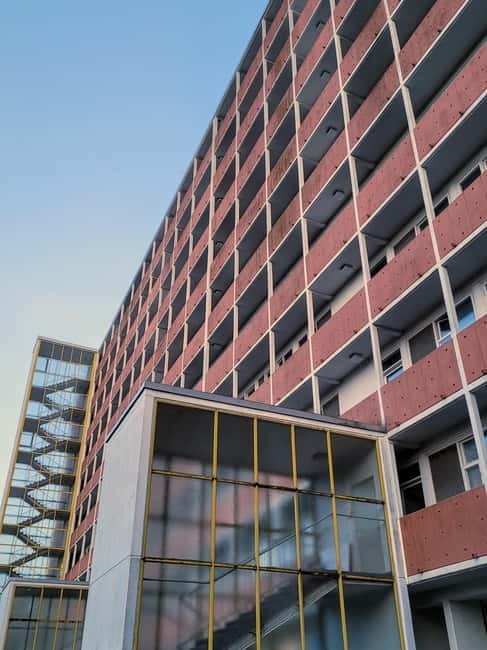
Hansaviertel is one of those Berlin places that rewards you for slowing down. It sits in central Berlin, squeezed between the Spree and the Tiergarten, but it still feels like a separate world: greener, quieter, and built with a “what if we redesign society” mindset. That contrast is the point. It is modern architecture, yes, but filtered through planning, politics, and everyday life.
What makes this tour different from a basic photo walk is the way you are guided to read the neighborhood as a set of layers. You start in the late 19th century, when Berlin was growing fast and new housing plans shaped social life. Then you move forward to the mid-20th century, where war damage, West Berlin ambition, and international modernism intersected in one major public statement.
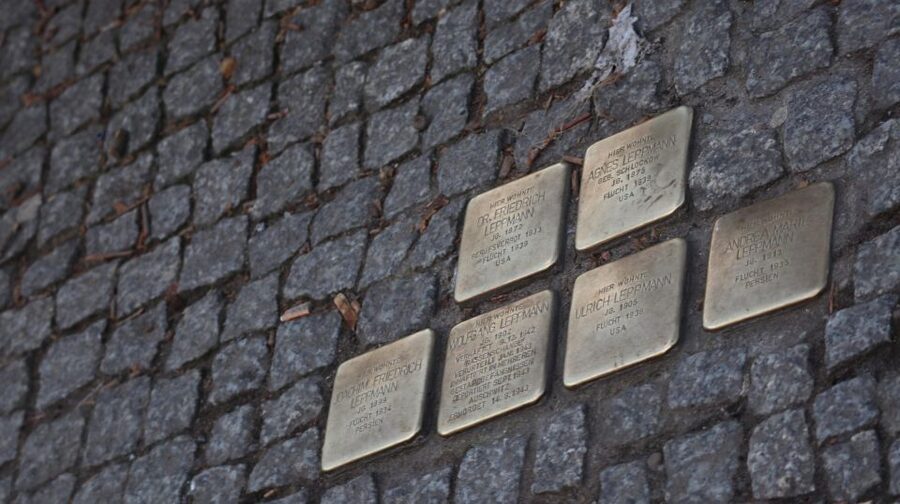
And the emotional layer matters. You will visit a site connected to Jewish life in Berlin that was destroyed through Nazi persecution and later also affected by bombing raids. Even if modernist buildings are your main reason for coming, this moment gives the whole story weight.
A few more Berlin walks and trips to compare
- Berlin: Reichstag, Dome and Government District Guided Tour
★ 4.7 · 18,288 reviews - Berlin: 1-Hour City Tour by Boat with Guaranteed Seating
★ 4.3 · 16,993 reviews - Berlin: TV Tower Standard Entrance Ticket
★ 4.4 · 15,883 reviews
Starting at Biergarten der Tiergartenquelle, then getting your bearings fast
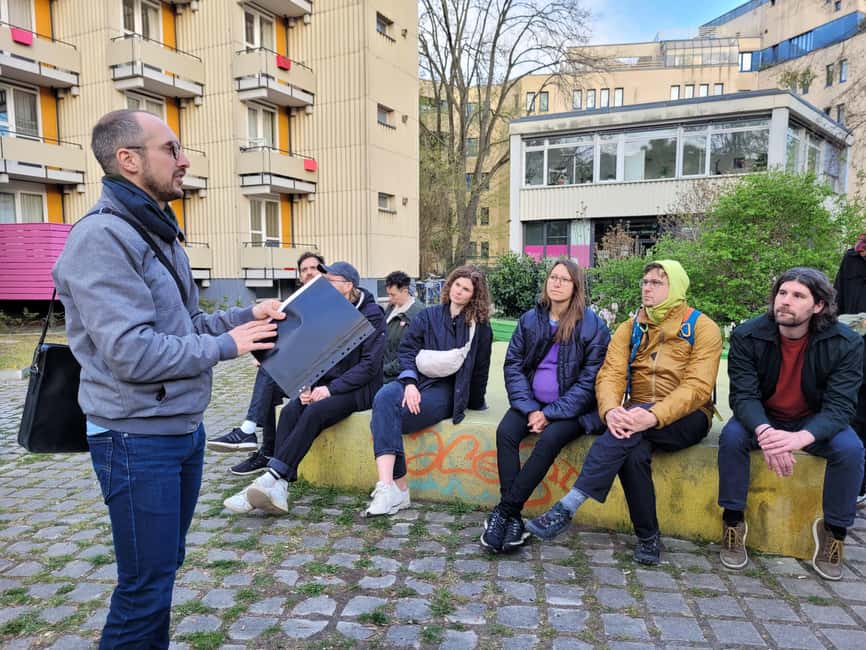
The tour begins at Biergarten der Tiergartenquelle, by the Berlin-Tiergarten S-Bahn station. The meeting spot is easy to find: look near the exit for Siegmunds Hof and Bachstraße, and find the guide with the orange umbrella. This matters more than you might think. Berlin transit hubs can feel like mazes, and a clear meeting point keeps your start calm.
From the first minutes, the guide sets the tone. You are not wandering “random modernism.” You are being oriented to the logic of the district. Why is it arranged the way it is? Why do the streets feel both planned and surprisingly relaxed? And how did the city’s growth patterns and then war change what “good urban life” was supposed to look like?
Because this is a walking tour that lasts about two hours, you will want to be comfortable from the start. Wear shoes you can stand in, and bring a small bottle of water. This is one of those tours where you will enjoy the details more if your feet are not bargaining with you.
The 19th-century villas and named residents you can picture
Hansaviertel’s story begins long before the Cold War. Berlin’s population was booming, and the district developed as a middle- and upper-class area with villas, manicured gardens, and elegant façades. It is a reminder that modernism did not appear out of nowhere. It replaced something, and it also borrowed from earlier ideas about space, status, and the shape of a respectable neighborhood.
As you walk, you learn about notable residents connected to this area. The tour highlights people such as Rosa Luxemburg, Nelly Sachs, and Käthe Kollwitz. That list is not just trivia. It helps you picture the district as a real home for real lives, not only a later stage for architecture experiments.
The guide’s job here is crucial: they keep the timeline readable while you are surrounded by greenery and streets that could otherwise feel similar. If you like history you can see, this part delivers. You start noticing how the neighborhood layout and the building style both create social signals, from private gardens to the feel of a street.
One practical note: since the tour is history-heavy, it can help if you go in with an open mind. You do not need to be an architecture student. You do need curiosity.
A memorial tied to Jewish life in Berlin, and why it changes the tone
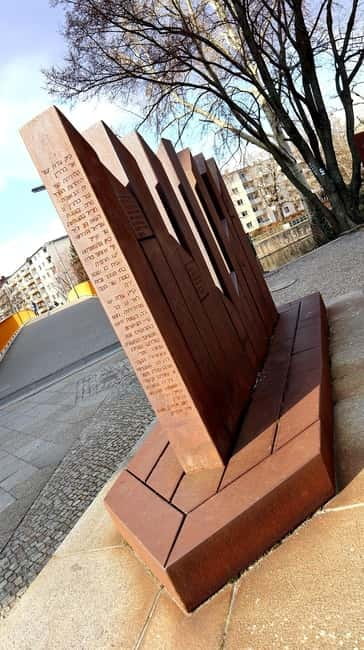
The walk then takes you to a quiet but powerful memorial connected to one of Berlin’s most significant Jewish communities. This is a site where two destructive forces overlap in the neighborhood’s story: Nazi persecution, which destroyed Jewish life socially and physically, and then later the Allied bombing raids, which added another layer of loss.
This stop matters because it disrupts the temptation to treat architecture as pure aesthetics. In the Hansaviertel story, buildings are tied to ideology and power. But human lives were tied to persecution and survival too. Visiting this memorial reframes what you are about to see next, because you understand the stakes of rebuilding.
If modernist buildings ever feel emotionally distant to you, this is the point where the tour brings them back to earth. You start thinking about what it means to rebuild a city, not just how it looks on paper.
Same city, a different way to spend the afternoon:
- Berlin: Boat Tour Along the River Spree
★ 4.4 · 11,252 reviews - Discover Berlin Half-Day Walking Tour
★ 5.0 · 9,624 reviews - Berlin: Government District around the Reichstag Guided Tour
★ 4.7 · 8,447 reviews - Berlin: Reichstag, Plenary Chamber, Cupola & Government Tour
★ 4.6 · 8,422 reviews
Interbau 1957: when rubble planning became a Cold War showcase
Now comes the dramatic turn. In 1957, West Berlin hosted Interbau, an international architecture exhibition designed to help redefine what a postwar city could be. The big idea was simple but ambitious: use the cleared land, the war scars, and the urgency of the moment to prove that a future-minded urban model could work.
So Hansaviertel became a Cold War stage. The district was redesigned by influential architects, turning a damaged landscape into a public demonstration of modern planning ideals. This is not just architecture as style. It is architecture as messaging.
As you walk, the tour keeps asking the right questions. What kind of life was this design trying to shape? What did it promise people would gain, like light, space, movement, or a more rational way to live? And then, the best question: does it still feel modern?
That last question is what makes the tour worth your time even if you have seen other modern architecture elsewhere. You are guided to judge how the design holds up in real streets today, not only in ideal diagrams.
Walking among modernist icons: Gropius, Niemeyer, Aalto, and the “why”
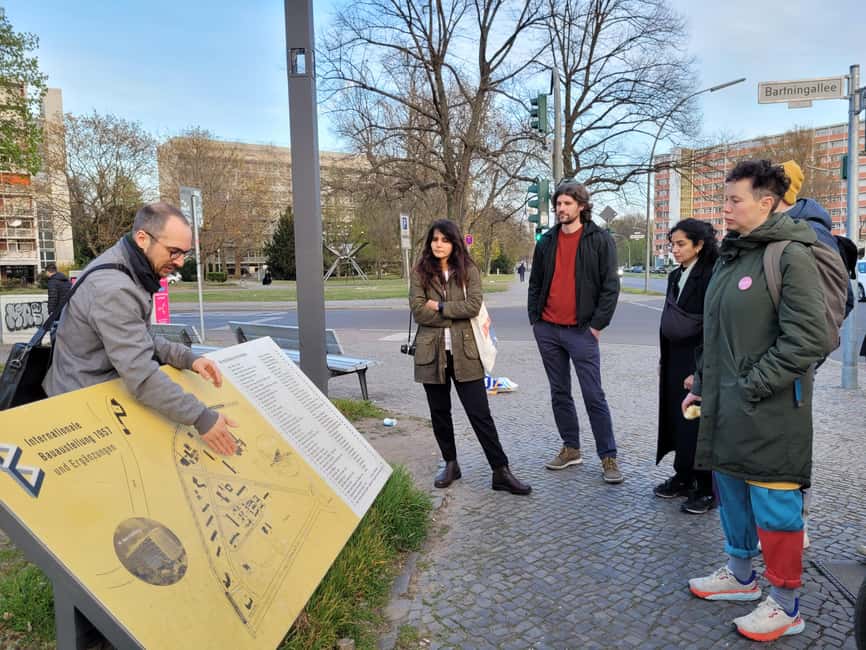
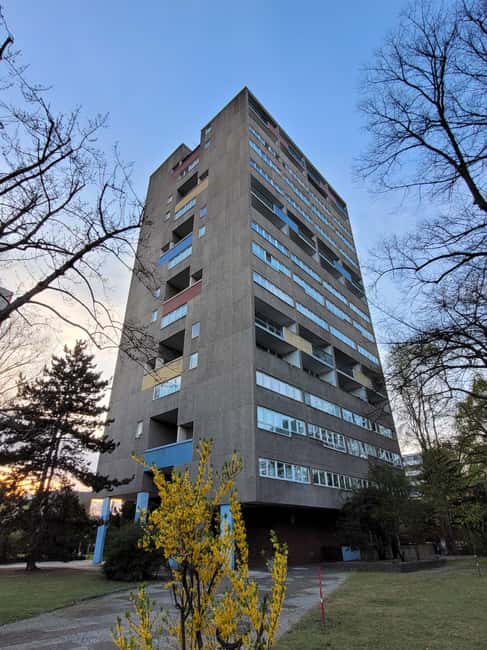
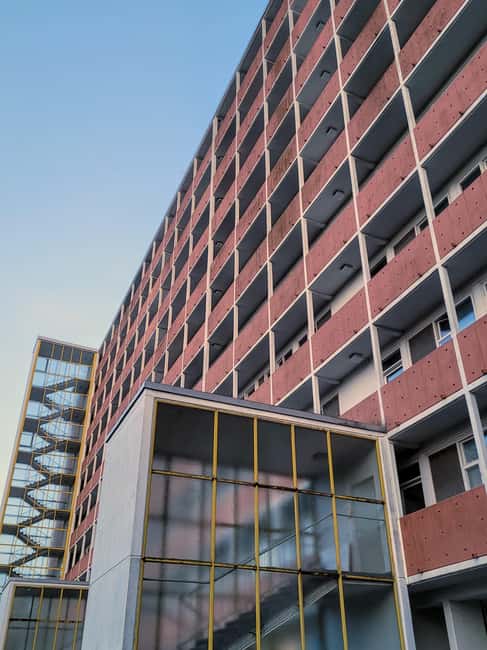
The Hansaviertel walk gives you a rare chance to connect names to street-level reality. You see bold designs associated with major figures like Walter Gropius, Oscar Niemeyer, and Alvar Aalto. The tour uses these architects as anchors, so the buildings do not feel like random specimens.
Here is how I think about it. Modernism can look confident from a distance, but up close it often comes down to decisions you can actually feel: how buildings sit on their plots, how the street interacts with open space, how circulation and sightlines shape daily routines, and how form signals ideology.
The guide’s explanations help you notice those choices. Instead of treating the buildings as icons, you start reading them as arguments. Some designs feel experimental, even a little provocative, because modernism in the 1950s was not trying to be polite. It was trying to declare a new identity for postwar life.
And because you are walking, the tour keeps returning you to the “experience of the space.” You are not only learning what the architects believed. You are learning what the neighborhood makes easier or harder in practice.
That is also why this tour is strong for first-time visitors to Berlin. You step away from the biggest landmark crowds and into a district that is central and calm, while still being deeply political in its origins.
Where the walk finishes at Hansaplatz, and what to notice next
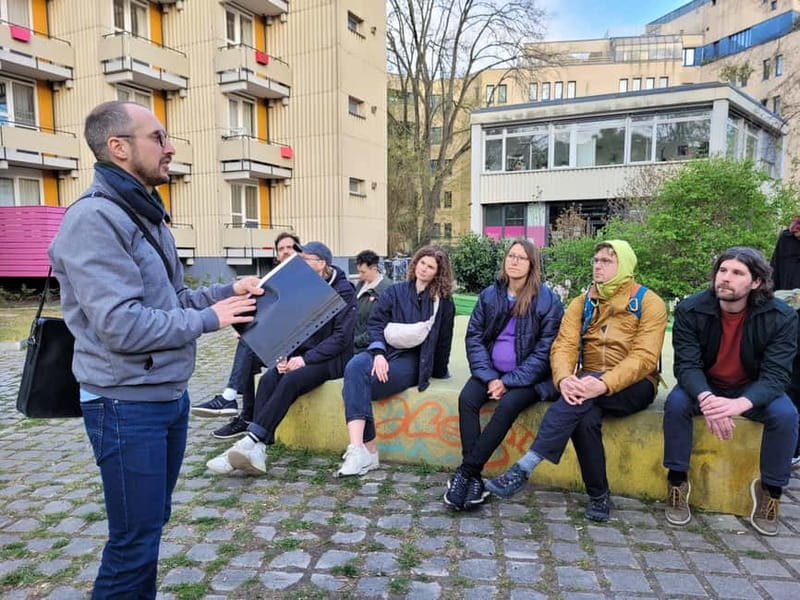
The tour ends at Hansaplatz. This is a helpful finishing point because it lets you pause your brain after a dense two hours. You have seen the timeline shift, felt how the neighborhood is planned, and heard the stories behind the architecture. Now you can look again without the guide talking over your observations.
When you step away, try one simple exercise: pick one building and ask what it is doing for the street and the people moving through it. Is it creating openness or enclosure? Is the design making the space feel organized or surprising? Does the greenery still feel like part of the original idea, or like a later layer?
If you have the energy afterward, you can also use the Tiergarten and Spree area for a self-paced break. You will likely want time outdoors after standing and listening.
Who should book this Berlin modernist architecture walk
This tour is best for you if:
- You love architecture, but you also care about the people and politics behind it.
- You like neighborhoods where you can walk and understand the “why” without needing museum tickets.
- You want Berlin history that is less about monuments and more about planning, identity, and rebuilding.
It might not be the best match if:
- You want only light sightseeing with minimal context. This walk is heavier than a casual stroll.
- You are sensitive to standing time. About two hours on foot is the deal.
Age-wise, it is not meant for children under 14, and minors must be with an adult. Also note that the tour is offered in German and English, and it is wheelchair accessible, so it can work for a wider range of visitors than many city walking experiences.
The real value: a guide who keeps the story moving
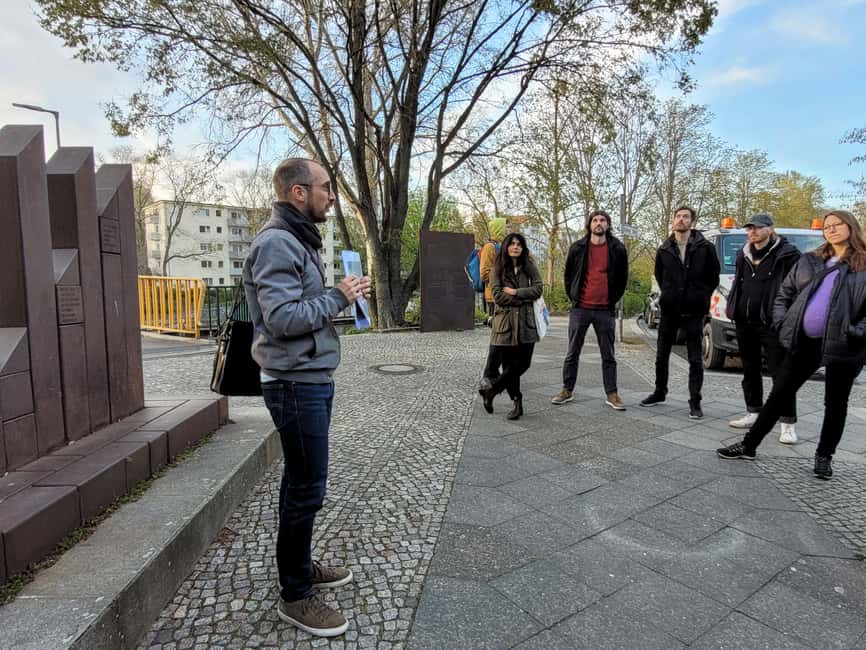
One of the most praised parts of this tour is the guide’s storytelling and responsiveness. The guide approach here is practical and interactive, so you are not stuck listening to a lecture while your brain checks out. You get a lively sense of how the district changes from era to era, and you can ask questions as you go.
That matters for value. With Berlin, you can always read on your own. But you cannot easily turn a neighborhood into a readable timeline without help. Here, the guide does that work for you, including the jump from villas and named residents to a memorial site, and then into the architectural ambitions of Interbau.
If your goal is to leave with real understanding, not just photos, this is a smart use of time.
Should you book this tour?
Yes, you should book it if you want Berlin in a form most visitors skip: a focused walk through Hansaviertel, where modernist architecture is tied to Cold War thinking, earlier city growth, and the memory of destroyed Jewish community life. It is a compact two hours that gives you a lot of “readability” for what you are seeing, especially if a guide helps you connect names like Gropius, Niemeyer, and Aalto to street reality.
Pass if you only want quick landmark hits or if you dislike walking with substantial historical context. Otherwise, this is an excellent way to get your bearings fast in a part of Berlin that still feels like it has ideas worth arguing about.
FAQ
How long is the Berlin Hansaviertel modernist architecture tour?
It runs about 2 hours.
Where does the tour start?
You meet at the Biergarten der Tiergartenquelle area, by the Berlin-Tiergarten S-Bahn station (near Exit Siegmunds Hof / Bachstraße).
Where does the tour end?
The tour ends at Hansaplatz.
What languages is the guide available in?
The live guide is available in German and English.
Is there an admission ticket or museum entry included?
No. Entry to museums or monuments is not included unless it is specifically part of the itinerary.
Is the tour accessible for wheelchairs?
Yes, it is wheelchair accessible.
How much walking should I expect?
Plan on comfortable walking and standing for about 2 hours.
Is it suitable for children?
It is not suitable for children under 14, and minors must be accompanied by an adult.
What should I bring with me?
Wear comfortable shoes and bring water.
Do I get food or drinks during the tour?
No. Food and drinks are not included.
Newest Berlin reviews on the site
- Jetbike Berlin fun bike beer bike★ 5.0 · 3 reviews
- Karl-Marx-Allee Walking Tour: Berlin’s Socialist History★ 5.0 · 5 reviews
- Homeless on chic streets: city tour in Berlin from personal experience★ 4.6 · 3 reviews
- Berlin: Sachsenhausen Concentration Camp Guided Tour★ 4.9 · 42 reviews
- Historyof the Trans, Queer & Gay communities of Berlin tour★ 4.8 · 17 reviews
- Historic Berlin Pubs & History Tour★ 4.9 · 73 reviews
- Berlin: City Center Walking Tour★ 4.7 · 45 reviews
- Half-Day Berlin Highlights Segway Expedition★ 4.5 · 61 reviews
Berlin Tours, compared.
Reichstag, Dome and Government District Guided Tour
Read our review →
1-Hour City Tour by Boat with Guaranteed Seating
Read our review →
Government District around the Reichstag Guided Tour
Read our review →
Reichstag, Plenary Chamber, Cupola & Government Tour
Read our review →