
Reviewed · PRIVATE DRIVERS
Welcome/Farewell SightseeingTaxi Tour +Transfer from/to the airport
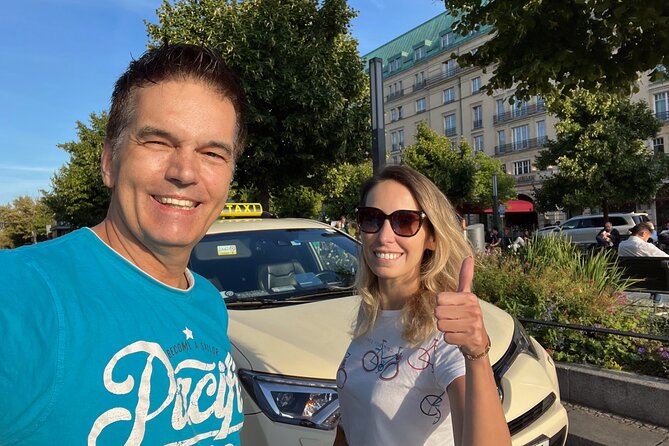
Berlin by taxi feels oddly perfect. This is a practical way to see major Berlin landmarks without losing hours to transit, with airport-to-city transfer baked in. I love the pace too, because your driver can keep the car moving while still making photo stops at the places you actually want.
Two things I really like: first, you get real context at each stop, from the meaning of the Brandenburg Gate to what the Soviet-era building choices say about power. Second, guide Gunter Bauer (GAT-Productions) keeps things clear and comfortable, and you can plan the rest of your days after the drive. The one drawback to think about is time: with a 1 to 3 hour window, the route can include several “stop or drive past” moments, so you should pick what matters most to you.
In This Review
- Key things to know before you ride
- Price and Logistics: What $171.52 Really Buys
- Taxi Pickup at BER and Hotel: How Not to Miss Your Driver
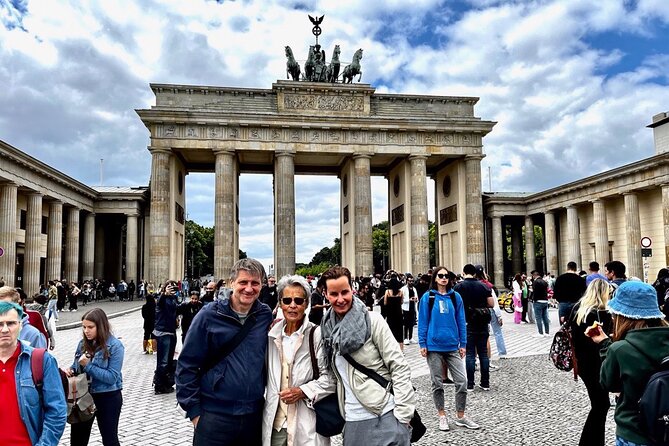
- Stop 1: Brandenburg Gate and the Reunification Story in One Ride
- Reichstag, the Bundestag Work Buildings, and Parliament Power You Can See
- Checkpoint Charlie Area and the Wall Reality That Hits Hard
- Unter den Linden: The Long Boulevard That Explains Berlin’s Shape
- Pariser Platz and the Diplomatic “Good Room” of Berlin
- Gendarmenmarkt: Two Cathedrals, One Beautiful Square
- Museum Island and Berlin Cathedral: Choose Your Depth
- Hackescher Markt and Hackesche Höfe: Small-Scale Berlin You Can Feel
- Jewish Life on Hamburger Straße and the Story Behind the Old Synagogue
- East Berlin Symbols: Alexanderplatz and the Red City Hall
- Nikolai Quarter, the Garlic House Area, and the Spree Lock View
- The 2711 Stelae Memorial and the Ministry District Context
- Should You Book This Taxi Sightseeing Tour?
- FAQ
- Where do you pick me up for the Welcome Tour?
- Where do you pick me up for the Farewell Tour?
- Is the tour in English?
- Do I need separate tickets for places like Brandenburg Gate, Pariser Platz, and the Stadtschloss area?
- What is included in the price?
- Can I cancel for free?
Key things to know before you ride
- BER pickup is handled as part of the experience, so you start sightseeing soon after landing
- Private group setup means your route stays flexible for your interests
- WiFi and an air-conditioned vehicle keep you sane during hot or chilly Berlin days
- Major reunification and parliament stops are easy to reach without navigating crowds
- Guided storytelling is built into the drive, so landmarks make sense fast
Price and Logistics: What $171.52 Really Buys
At $171.52 per person for about 1 to 3 hours, this isn’t a cheap “just drive me around” taxi. It’s closer to a guided orientation plus transportation, with VAT covered for both the taxi ride and the city tour, and parking fees included so you do not have to think about logistics mid-route.
You also get a few comfort perks that add real value in Berlin. The car is air-conditioned, there is WiFi on board, and the tour is offered in English. That matters because many Berlin sights are easy to misunderstand from the sidewalk, but a good explanation turns them into something you remember.
The other value play is flexibility. Pickup is offered either from your city address or hotel (Farewell Tour) or from BER airport (Welcome Tour). In a city where time often disappears between attractions, this structure lets you get bearings fast.
A few more Berlin walks and trips to compare
- Berlin: Listening Station Teufelsberg Tour with Transfer
★ 4.8 · 354 reviews - Private Berlin Custom Half-Day Tour with Private Driver and Guide
★ 5.0 · 59 reviews - Berlin Private Transfer to/from Berlin Brandenburg Airport
★ 4.0 · 32 reviews
Taxi Pickup at BER and Hotel: How Not to Miss Your Driver
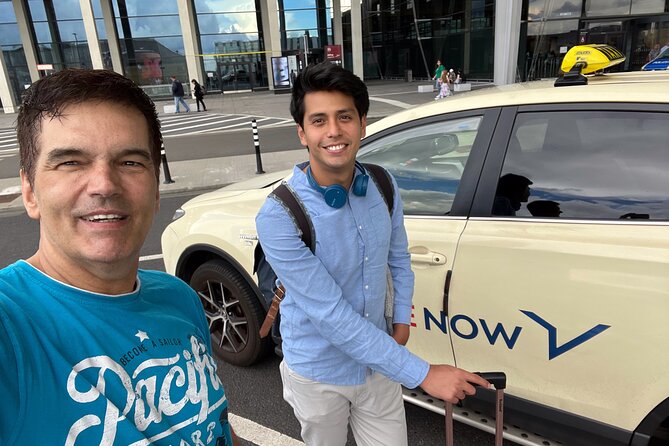
This tour works best if you stay proactive. For the Welcome Tour from BER, you share your flight number and arrival time, and if you already know your schedule changes, you share potential delays too. After landing, you message through SMS or WhatsApp directly after you arrive, and again once you have your suitcases at the baggage carousel.
The meeting spot detail is specific, which I really appreciate. You wait about 5 minutes at a free waiting location, then your driver meets you in the 2nd lane inside the arrivals area, not the general queue in the 1st lane. That single detail can save you the usual airport scramble.
For the Farewell Tour, the rhythm is different: you come out onto the street only after you receive an SMS or WhatsApp from the driver. It is a simple rule, but it prevents the common problem of standing in the wrong place at the wrong time.
If you travel with kids, there is an optional baby car seat (MaxiCosy) available on request. For strollers, the cradle needs to be removable and the frame foldable, and you should plan for extra suitcase space.
Stop 1: Brandenburg Gate and the Reunification Story in One Ride
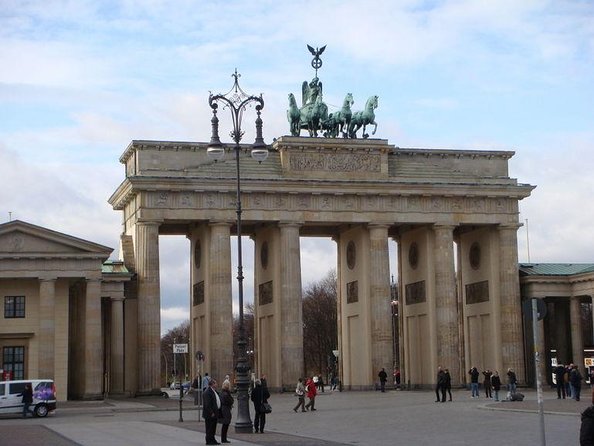
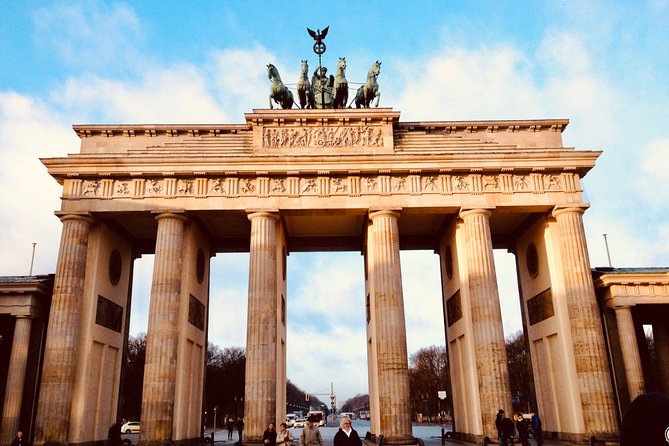
The Brandenburg Gate is the kind of landmark you think you already know, until the symbolism clicks. You hear how it started as a city gate, then got reshaped by major European events, including Napoleon’s era when the Quadriga ended up in Paris. After Allied victory, the “goddess of peace” returned in a triumphant procession, and the later icon details matter more than people expect.
In the divided city period, the gate basically became a symbol under pressure. The surrounding war damage was cleared away, and the gate stood isolated by walls and fences, including barriers that cut it off from one side of the city. You also get the practical sense that this was not just “a pretty monument,” it was a real boundary you lived next to.
Then comes the turning point: once the Wall fell, the gate regained its role as a public symbol of German reunification. It is the kind of explanation that helps you photograph the place in the right mood, not just the right angle.
This stop is listed with free admission, so you are not stuck budgeting time around tickets. The time here is short, but the story gives it weight.
Reichstag, the Bundestag Work Buildings, and Parliament Power You Can See
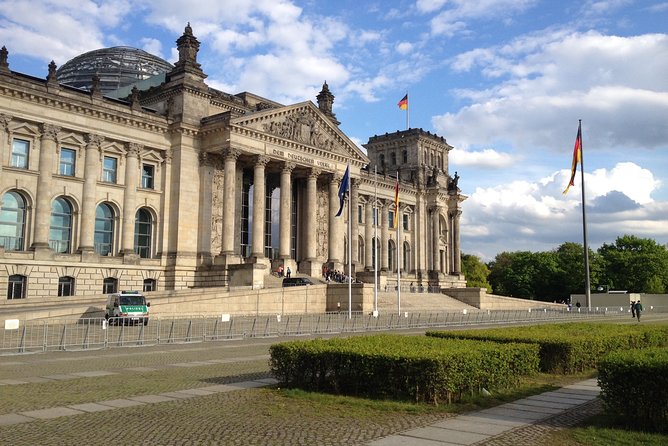
If Berlin has a “government district that still feels human,” this is it. The route includes the dramatic history around the Reichstag building and the later rebuild, plus the famous dome that signals a new era of transparency.
You also get a tour-through-the-tile explanation of why the rebuilt parliament complex looks the way it does. The Reichstag dome and the glass design are not just architecture theater. You understand how Berlin chose a visible civic identity after the city’s violent 20th century chapters.
From there, you look at the Federal Chancellery building, described as tall and tightly packed with working space. The details you hear, like the chancellor’s office location and the fact that there is an official apartment above the rotunda that is not used, make the building feel less myth and more workplace.
The drive continues into the “engine room” of parliamentary work, where committee activity happens and the public view can still be possible from outside due to the glass concept. In other words, you learn which parts of parliament are for speeches, and which parts are for the real work.
A good stop here is not about memorizing names, it is about realizing that Berlin built modern government spaces right into a landscape marked by division.
Same city, a different way to spend the afternoon:
- Berlin: Reichstag, Dome and Government District Guided Tour
★ 4.7 · 18,288 reviews - Berlin: 1-Hour City Tour by Boat with Guaranteed Seating
★ 4.3 · 16,993 reviews - Berlin: TV Tower Standard Entrance Ticket
★ 4.4 · 15,883 reviews - Berlin: Boat Tour Along the River Spree
★ 4.4 · 11,252 reviews
Checkpoint Charlie Area and the Wall Reality That Hits Hard
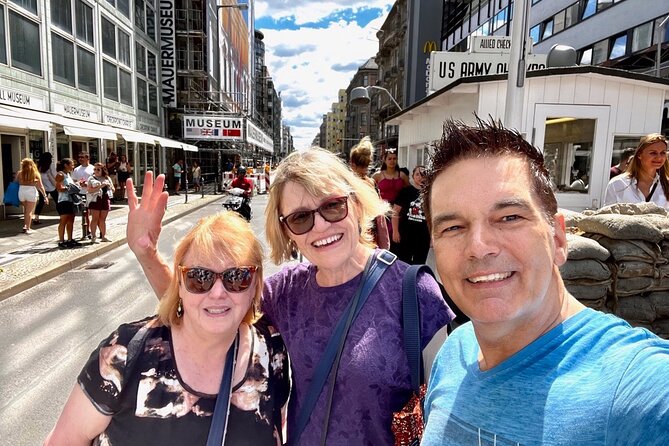
The route includes the Wall-era train station area tied to East to West travel, and the barriers that made every movement feel controlled. You hear the detail about that station being one of the few places where people could travel between East and West, and how customs checkpoints and barrier systems shaped daily life.
You also get the uncomfortable but important part: this area was used for escapes. Some were daring, and some did not work out. The point is not suspense, it is understanding that the Wall was not an abstract line on a map.
Stasi observation walks and the mention of the nearby Palace of Tears put extra context behind the physical barriers. Even if you do not stop long, you leave knowing this was a machine built to manage separation, paperwork, and fear.
This is where a taxi tour can actually feel more respectful than a long walking circuit. You keep your time tight, but the guide’s framing helps you process what you see.
Unter den Linden: The Long Boulevard That Explains Berlin’s Shape
After the Wall-era tension, Berlin shifts back into grand city scale with Unter den Linden. You get the origin story, including how the boulevard began as something more like a route tied to the elector’s hunting grounds, then expanded as the city grew west.
The tree detail is a surprisingly good guide clue. You hear about the disagreement between walnut and linden trees, and how the linden version won. It sounds small, but it helps you read the street as intentional, not just scenic.
As you pass major institutions, you connect the dots between “grand buildings” and the idea of a city center built for education, culture, and civic power. The route highlights the State Library, Humboldt University, and the State Opera area.
This stretch is also practical for pictures because you are moving, but you can still catch strong views down the boulevard. Cafés are nearby too, so if you want to continue exploring after the taxi ride, this corridor is a smart place to break off.
Pariser Platz and the Diplomatic “Good Room” of Berlin
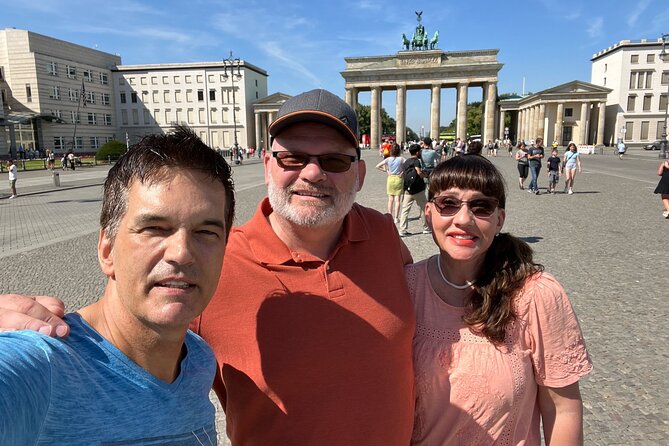
Pariser Platz is where Berlin performs its postcard side, but the story behind it is very real. You learn how the area was devastated and how the gate’s earlier isolation mirrored the division of the city. The point is that the place was not always open and welcoming in the way it looks now.
You also hear how the thick wall separation made it impossible to reach the gate from one side, with fencing on the other side during division. After reunification, the decision was to rebuild the surrounding presence modernized in materials and volume.
What matters here is the mix of architecture and diplomacy. You pass the Liebermann Haus, the Akademie der Künste, and the French and American embassy area as part of the restored civic ensemble.
Then you get one more layer that makes the buildings feel political rather than decorative: the Soviet Union built its major foreign representation here on a scale meant to show who mattered. The building’s inner courtyard and even details like ballrooms and a swimming pool are mentioned to help you picture how power was staged.
This is a stop that teaches you how Berlin’s politics shaped its skyline.
Gendarmenmarkt: Two Cathedrals, One Beautiful Square
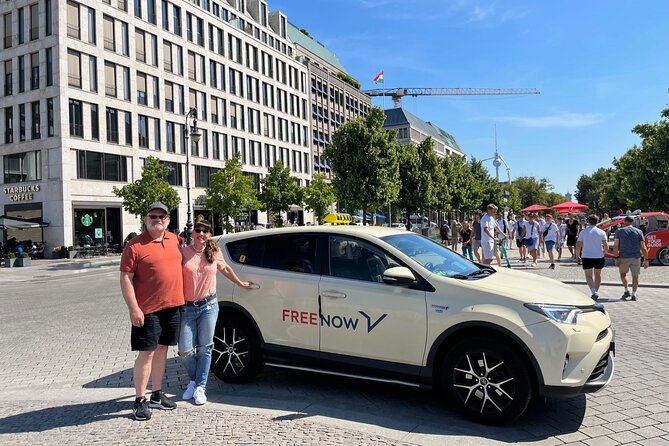
The tour can take you through or near Gendarmenmarkt, often described as one of the most beautiful places in Berlin. You learn the key twist: the two cathedrals are dramatic in shape, but they function more like parish and museum spaces today.
The German Cathedral is now tied to parliamentary history through a museum use, while the French Cathedral is still used for services by a reformed congregation that holds services in French on Sundays. Behind it, you hear about the small Huguenot museum, because refugees were allowed to build the church here.
Even if you are not a church person, this stop works because it shows a Berlin pattern. The city repeatedly turns conflict into shared institutions, and the architecture holds that memory.
If you want a brief pause that still feels meaningful, this is a strong candidate. It is also ideal for photos, since the square frames everything naturally.
Museum Island and Berlin Cathedral: Choose Your Depth
The route includes Museum Island, and it helps you understand why it is such a big deal. You learn it is a UNESCO-protected peninsula with five world-famous museums, and you hear the main highlights you can expect: early historical art, ancient Egypt, famous items like Nefertiti, and collections that range from sculpture to large-scale museum architecture.
You can also feel the “temple-like building” logic behind the design, described as a way to house paintings and sculpture like you are walking through civic stages.
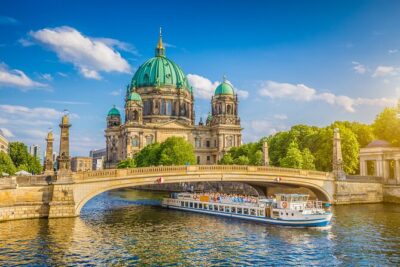
Then the drive can branch to Berlin Cathedral, which is framed as a favorite for one specific reason: it looks much older from the outside than it actually is, yet it hides a range of interior beauty and symbolic choices. You get context about the dome, plus the option to visit the church, burial place of the Hohenzollern, and possibly ascend to the dome depending on time.
This is one of those areas where people often over-plan. If your taxi window is short, you do not need to force every museum. The best strategy is to use the taxi ride to see where the UNESCO core sits, then pick one museum for a slower second visit.
Hackescher Markt and Hackesche Höfe: Small-Scale Berlin You Can Feel
Hackescher Markt and Hackesche Höfe are a different Berlin mood. You go from imperial-looking scale into a more intimate, almost small-town neighborhood feel, where older ensembles still exist even if the buildings are mostly from the 19th century.
You hear why this matters: much older Berlin around Nikolaiviertel and the red town hall was destroyed in the war or later cleared. What remains here is an ensemble that survived, then later got restored after reunification as both residential and commercial space.
The details you learn help you read the courtyards as living space, not just photo backdrops. Studios, workshops, and small businesses are part of the character.
This stop is also efficient. You do not need a long walk to understand why people like it. If you want a break from “big monuments,” this area delivers it fast.
Jewish Life on Hamburger Straße and the Story Behind the Old Synagogue
The route can include a pass or extended time near Hamburger Straße, where you can spot multiple layers of religious and community life. The stops mentioned include Sophienkirche, a Jewish cemetery, and a Catholic hospital area as potential walk-by points.
You learn it was not simply a ghetto area. There was Jewish life alongside Protestant congregations and old churchyard spaces, plus the presence of the KüsterHaus facades that still show war scars.
A key story here is the old synagogue and the later plan to build a new one in the 1860s. The new building in Moorish style with a golden dome is described, and you hear the tragic note that the large hall was destroyed in bombing.
This stop is worth it because it gives Berlin’s religious architecture a timeline, not just a look. You leave with a clearer sense of how communities built, expanded, and were hit by the 20th century’s violence.
East Berlin Symbols: Alexanderplatz and the Red City Hall
Alexanderplatz is where Berlin shows its socialist-era planning. You pass or stop near the TV tower and the cluster of buildings linked to the GDR redesign, including the House of Tourism, the House of Statistics, the House of the Teacher, and the House of Electrical Engineering, plus the world clock.
You also learn the origin point behind the square name, including that it once was called Ochsenplatz, and how the GDR concept aimed for huge space, modern buildings, and dramatic openness in a Russian-style prospect idea. Even the mention of room for tanks in the concept gives you a feel for the political mindset behind urban design.
Then the route heads to the Red City Hall. The description emphasizes how naming works in Berlin, and how during East Berlin times different seats of power sat in different town halls depending on side of the city. You can also visit some interesting rooms for free, including a room filled with plaster casts of well-known statues.
This is another place where your guide’s framing helps. You start seeing the city as a map of political choices, not just eras of architecture.
Nikolai Quarter, the Garlic House Area, and the Spree Lock View
The Nikolai Quarter stop is about old Berlin atmosphere, with a key realism check. You hear about reconstruction decisions made during GDR times, when only a few historic structures survived with missing roofs and towers, yet planners aimed to create a dense old-quarter feel.
Within that setting, you can see the Nikolai Church, today functioning as a city museum. The area also includes the garlic house, tied to Biedermeier-style interiors and a preserved domestic story set up for visitors. Nearby, you are pointed toward restaurants with views over the Spree, which is a practical reason people like this stop.
The tour also includes a look at the lock, and that is a fascinating Berlin detail. The oldest crossing helped shape settlement patterns, including fishermen on one side and traders on the other. The story moves from mills on the bridge powered by river water, to later lock engineering, and then to tearing down earlier systems in favor of a modern double-chamber lock.
This is where Berlin feels like a working city. It is not just historic sets, it is also how people moved and traded.
The 2711 Stelae Memorial and the Ministry District Context
One of the most emotionally heavy stops is the memorial with 2711 stelae. You learn it sits on the central mile between Brandenburg Gate and Potsdamer Platz, near the ministerial gardens area and close to the Reichstag. The design by Peter Eisenman is described as intentionally confusing at first, with understanding coming through walking among the stones.
Then you get what the stones are meant to communicate. The guide explains the insecurity and decision pressure placed on Jewish people in Nazi Germany, including the questions of whether to emigrate and what to take with you. The recruitment order leads toward what happened later, and you hear that more information exists in the basement area.
I like this stop because it forces you to slow down mentally, even if the taxi ride keeps your schedule moving. The guide’s words make it clearer without turning it into trivia.
The route may also include HausVogteiPlatz, tied to the former Jewish clothing district and a named Vogtei facility history. You hear how Jewish tailoring became concentrated there in the 19th century due to restrictions elsewhere, and you notice how modern restored residential spaces preserve the feeling of old row-house “mini palaces.” Mirrors as art objects remind you of the tailoring trade past.
Should You Book This Taxi Sightseeing Tour?
If you want to see Berlin’s headline sights plus deeper meaning in a short amount of time, this is a strong choice. The taxi format makes it easier to stitch together neighborhoods you might otherwise bounce between with transit. And the guide factor is real: with Gunter Bauer, the drive turns into a guided story, and you get photo moments at key points so your memories are anchored.
I would skip or adjust your expectations if you are the type who needs a long museum session at every stop. With a 1 to 3 hour window, some sites are naturally stop or drive past. If you book this, decide what your top three “must understand” places are, then let the rest support them.
If you want a Berlin plan that starts with orientation and ends with confidence, this ride does that well.
FAQ
Where do you pick me up for the Welcome Tour?
For the Welcome Tour, pickup is from BER Airport. You share your flight number and arrival time, and after landing you message the driver via SMS or WhatsApp when you are ready, then again when you have your suitcases. The meeting point is in the arrivals area, with the driver waiting about 5 minutes from a free waiting spot and meeting you in the 2nd lane.
Where do you pick me up for the Farewell Tour?
For the Farewell Tour, pickup is from your hotel or accommodation. You wait to go outside until the organizer sends an SMS or WhatsApp, and you include a cell phone number when booking.
Is the tour in English?
Yes. The experience is offered in English.
Do I need separate tickets for places like Brandenburg Gate, Pariser Platz, and the Stadtschloss area?
The itinerary notes free admission at Brandenburg Gate, Pariser Platz, and Stadtschloss Berlin. The experience itself includes the sightseeing and transfer, but the only explicitly listed free-admission stops are those named.
What is included in the price?
Included are an air-conditioned vehicle, parking fees, WiFi on board, pickup from your desired location in the city, transfer from and to BER airport, and the taxi ride plus city tour with VAT included.
Can I cancel for free?
Yes. There is free cancellation if you cancel at least 24 hours before the experience start time for a full refund.
Newest Berlin reviews on the site
- Your ticket to The Wall Museum Berlin★ 3.0 · 60 reviews
- Rickshaw Tours Berlin – Groups of up to 16 people with several rickshaws★ 4.0 · 97 reviews
- Love and War in Berlin: Self-Guided Story Puzzle Walk★ 5.0 · 7 reviews
- Warnemuende Shore Excursion: Berlin Private Sightseeing Tour from Rostock★ 5.0 · 4 reviews
- eSIM for Germany and 34 European Countries★ 4.5 · 16 reviews
- Walking on the Wall: 3-Hour Tour in Berlin★ 4.5 · 34 reviews
- Karl-Marx-Allee Tour: Life and Architecture in East Berlin★ 5.0 · 19 reviews
- Warnemuende Shore Excursion: Private Berlin Tour★ 4.5 · 27 reviews
Private Drivers, compared.
Listening Station Teufelsberg Tour with Transfer
Read our review →
Private Transfer from Munich Airport to Munich City by Luxury Van
Read our review →
Private Berlin Custom Half-Day Tour with Private Driver and Guide
Read our review →
Berlin Private Transfer to/from Berlin Brandenburg Airport
Read our review →
Arrival Transfer from Munich Airport to Munich City by Sedan
Read our review →

Private Transfer from Berlin to Prague with 2h of Sightseeing
Read our review →Browse the lists this tour appears in