
Reviewed · CRUISES & BOAT TOURS
Berlin East Side Tour 2.5 hour cruise with commentary
Spree cruises feel like shortcuts through a city. This 2.5-hour Berlin East Side tour pairs live bilingual commentary with big skyline moments, including Museum Island, the East Side Gallery, and the Reichstag area. It also slows down for a real working lock, so you get more than just postcard views.
I especially like the longer 2.5-hour route, because it covers more ground than the common 1-hour options. Second, I like that you get specific place-based context as you pass landmark after landmark, rather than vague narration that could fit any city.
One drawback to consider: the onboard experience can swing depending on where you sit. The top deck offers the best scenery, but sound clarity and comfort can be hit or miss when it gets hot or crowded inside.
In This Review
- Key things to know before you board
- Start at Alte Börse, then let the Spree do the walking
- What the onboard vibe is like
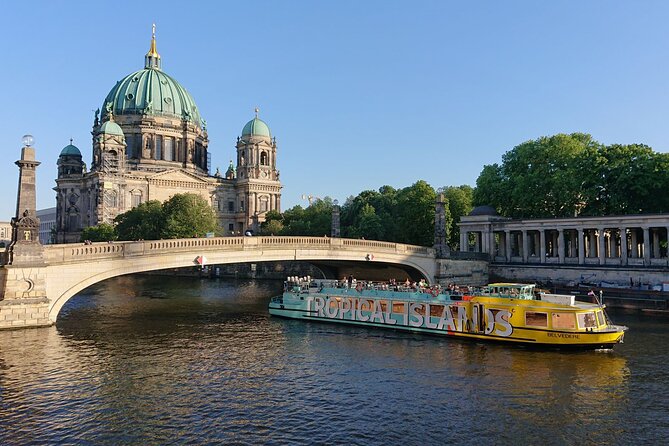
- Museum Island, Berlin Cathedral, and Humboldt Forum from the river
- Why these sights work well on a boat tour
- Mühlendammschleuse: watch a working lock and learn why Berlin grew here
- East Side Gallery: the Wall story in its longest surviving stretch
- How to get the most out of this section
- Oberbaumbrücke area, Stralauer Tor echoes, and Molecule Man
- Nikolaiviertel and Berlin TV Tower: old settlement meets modern icons
- Why these two stops feel like a combo
- Reichstag and the government district: politics with a sky-high view
- Humboldthafen and the House of World Cultures, aka Pregnant Oyster
- Palace of Tears and the Friedrichstrasse border maze
- Comfort, sound, and the top deck vs downstairs decision
- My practical advice
- Price and value: why $36.04 can feel either fair or too much
- My value take
- Who this Berlin East Side cruise fits best
- Should you book this East Side Tour 2.5-hour cruise?
- FAQ
- How long is the Berlin East Side Tour cruise?
- Is the tour commentary offered in English?
- Where does the cruise depart from?
- Does the ticket include food or drinks?
- Is there a toilet on board?
- How many people are on the tour?
- Can I cancel for a full refund?
Key things to know before you board
- 2.5 hours on the Spree: enough time to see a lot without turning it into a full-day outing
- Live English and German commentary: you hear it as you pass major sights, not after the fact
- Mühlendammschleuse lock time: you get a real sense of how the river and city work
- East Side Gallery from the water: you see the Wall story in the exact stretch it was painted
- Top deck vs downstairs tradeoff: better views outside, but comfort and audio can vary
- Onboard bar available for purchases: drinks and food are extra, so plan for that
Start at Alte Börse, then let the Spree do the walking
This cruise leaves from Anlegestelle Alte Börse / BWSG Berliner Wassersport und Service GmbH on Burgstraße 27 (Mitte). The departure time listed is 2:45 pm, and the trip ends back at the meeting point, which makes planning your afternoon simpler.
I like that the boat tour limits the stress. You are not doing stop-and-start transit. You are just moving along the river with a steady view line, which is perfect if your legs are tired from museums or you want an easier day one.
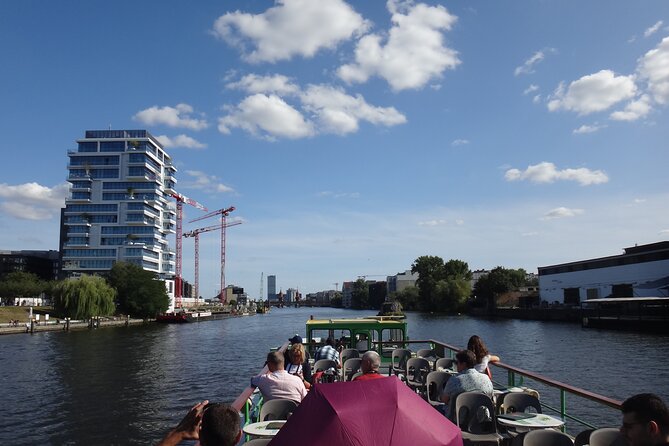
The group is capped at 55 travelers, so it feels more like a shared sightseeing ride than a packed party. You also get the practical basics on board: a toilet is available, and there is an onboard bar with food and drinks (you pay for anything you order).
More Boat Tours in Berlin
- Berlin: 1-Hour City Tour by Boat with Guaranteed Seating
★ 4.3 · 16,993 reviews - Berlin: Boat Tour Along the River Spree
★ 4.4 · 11,252 reviews - Berlin: 1-Hour Boat Tour with Bilingual Guide (Ger/Eng)
★ 4.7 · 4,800 reviews
What the onboard vibe is like
The tour runs with live commentary in English and German. That matters because the commentary is timed to what you are seeing from the water. It is not just background music while buildings blur by.
You can also expect the boat ride to be relaxed in pace. Some people note it can feel slower than other similar cruises, but that can be a feature. Slower means fewer rushed photos and more time to watch details like bridges, embankments, and how the city sits along the water.
Museum Island, Berlin Cathedral, and Humboldt Forum from the river
A huge chunk of what makes Berlin feel like Berlin is clustered around the Spree in this part of the city. From the water, you get a cleaner sightline than you would from a street corner, especially when you want to connect buildings to the riverfront.
You pass the Berlin Cathedral at Lustgarten, formally the Oberpfarr- und Domkirche zu Berlin. It was built from 1894 to 1905 in Neo-Renaissance and Neo-Baroque style and is the largest Protestant church in Germany by area. The cathedral also has one of the major dynastic burial sites in Europe, so it is more than a pretty facade.
Then comes the Museum Island area, a UNESCO-listed museum ensemble built between 1830 and 1930 for Prussian kings. The complex includes the Old Museum, New Museum, Old National Gallery, Bode Museum, and Pergamon Museum, plus the James Simon Gallery as a modern visitor hub. From the Spree, you see how this cultural zone sits like an anchor at the heart of the city.
The cruise also brings you past the Humboldt Forum, located in the Berlin Palace building. It functions as a universal museum and cultural space, including parts of the Berlin State Museums and the Berlin City Museum, plus the Humboldt Laboratory. The value here is how the cruise frames the area as a living cultural campus, not only a single stop.
Why these sights work well on a boat tour
If you are trying to get your bearings fast, this is one of the best kinds of route. Museums and major churches can be hard to connect on foot because you end up in lines and crowds. On water, the landmarks line up visually.
Also, when you are later at places like the Reichstag or the East Side Gallery, you will understand the geography better because you already saw the city core and its riverfront structure.
More boat trips from Berlin:
- Berlin: 3.25-Hour Spree & Landwehrkanal Boat Tour
★ 4.6 · 4,311 reviews - Berlin: Hop-On Hop-Off Sightseeing Bus with Boat Options
★ 4.3 · 4,012 reviews - Berlin: 1-Hour City Sightseeing Cruise
★ 4.4 · 2,210 reviews - Berlin: 2.5-Hour East Side Boat Cruise with Commentary
★ 4.4 · 2,016 reviews
Mühlendammschleuse: watch a working lock and learn why Berlin grew here
One of the most memorable parts of the route is Mühlendammschleuse, the lock in the Mitte district east of Mühlendamm on the Fischerinsel. The Spree-Oder waterway runs through here, and the historical story is tied directly to navigation and trade.
What makes this stop special is that it is not a monument you simply look at. A lock is action. You get the chance to observe a real river mechanism and how Berlin manages water levels and boat movement.
This lock was put into operation in 1942 and it overcomes a drop of 1.51 meters. The tour notes also indicate about 20 minutes at this part of the ride, and admission is ticket free for what is offered at the lock.
From the city history angle, the location is tied to early connections between towns that shaped Berlin. Even if you are not a history nerd, you can feel why this spot mattered for settlement and commerce.
East Side Gallery: the Wall story in its longest surviving stretch
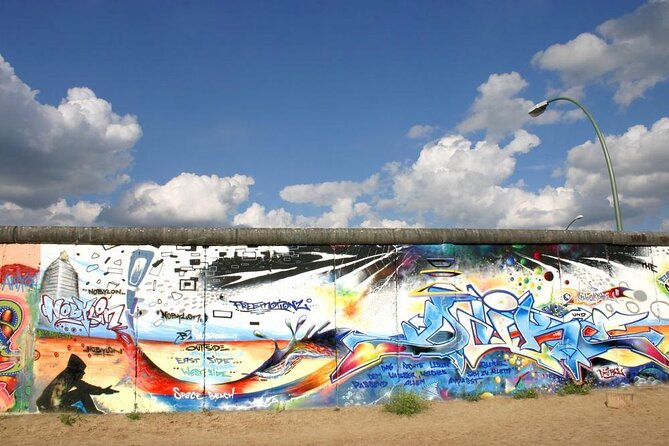
Then you slide into the emotion and symbolism of the Berlin Wall, and you do it the right way, from the waterline. The cruise reaches the East Side Gallery area, a permanent open-air gallery on the longest surviving section of the wall along Mühlenstraße.
Here are the key facts that make it worth your time:
- In spring 1990, after the Wall opened, this section was painted by 118 artists from 21 countries
- The painted stretch runs 1316 meters
- The original artworks on the side facing East Berlin have not survived fully, and what remains includes replicas made in 2009
It also helps to understand the river geography. The actual border here was on the Kreuzberg bank of the Spree. The gallery sits on the Hinterland Wall, which had closed off the border area to East Berlin.
How to get the most out of this section
This is one of those places where it is easy to think you have already seen it because you have seen photos. The boat perspective changes it. You see scale, wall length, and the way the river cuts across the urban grid.
If you care about the art and the political message, bring your attention for this part. The cruise framing tends to make the whole Wall story feel more concrete than the usual quick walk-by.
Oberbaumbrücke area, Stralauer Tor echoes, and Molecule Man
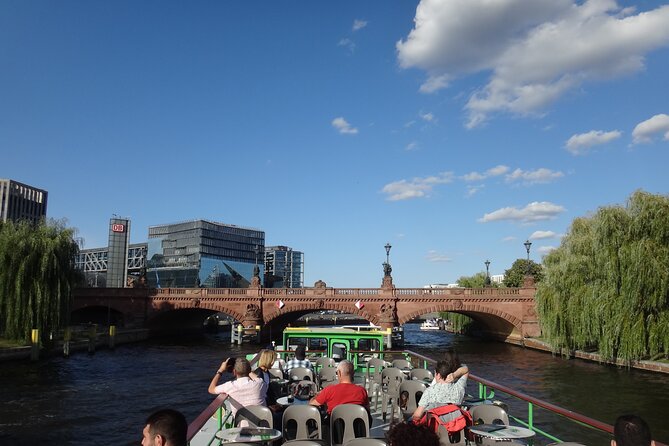
As the cruise continues, you move into one of Berlin’s most photogenic stretches. You will pass the Oberbaum Bridge area, and the storytelling around the river fortifications and customs history is what makes this section more than just a famous bridge photo.
The route includes a historical idea of how the river was controlled. At one time, there were wooden bridge structures at the level of the former city wall, and the Spree was blocked on both sides with a narrow walkable passage in the middle. That passage helped collect customs duties. When night came, the passage was sealed with a thick trunk reinforced with iron nails, known as the tree.
There were also references to an upper tree on the east side, and when the city limits shifted and the Berlin customs wall was built in 1723, a new bridge with flaps for shipping traffic was built near the Stralauer Tor, which served as an entrance into Berlin.
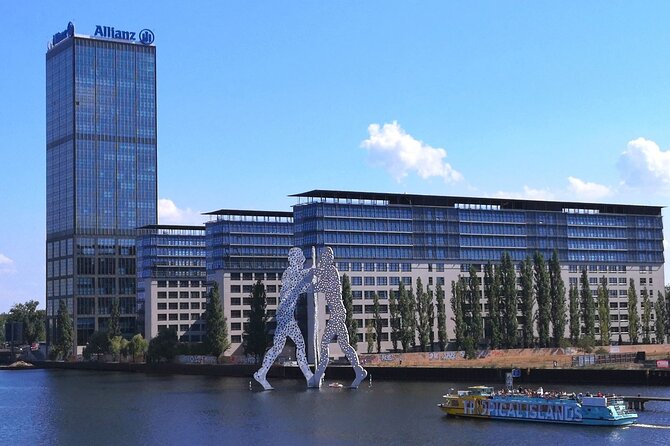
Then you reach a modern counterpoint: the Molecule Man. This is a monumental sculpture by Jonathan Borofsky, created in May 1999. It is a three-person sculpture installed in the Spree between Elsenbrücke and Oberbaumbrücke near where the districts meet.
This pairing is fun: you get the old customs control story and then the contemporary public art presence, both placed directly in the river corridor.
Nikolaiviertel and Berlin TV Tower: old settlement meets modern icons
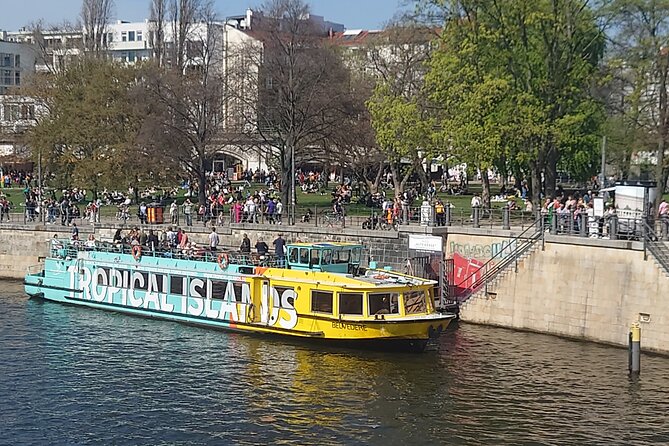
Next, the cruise flows past sights that show how Berlin stacks different eras next to each other.
You see Nikolaiviertel, in Mitte. It is described as the oldest settlement area in Berlin. Most of it was destroyed in World War II, then rebuilt between 1980 and 1987 by architect Günter Stahn for the East Berlin magistrate, in time for Berlin’s 750th anniversary. The rebuilt area is built around the Nikolaikirche, using an almost medieval floor plan with an ensemble of historic-style townhouses and adapted prefabricated buildings.
From there, you pass the Berlin TV Tower, standing at 368 meters. Completed in 1969, it was once the second highest TV tower in the world and is one of Germany’s most visited sights, with over a million visitors each year.
Why these two stops feel like a combo
Old-town reconstructions can sometimes feel staged. But when you see Nikolaiviertel and the TV Tower on the same river ride, you get how Berlin treats continuity. The city rebuilds, remembers, and then moves forward fast, in the same visual frame.
If you like photo angles, the river gives you the chance to capture the tower and rooftops together without the usual street-level clutter.
Reichstag and the government district: politics with a sky-high view
The cruise continues toward the Reichstag building, now the seat of the German Bundestag since 1999. It was built between 1884 and 1894 in Neo-Renaissance style by architect Paul Wallot. You also learn about the Reichstag’s past roles, including housing the Reichstag of the German Empire and the Weimar Republic.
After major damage from events in 1933 and World War II, the building was restored in a modernized form in the 1960s. Then from 1995 to 1999, it underwent a major redesign by Norman Foster for permanent parliament use.
The glass dome above the plenary hall is noted as accessible, based on an idea by Gottfried Böhm. Even if you are not going up during this cruise, seeing it from the river helps you understand why this building is such a symbolic focal point.
You also pass the Kronprinzenbrücke, which connects Mitte and Tiergarten toward the government district. It is next to the Spreebogenpark and the German Bundestag’s day-care center. This bridge section matters because it places you in the geography between the historic city fabric and the modern administrative core.
Humboldthafen and the House of World Cultures, aka Pregnant Oyster
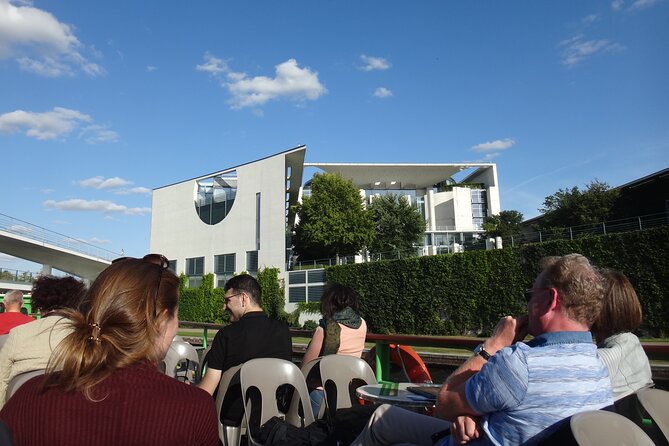
The cruise route includes Humboldthafen, a listed dock in Mitte. It has a water surface of 33,500 square meters and an approximate depth of 3.5 meters. Seeing it from the river helps you grasp how much water infrastructure Berlin has built, not just architecture.
You also pass the House of World Cultures (HKW). It is an exhibition space for international contemporary art, with a focus on non-European cultures and societies. The site opened in the former congress hall setting along the Spree in the government district, and it has a Berlin nickname based on its shape: Pregnant Oyster.
This matters because on many sightseeing routes, contemporary culture gets skipped. Here, it gets treated as part of the same river story as parliament buildings and wall memorial art.
Palace of Tears and the Friedrichstrasse border maze
One of the most emotionally charged landmarks on the route is the Palace of Tears, the colloquial name for the former departure hall of the border crossing point at Bahnhof Friedrichstrasse.
The name came about because East Germans used to say goodbye to western visitors in tears, since many East German citizens did not have freedom to travel to the Federal Republic. The tour also notes that the control and check-in counters were staffed by employees of the Ministry for State Security in uniforms of the GDR border troops.
From a “learn the city” point of view, this is powerful because it anchors Cold War history to the physical geography. You are not reading about a system. You are moving past the space it used to occupy.
Comfort, sound, and the top deck vs downstairs decision
This is where your personal preferences really matter.
A lot of people praise the trip for being relaxing and informative, and many love sitting on the top deck for views. The tradeoff is that audio can be harder to catch from the upper seating area in some conditions. Some notes also mention that the commentary on deck can be tough to hear, especially if the boat is moving or you are not close to the best sound position.
Comfort can also vary. There are mentions of heat on board and that ventilation might not feel ideal if you end up downstairs. One complaint notes no air conditioning worked at the time and that there were no windows opened, with smells near the lower salon. Seat comfort gets mixed reviews too, including tight rows that connect you to other people.
Then there is the human factor. A couple reviews mention rowdy behavior from passengers with drinks, which encouraged people to move inside. So if you want a quieter atmosphere, I would plan to stay flexible during the ride, and choose your spot based on sound and comfort rather than only view.
My practical advice
- If you want photos and wide views, choose the top deck early.
- If you care more about hearing the English narration cleanly, consider staying inside or moving closer to where sound carries better.
- Dress for “river weather,” not just daytime weather, because it can feel cooler out on the water and hotter when the boat gets busy.
Price and value: why $36.04 can feel either fair or too much
At $36.04 per person for about 2 hours 30 minutes, the value depends on what you want from Berlin that day.
If you want more sight coverage and more river storytelling than a quick cruise, this price can make sense. People repeatedly point out that the longer route is a real upgrade over the common shorter options, because you see additional landmarks and more river sections. One note also highlights that the 2.5-hour format reaches farther southeast, which lets the route include places you might miss with a tighter loop.
Also, you are paying for live bilingual commentary plus an experience that includes a lock section. That is not always true for shorter “see-the-city” cruises, where you might simply watch the scenery without the working-water detail.
That said, the complaints you should take seriously are about narration quality and length. Some notes say the English portion starts after you have passed earlier points, or that the commentary can feel too long. Others say it can feel monotone, or that the tour is not much beyond what you get from shorter versions.
My value take
This is a strong buy if you treat it like a guided orientation to Berlin’s geography. It is also a good deal if you plan to combine it with a few focused museum visits afterward.
If you are the type who hates long narration and prefers independent browsing, you might find the added time less worth it than you hoped. In that case, a shorter cruise could match your style better.
Who this Berlin East Side cruise fits best
This tour suits you best if you want:
- a day-one orientation to Berlin’s core and east side landmarks
- the Wall memorial experience from the most direct viewing angle
- a low-effort sightseeing window where you can sit down while learning
- strong viewing for major architecture, bridges, and riverfront districts
It can also work well for architecture and civic design fans, because you pass the Reichstag, the Museum Island complex, and modern cultural spaces like the HKW. The route connects those themes through the river, which makes Berlin feel less like separate attractions and more like one system.
If you are traveling with a strong need for quiet, or you know you get bothered by smells or heat indoors, do not ignore the comfort reviews. Pick your seat with that in mind and be ready to switch spots.
Should you book this East Side Tour 2.5-hour cruise?
I would book it if your goal is to see a wide slice of Berlin in one calm outing, especially if you want the East Side Gallery and the Museum Island area in the same afternoon. The lock stop adds real texture, and the longer duration is repeatedly described as the main reason it feels worth it.
I would skip it, or at least consider a shorter option, if you know you struggle with audio that is not perfectly timed to your language preference, or if you only want major “event history” beats rather than a blend of architecture, geography, and story.
Overall, this is a solid pick for travelers who want to understand Berlin from the water first, then explore on foot later with a better sense of where everything sits.
FAQ
How long is the Berlin East Side Tour cruise?
It runs for about 2 hours 30 minutes.
Is the tour commentary offered in English?
Yes. The live commentary is offered in English (and also in German).
Where does the cruise depart from?
The meeting point is Anlegestelle Alte Börse / BWSG Berliner Wassersport und Service GmbH at Burgstraße 27, 10178 Berlin.
Does the ticket include food or drinks?
No. There is an onboard bar with food and drinks, but purchases are your own expense.
Is there a toilet on board?
Yes, the boat has a toilet.
How many people are on the tour?
The tour has a maximum of 55 travelers.
Can I cancel for a full refund?
You can cancel up to 24 hours in advance for a full refund.
Newest Berlin reviews on the site
- Your ticket to The Wall Museum Berlin★ 3.0 · 60 reviews
- Rickshaw Tours Berlin – Groups of up to 16 people with several rickshaws★ 4.0 · 97 reviews
- Love and War in Berlin: Self-Guided Story Puzzle Walk★ 5.0 · 7 reviews
- Warnemuende Shore Excursion: Berlin Private Sightseeing Tour from Rostock★ 5.0 · 4 reviews
- eSIM for Germany and 34 European Countries★ 4.5 · 16 reviews
- Warnemuende Shore Excursion: Private Berlin Tour★ 4.5 · 27 reviews
- Walking on the Wall: 3-Hour Tour in Berlin★ 4.5 · 34 reviews
- Karl-Marx-Allee Tour: Life and Architecture in East Berlin★ 5.0 · 19 reviews
Cruises & Boat Tours, compared.
1-Hour City Tour by Boat with Guaranteed Seating
Read our review →
1.5-Hour Harbor and Speicherstadt Day Cruise
Read our review →
River Main Sightseeing Cruise with Commentary
Read our review →Browse the lists this tour appears in