
Reviewed · HISTORICAL TOURS
Freiburg – Historic walking tour
Freiburg packs a lot into two hours. This private historic walking tour is a smart, first-timer friendly way to connect the dots between Old Town streets, medieval buildings, and the city’s defensive gates on the edge of the Black Forest.
I especially like the tight focus on “the main scenes” without making it feel rushed. You’ll see major landmarks like Freiburg Cathedral, the old government buildings, and both remaining medieval gates, Martinstor and Schwabentor.
One heads up: entrance fees are not included, so plan on paying extra if you want to go inside places like the cathedral. Also, it is a walking tour, so warm weather can make the pace feel longer.
In This Review
- Key highlights worth knowing
- Why this Freiburg historic walk works fast
- Siegesdenkmal to Haus zum Walfisch: war, art, and a filming location
- Altes Rathaus and Gerichtslaube: government power in stone
- Freiburg’s university roots: what started in 1457
- Freiburg Cathedral: Romanesque structure with real staying power
- Bertold’s Fountain and Kaiser-Joseph-Strasse: where tram lines meet myth
- Martinstor to Saint Martin’s church: a gate with a church nearby
- Adelhauser Kirche: Dominican convents merged into one new setting
- Ending at Schwabentor: the other remaining medieval gate
- Price and value: what $370.06 buys you
- The guide factor: lively stories even in heat
- Who should book this tour
- Should you book this Freiburg Historic walking tour?
- FAQ
- How long is the Freiburg historic walking tour?
- Is this tour private or shared?
- What is the group size limit?
- Where do I meet the guide?
- Where does the tour end?
- What language is the guide?
- Is the ticket mobile?
- Are entrance fees included?
- Which major site’s admission is not included?
- What is the cancellation policy?
Key highlights worth knowing
- Private group flexibility that lets your guide adjust the route to your questions and pace
- Two medieval gates on the same loop, Martinstor and Schwabentor, so you really understand the fortifications
- Cathedral survival story, built around 1200 and still standing after the 1944 raids
- University city details, including the old university opened in 1457 and what remains there today
- Street-level texture, from the Whale house complex to Bertold’s Fountain at a major tram junction
Why this Freiburg historic walk works fast
Freiburg is the kind of city where your first hour can feel like you are wandering. This tour fixes that. In about two hours, you get a guided line from one landmark to the next, so the streets start to make sense.
What helps most is the format: you pick from multiple daily tour times, and it stays private for your group. That means you are not stuck watching a guide talk past you. You can ask why something was built, what survived war, and how Freiburg’s medieval identity still shows up in everyday corners.
I also like that it is not only “pretty buildings.” You learn what they were for. Government, courts, church, university, and city defense all sit along your route, side by side, which is a very Freiburg way to learn history.
More Walking Tours in Freiburg
- Freiburg: City Walking Tour with Drag Queen Betty BBQ
★ 4.7 · 525 reviews - Freiburg: Ghost walk with Historix-Tours “Murderers, graves, and ghosts”
★ 4.4 · 20 reviews - Freiburg: Express Walk with a Local in 60 minutes
★ 4.7 · 11 reviews
Siegesdenkmal to Haus zum Walfisch: war, art, and a filming location
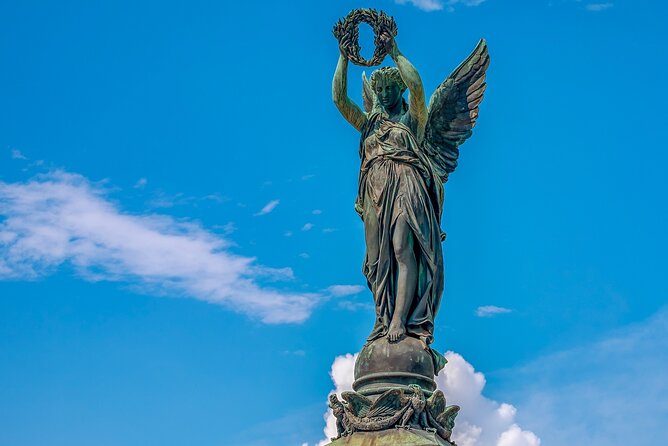
You start near Friedrichring 13 and ease into the story of Freiburg by way of the Siegesdenkmal, the Victory Monument. It is dedicated to the German army and marks Germany’s victory over France in the Franco-Prussian war of 1871. Even the way it was chosen adds a layer, because a public competition brought together 18 sculptors to select the design.
From there, the walk turns into something more playful. You pass the Haus zum Walfisch, the Whale house, a Gothic bourgeois house that is actually a complex made out of 17 buildings. That detail matters because it explains why the façade feels like a puzzle of connected structures instead of one tidy “single house.”
Then there is the pop-culture connection. This building was a central filming location for the 1977 horror film Suspiria. You do not need to be a film fan to enjoy it, because it gives you a memorable hook for an otherwise old, dense quarter.
Altes Rathaus and Gerichtslaube: government power in stone
Next you hit the civic heart around the old and new town halls. The Altes Rathaus is the old town hall building that houses the office of the government. It is in a Renaissance style, and it has many paintings inside, plus a bridge that connects the old town hall and the new town hall.
The real story is the 1944 bombing. The old town hall was destroyed and later reconstructed with three new wings. That single fact changes how you look at it, because you start seeing layers: medieval era setting, Renaissance features, and post-war rebuilding.
Just behind the old town hall sits the Gerichtslaube, the Old Court house. It is one of Freiburg’s oldest government buildings, dating to around the 13th or 14th century. When you stand there, you get a sense of how long this spot has been used for authority and decision-making, long before today’s city center was shaped.
A practical note: this is a stop where you can ask your guide to point out what would have mattered most to the people living and working here. Court buildings and town halls are not just architecture, they are the stage where local life played out.
Freiburg’s university roots: what started in 1457
After the civic sites, the tour shifts into Freiburg as an education city. You see the old university, opened in 1457, and it is said to have been run from many buildings rather than one central campus.
That matters because it explains why the city feels woven together. Instead of one “university area” you can circle on a map, Freiburg’s higher learning shows up as scattered spaces inside the Old Town fabric. Even now, a few research departments at the site of the old university still exist.
This is one of those moments where a guide helps you see patterns. You look at a building, but then you learn what kind of activity went on there and how Freiburg’s long school tradition shaped the city’s pace and priorities.
A few more Freiburg walks and trips to compare
- Freiburg: Exciting City Tour with sightseeing and history
★ 4.3 · 103 reviews - Freiburg: Walking and Strolling the Historic Center
★ 4.7 · 6 reviews - Leipzig: City History Canal Sightseeing Tour on a Motorboat
★ 4.7 · 7,671 reviews - Berlin: Natural History Museum Entrance Ticket
★ 4.6 · 3,382 reviews
Freiburg Cathedral: Romanesque structure with real staying power
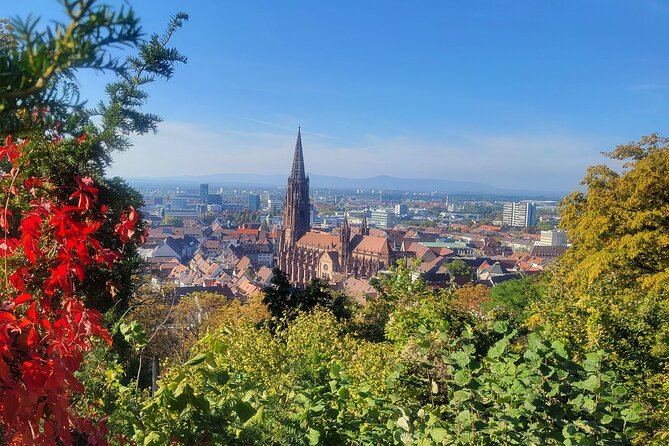
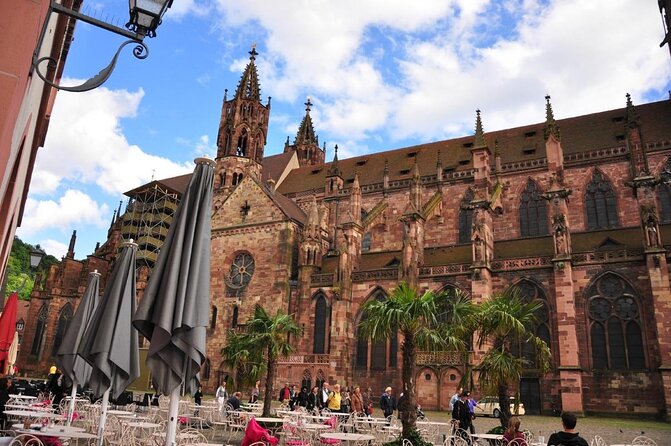
The highlight stop is usually Freiburg Cathedral, and for good reason. It is Romanesque in style, built around the year 1200 by the last duke of Zähringen. The structure survived the bombing raids of 1944, which is a huge part of why it still feels anchored to place.
Construction took nearly 300 years. That long timeline is more than trivia. It means you get a building that reflects multiple generations of builders, plus the odd human detail that the designers could not fully see it finished.
Inside, there are two important altars you may hear about: the Hans Baldung altar and the altar of Hans Holbein the Younger. If you are the type who likes to recognize names tied to art history, this is a strong stop.
One consideration: cathedral admission is not included in the tour price. The tour can get you to the right spot and give you context, but you may want to budget extra if you plan to go in.
Bertold’s Fountain and Kaiser-Joseph-Strasse: where tram lines meet myth
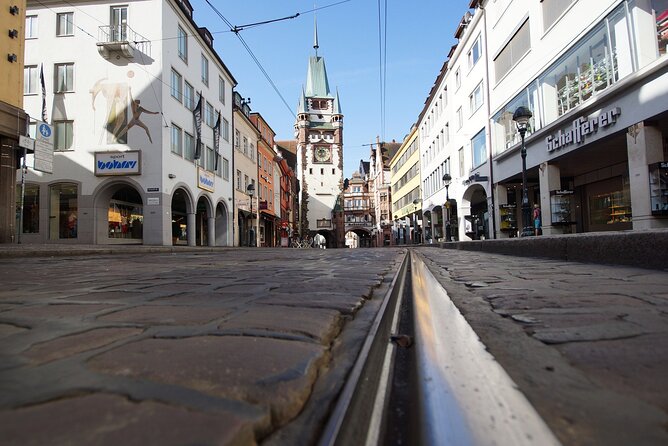
Before the gates, you hit Bertold’s Fountain, a historic monument with an equestrian statue. The original fish fountain was destroyed during World War II, and the current look is part of Freiburg’s post-war rebuilding story.
The location is also important for how you navigate later. Bertold’s Fountain sits in a central area where trolley car lines intersect with the shopping street known as Kaiser-Joseph-Strasse. You learn the lay of the land here, so the later gate walls and church stops feel like they belong to the same connected system.
If you like practical travel moments, this is it. You get oriented at a place where you are likely to pass again, and you understand why it is a natural meeting point.
Martinstor to Saint Martin’s church: a gate with a church nearby
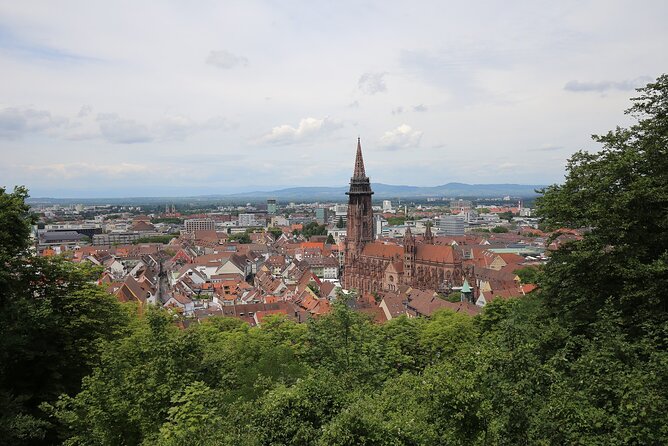
Next comes Martinstor, Martin’s gate, dating back to the 13th century. It is one of only two remaining gates out of five medieval gates, which is exactly why your guide points out how these walls once shaped movement and boundaries.
Crossing from the gate into the area near Saint Martin’s church gives you a sense of how defense and worship lived side by side. Saint Martin’s church dates back to 1206, and you might notice that its architecture changed over time, from baroque to neo-gothic influences. It was partially destroyed during the 1944 bombings, and reconstruction started in 1949.
This stop works best if you slow down for a minute and let the “layers” land. War, repair, and style shifts all show up in the same place, so the church feels less like a museum piece and more like a living building that kept changing.
Adelhauser Kirche: Dominican convents merged into one new setting
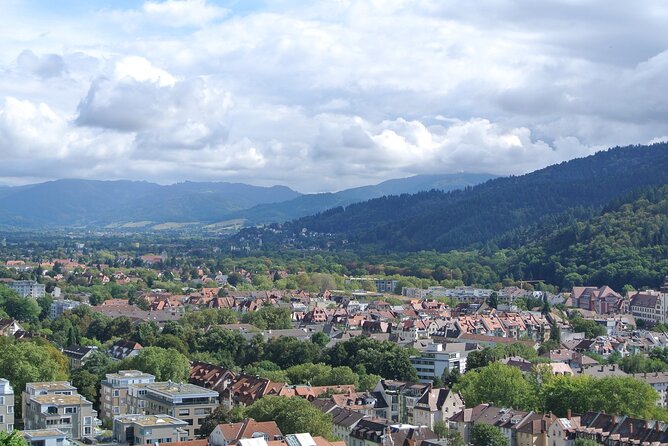
After the gate, you reach Adelhauser Kirche, specifically the Adelhauser New Convent. This is built by merging four medieval Dominican convents. The four convents had been centers of Christian mysticism during the Middle Ages, which gives you a very different flavor than the civic stops you already saw.
The new building was constructed under the direction of Jean La Douze in 1687. That date puts it firmly in the post-medieval era, when religious orders reshaped space to match changing life and needs.
Even if you only spend a short moment here, the value is in the contrast. One part of the tour teaches you how Freiburg governed itself. Another part shows how it educated and worshiped. This convent stop adds a third dimension, how spiritual practice shaped physical buildings.
Ending at Schwabentor: the other remaining medieval gate
You finish at Schwabentor, the Swabian gate, which dates back to the mid 13th century. Like Martinstor, it is one of the two remaining gates out of the five medieval gates.
This ending makes sense. After you have seen the cathedral, court buildings, and church architecture, you can finally “zoom out” and understand how the city’s defense system connected everything. You stop thinking about gates as isolated landmarks and start seeing them as infrastructure.
The tour ends at Oberlinden 25 near the Schwabentor area, with the Swabian gate as the final reference point.
Price and value: what $370.06 buys you
The price is $370.06 per group, up to 15 people. That sounds like a lot until you do the math for your actual group size. The key value is that it is private, so you are paying for an English-speaking guide plus a guided walking route that ties multiple major sites together into one coherent experience.
You also get practical scheduling value. You can pick from multiple times during the day, and the tour uses a mobile ticket. If your trip schedule is tight, a guaranteed start time and a structured route can save more stress than you expect.
Where the cost might feel less attractive is if you are traveling solo or as a tiny group. Then you are paying for the whole group price yourself. In that case, the tour still works well for orientation, but it helps to compare against your personal preference for private, guided time.
And remember: entrance fees are not included. The cathedral specifically is listed as not included, while some other spots are free if you want to step in.
The guide factor: lively stories even in heat
One of the strongest signals from the experience is that the guide can keep things lively. A past group highlighted a guide named Matthias as entertaining in very hot conditions, 35 degrees Celsius. That matters because Freiburg walking routes are exposed in places, and a dry factual lecture does not help you enjoy standing around buildings.
Even if you are not there on a heatwave day, a good guide makes the difference between seeing landmarks and understanding them. Here, the guide is clearly doing more than reciting dates. You connect the Franco-Prussian war monument with post-war reconstruction and then with the city’s defensive gates.
Who should book this tour
This is a great fit if you:
- Want a first-time orientation to Freiburg without spending a whole day reading guidebooks
- Like medieval university city details, not just one big cathedral stop
- Enjoy city structure, like how gates, courts, and churches shaped daily life
- Prefer a private format where you can ask questions and move at your pace
It may be less ideal if you only want “inside visits.” The tour covers many important exteriors and adds context, but entrance fees are separate, and the time is built around walking between key points.
Should you book this Freiburg Historic walking tour?
If you want to get your bearings quickly, this tour is a strong choice. You cover major Freiburg highlights in about two hours, you learn how the city rebuilt after 1944, and you finish at the Swabian gate with a better understanding of how the Old Town worked as a defended, organized place.
Book it if you value a private guided loop and want a clean route for your first day in Freiburg. Skip it only if you already know the city well or if you plan to spend most of your time on paid museum interiors rather than guided street-level context.
FAQ
How long is the Freiburg historic walking tour?
It runs for about 2 hours.
Is this tour private or shared?
It is a private tour/activity, so only your group participates.
What is the group size limit?
The tour is priced per group for up to 15 people.
Where do I meet the guide?
The start point is Friedrichring 13, 79104 Freiburg im Breisgau, Germany.
Where does the tour end?
The tour ends at Oberlinden 25, 79098 Freiburg im Breisgau, Germany.
What language is the guide?
The guide is an English speaking guide.
Is the ticket mobile?
Yes, it uses a mobile ticket.
Are entrance fees included?
No, entrance fees are not included.
Which major site’s admission is not included?
Freiburg Cathedral is listed as admission ticket not included.
What is the cancellation policy?
The experience is non-refundable and cannot be changed for any reason. If you cancel or ask for an amendment, the amount you paid will not be refunded.
Newest Freiburg reviews on the site
- Kling, mulled wine, klingelingeling – the Christmas city tour with Betty BBQ★ 4.0 · 9 reviews
- Veni vidi vino – the Freiburg wine hike★ 4.0 · 8 reviews
- Black Forest Tour by car – Quick Tour from Freiburg★ 5.0 · 13 reviews
- Group tour in Italian in Freiburg im Breisgau★ 5.0 · 6 reviews
- Hey, Hallöchen, Freiburg! – The Travestie City Tour with Betty BBQ★ 5.0 · 124 reviews
- Freiburg in Breisgau Scavenger Hunt and Sights Self-Guided Tour★ 4.5 · 25 reviews
- Private: Outdoor • Escape • Experience Freiburg: Luise & Friedrich★ 5.0 · 5 reviews
- Freiburg Self Guided Sherlock Holmes Murder Mystery Game★ 4.0 · 7 reviews
Historical Tours, compared.
City History Canal Sightseeing Tour on a Motorboat
Read our review →
Browse the lists this tour appears in