
Reviewed · SELF-GUIDED TOURS
Roman Cologne: A Self-Guided Audio Tour
Roman streets, explained by your phone. This self-guided audio walk turns Cologne Cathedral and other major sights into a story about what’s under your feet.
I especially like how the route links big landmarks with smaller details you’d normally miss at street speed. And you get to control the pace, stop when you want, and hear the same walk again later.
Two things I like a lot: the offline access (audio, maps, and geodata stay on your phone) and the way the narration follows a walkable storyline with practical prompts as you go. One possible drawback is navigation can feel fussy if you try to start somewhere else or walk the route in reverse, since the app uses GPS location cues.
In This Review
- Key highlights worth your time
- Entering Roman Cologne: what this walk really does for you
- VoiceMap setup: offline English audio that actually works on-site
- Finding the right start: Kreuzblume to Cologne Cathedral
- From the cathedral zone to Cologne’s Roman Northern Gate
- Roman-Germanic Museum mosaic window, then the harbor road puzzle
- Romisches Praetorium to Alter Markt: Roman power meets everyday streets
- Great St Martin Church, Roman warehouse foundations, and the value of looking up
- Schmitz Saule, Marsilius and Agrippa: quirky links that make the walk memorable
- St Maria im Kapitol, the Roman temple district, and ending near Ubii Monument
- Price and timing: is $11.99 good value for Roman Cologne?
- Should you book Roman Cologne with VoiceMap?
- FAQ
- How long is the Roman Cologne self-guided audio tour?
- How much does it cost?
- Is the audio available in English?
- Does the VoiceMap tour work offline after I download it?
- Where does the tour start and where does it end?
- What time can I take the tour?
- What do I need to bring with me?
- Are museum or attraction tickets included?
- Is this tour private for my group?
- Is this tour refundable if I cancel?
Key highlights worth your time
- Offline VoiceMap download: audio and maps stored on your device
- GPS-triggered narration: audio lines up with where you are
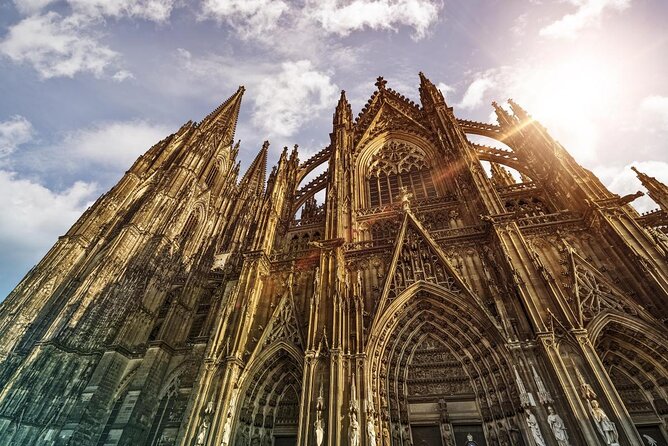
- Cologne Cathedral to Roman Cologne: modern monuments explained through Roman layers
- Roman mosaics without a full museum detour: you can see a major mosaic through a museum window
- Fun, oddball connections: moon landing 1969 and ancient Romans
- A satisfying finish at Ubii Monument: you end with Cologne’s oldest stone tower
Entering Roman Cologne: what this walk really does for you
Cologne is one of those cities where the present sits right on top of the past. What this Roman Cologne audio tour does well is give you a way to read the streets as evidence, not just scenery. You’ll keep seeing the same theme: Roman structures, later reuse, and how the medieval and modern city grew around them.
If you like walking with context, this is a strong fit. I like that it focuses on a clear chain of places, from the cathedral area to Roman sites like the northern gate and the big Roman palace. You end up with a mental map of Cologne’s Roman layer instead of a list of stops.
The tone is also suited to a self-guided format. You aren’t forced to match someone else’s pace, and you can pause for photos, a coffee, or just to look harder at the façades and street angles.
A few more Cologne walks and trips to compare
- Cologne: Panoramic City Cruise
★ 4.3 · 5,698 reviews - Cologne: Brewery Tour with 3 Kölsch Beer Tastings
★ 4.7 · 3,108 reviews - Cologne: Top Sights Rhine River Cruise – Skyline Tour
★ 4.4 · 3,030 reviews
VoiceMap setup: offline English audio that actually works on-site
This tour uses the VoiceMap app on Android and iOS. The big practical win is that you get offline access: audio, maps, and geodata are stored on your phone after download. That means you can take the walk without relying on constant mobile data.
It also has lifetime access and no time pressure. Once you buy the tour, you can come back and use it later, which is great if you’re staying a few days and want to choose your best walking time.
One important tip: download ahead of time while you have a solid connection, then test it. If you’re the type who assumes everything will run in real time online, you can accidentally plan your day wrong. Aim to have the tour ready before you step outside.
Finally, the tour is in English. That’s a plus for anyone who wants a self-guided experience without translating or struggling with limited signage.
Finding the right start: Kreuzblume to Cologne Cathedral
The walk starts in front of the Kreuzblume. The listed starting address is Cologne Cathedral Domkloster 4, so in practice you want to be in the cathedral zone and at the correct marker before you hit play.
Here’s why the exact start matters: the app uses GPS location cues to trigger the narration as you move. That’s convenient because you can walk with your phone in your pocket more often, but it also means the storyline is designed around the intended route order.
If you start somewhere else, you can end up with mismatched audio timing, especially if you try to walk backward. The app is set up to skip locations, but it’s not really designed for reverse-walking.
So do yourself a favor: start where the tour tells you to, then let GPS guide the audio. You’ll spend less time fiddling and more time reading the buildings.
From the cathedral zone to Cologne’s Roman Northern Gate
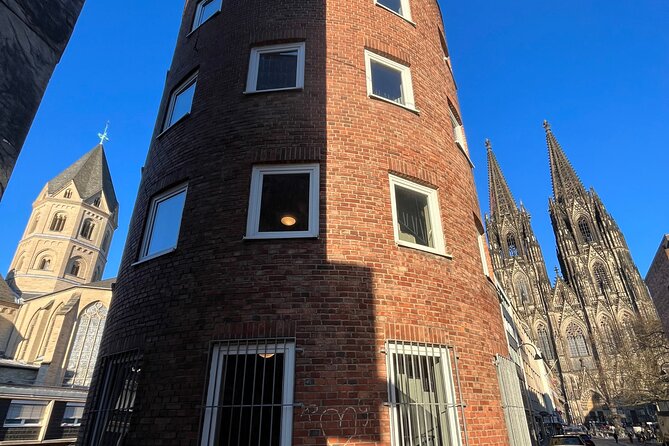
After you get going, one of your first major anchors is Cologne Cathedral. The tour walks you past it and gives you the cathedral’s role in the larger story of the city you’re standing in.
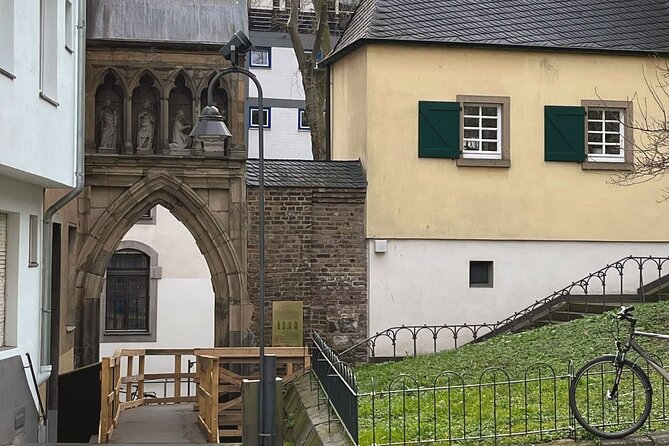
Then you move toward the Romans’ Northern Gate. This is the kind of stop that gets more interesting the longer you look. Even if you’re seeing only a portion of the structure or its surroundings, the narration helps you understand how Roman fortification and city planning shaped what came next.
At this stage, I like that the walk stays visual. You’re not stuck reading museum-style labels. You’re watching how the Roman city would have felt spatially, while the modern city explains itself around it.
A good way to experience this section is slow down for street intersections. Roman planning often shows up in how streets connect and where major entrances sit relative to other landmarks.
Same city, a different way to spend the afternoon:
- Cologne: Chocolate Museum Entrance Ticket
★ 4.4 · 2,790 reviews - Cologne: 24h Hop-On Hop-Off Sightseeing Bus Ticket
★ 4.3 · 2,735 reviews - Cologne: Melaten Cemetery Life, Love and Death Tour
★ 4.9 · 2,728 reviews - Cologne: Night Watchman Old Town Walking Tour
★ 4.6 · 1,638 reviews
Roman-Germanic Museum mosaic window, then the harbor road puzzle
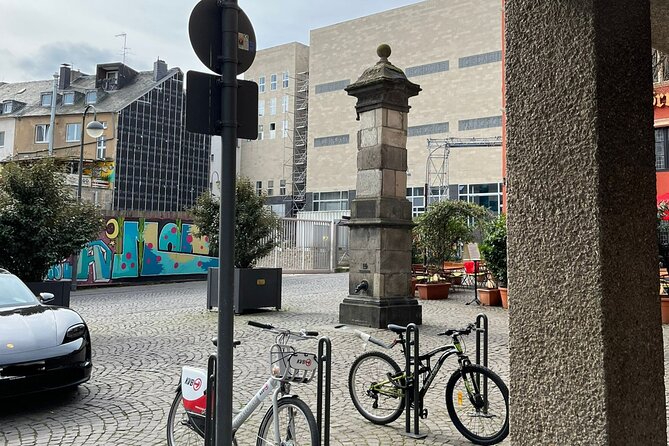
One of the smartest moments on the route is the Roman-Germanic Museum mosaic window. The tour invites you to peer through the window to see one of the world’s largest and best-preserved Roman mosaics. That’s a huge value move if you don’t want to commit to full museum entry, since admission tickets are not included.
You’re also getting a “use your eyes” experience. You don’t need to be an art expert to appreciate that a mosaic this well preserved belongs to a Roman world that survived in remarkable fragments.
Next you head down Die Römische Hafenstraße in Köln. The narration gives you the street-level reasoning behind why this Roman harbor road was only imperfectly rebuilt, with a specific reference to Kurt Hackenberg Platz. That detail matters because it turns a normal street into a historical clue.
If you’re the kind of person who likes cause and effect, this section delivers. It’s not just Roman sites named for Roman sites’ sake. You learn what was rebuilt, what changed, and how the city’s modern layout still hints at the original.
Romisches Praetorium to Alter Markt: Roman power meets everyday streets
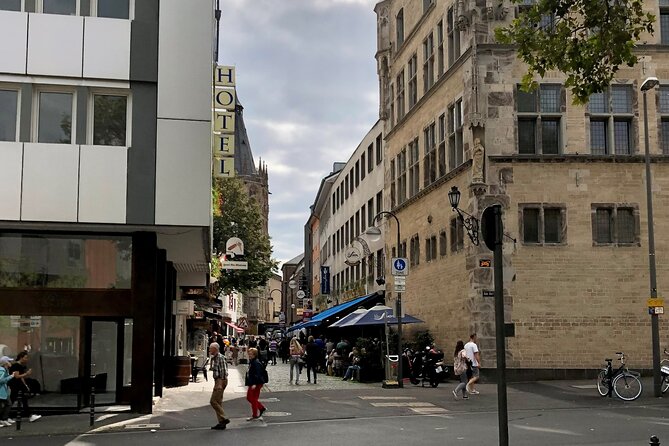
As you continue, you pass by the Romisches Praetorium, described as the largest Roman palace in the Rhineland. This is your “scale” stop. The point isn’t only to admire a landmark, it’s to understand the Roman administrative and political footprint here.
Then the tour takes you through Alter Markt, the old market area of Cologne. This is where the walk gets more relatable. Markets are where daily life happens, and linking a Roman center to a later marketplace helps you see how the city kept reinventing its purpose on similar ground.
The pairing works: you’ve just been thinking about power and buildings, and now you’re thinking about trade and routine. That rhythm helps the story stick.
A practical tip: when you reach the market area, take a moment to look around before your next audio cue. The narration makes more sense when you can see the human scale of the space around you.
Great St Martin Church, Roman warehouse foundations, and the value of looking up
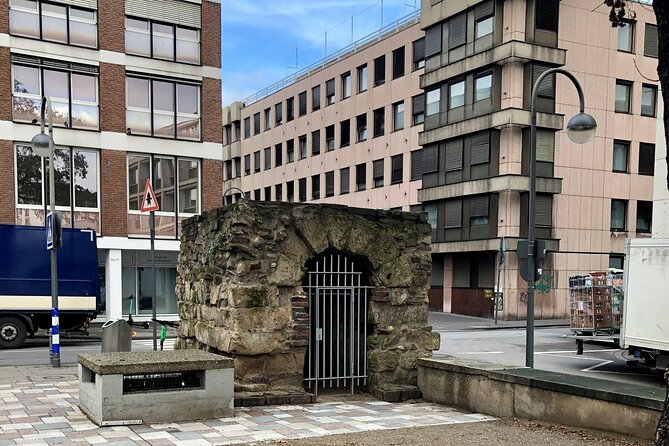
One of the most interesting medieval connections comes at Great St Martin Church. The tour explains that it was built in the Middle Ages on the foundations of a Roman warehouse. That single fact turns the church from a standalone sight into a layered reuse story.
When you stand near a building like this, you’ll probably notice the scale and materials first. The audio helps you notice something else too, the idea that Romans built a function, then later centuries kept using that footprint.
I also like this stop because it gives you a reason to watch for clues in architecture rather than expecting a big obvious ruin. Not everything Roman is waiting to be photographed like a postcard.
If you want to make this part extra effective, pause for a slow scan of façade lines and street approach angles. Even without entering any site, you’ll catch how a Roman industrial space could fit into a later church-centered urban layout.
Schmitz Saule, Marsilius and Agrippa: quirky links that make the walk memorable
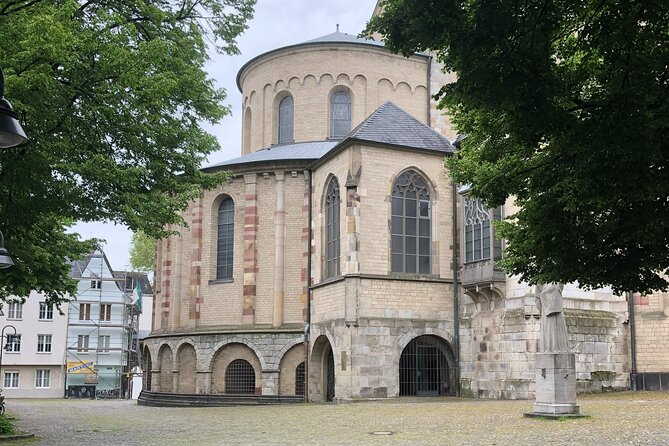
This route has room for personality, and two spots show it well.
First, Schmitz Saule. The tour connects the 1969 moon landing to the ancient Romans in Cologne. Even if you don’t usually care about pop-science or space history, the connection gives your brain a fun hook to remember the Roman setting. It also makes the tour feel less like a lecture.
Second, you’ll pass Schmitz Saule and then hear how to spot celebrated Roman soldiers, Marsilius and Agrippa, on the Gürzenich Köln Gothic facade. This is exactly the kind of instruction that makes a self-guided tour worth paying for. Instead of walking past a façade, you get a reason to search it.
This section is also a good “hands in your pockets” moment. The narration is guiding your attention, not telling you to run around. You can look when the audio cue tells you to look, then move on when it does.
St Maria im Kapitol, the Roman temple district, and ending near Ubii Monument
As you move toward the final stretch, you’ll pass through the former Roman temple district and see St Maria im Kapitol. The audio ties this area to the idea of Roman sacred space and helps you understand why this part of the city feels important in a different way than the market or harbor zones.
Then the tour ends near the Ubii Monument, described as the oldest stone tower in Germany. This finish is satisfying because it gives you something solid and unmistakable at the end of your walk, a final anchor that turns the whole route into a complete arc.
One more practical note: the listed end address is Mühlenbach 35, Cologne, and the tour ends near the Ubii Monument. If you want a clean finish, plan to end your stroll there rather than cutting the walk early.
Price and timing: is $11.99 good value for Roman Cologne?
At $11.99 per person, you’re paying for a walkable story you can use on your schedule. The big value boosters are lifetime access, offline support, and a route that’s designed around major Roman and Roman-linked sites.
A 1 hour to 1 hour 30 minutes pace is realistic for a self-guided audio walk if you stop briefly for photos and street reading. If you walk faster, you might compress it. If you linger, you’ll stretch it toward the upper end.
What you should bring is simple, but do it. You need your smartphone and headphones, since they are not included. Also, keep your phone battery in mind, since GPS audio works best with a reliable charge.
If you want extra value, you can use this tour on a day when museums are closed. Even where you only peer through a window, you still get the Roman context without paying additional admission.
Should you book Roman Cologne with VoiceMap?
Book it if you want a self-guided way to understand how Cologne’s Roman layer shaped the modern city. I’d especially recommend it if you like walking at your own pace, and if you value offline audio so your day doesn’t depend on mobile coverage.
Skip it if you want lots of time inside museums, or if you get annoyed by phone-based navigation and GPS cues. Also, if you’re the type who needs constant action and doesn’t like pausing to look at stone, plaques, and façades, the tone may feel too calm.
For most people, this is an efficient way to turn “I’ll see a few sights” into “I understand why these places matter.” You finish with a clearer sense of Cologne as a city built in layers.
FAQ
How long is the Roman Cologne self-guided audio tour?
The tour is approximately 1 hour to 1 hour 30 minutes, depending on how long you stop at each location.
How much does it cost?
It costs $11.99 per person.
Is the audio available in English?
Yes, the tour is offered in English.
Does the VoiceMap tour work offline after I download it?
Yes. Once downloaded, the audio, maps, and geodata are stored on your device, so you can access the tour offline.
Where does the tour start and where does it end?
It starts at Cologne Cathedral Domkloster 4, 50667 Köln, Germany, and it ends near the Ubii Monument at Mühlenbach 35, 50676 Köln, Germany.
What time can I take the tour?
The experience lists opening hours as Monday through Sunday, 12:00 AM to 11:59 PM for the given availability window.
What do I need to bring with me?
You need your own smartphone and headphones. Tickets or entrance fees for attractions along the route are not included.
Are museum or attraction tickets included?
No. Tickets or entrance fees are not included, even though you’ll pass by places like the Roman-Germanic Museum.
Is this tour private for my group?
Yes. It’s listed as a private tour/activity, with only your group participating.
Is this tour refundable if I cancel?
No. The experience is non-refundable and cannot be changed for any reason.
Newest Cologne reviews on the site
- Cologne City Tour “Domstadt Experience” Exclusive tour for up to 12 people★ 5.0 · 6 reviews
- Street Art Tour Cologne Ehrenfeld★ 5.0 · 64 reviews
- XXL tour (11km)★ 5.0 · 3 reviews
- Street Art Tour Köln Ehrenfeld★ 5.0 · 33 reviews
- Hard Rock Cafe Cologne With Set Lunch or Dinner★ 4.0 · 45 reviews
- City Tour per Rikscha in Cologne★ 5.0 · 26 reviews
- Scavenger hunt Belgian Quarter Cologne★ 5.0 · 8 reviews
- e-Scavenger hunt Aachen: Explore the city at your own pace★ 4.0 · 13 reviews
Self-Guided Tours, compared.
Neuschwanstein Castle Skip-the-Line Ticket with Audio Guide
Read our review →
Solar Powered Sunset Catamaran Cruise & Audio Guide
Read our review →
Neuschwanstein Castle Express Ticket and Audio Guide
Read our review →
Neuschwanstein Castle Ticket With Audio Guided Tour
Read our review →
Spicy’s Gewürzmuseum Entry Ticket and Audio Guide
Read our review →
Browse the lists this tour appears in