
Reviewed · OLD TOWN WALKING TOURS
Koblenz – Old Town including the Deutsches Eck
Koblenz starts making sense fast. This private, 2 hour introductory walk threads together the Old Town and the Deutsches Eck headland, so you learn the why behind the sights instead of just ticking boxes. You also get built in context for the Rhine and Moselle confluence, which is the whole reason Koblenz exists in the first place.
I especially like two parts of the experience. First, you get a focused route through major landmarks like Liebfrauenkirche and the Basilica of St. Castor, with free entry at each stop. Second, the guide approach is clear and lively, which helps you understand the stories in plain language without needing to be a church-history buff.
One thing to keep in mind: it is a short, intro style tour. If you want long time inside churches or extra time for photos, you will likely do best adding a little free time on your own after the walk.
In This Review
- Key Things You Will Notice on This Koblenz Walk
- Getting Your Bearings in Münzplatz and the Roman Confluence
- Liebfrauenkirche and the Romantic Street Between Two Churches
- Basilica of St. Castor: Carolingian Roots in Plain Sight
- Schangelbrunnen at City Hall, France Ties in Stone
- Deutsches Eck and the Kaiser Wilhelm Memorial Views
- Why the Private, English-Led Format Matters for First-Timers
- Price and Value for a 2-Hour Old Town Introduction
- What to Pair This With After the Tour
- Who This Tour Suits Best, and Who Might Want Something Different
- Should You Book This Koblenz Old Town and Deutsches Eck Tour?
- FAQ
- How long is the Koblenz Old Town tour?
- What is the price?
- Is this a private tour?
- What language is the tour offered in?
- Do I get a mobile ticket?
- Where do we meet?
- Where does the tour end?
- Are there admission fees for the stops?
- Can I cancel for a full refund?
- Is the tour suitable for most people?
Key Things You Will Notice on This Koblenz Walk
- Münzplatz’s Roman roots, tied to the confluence name history
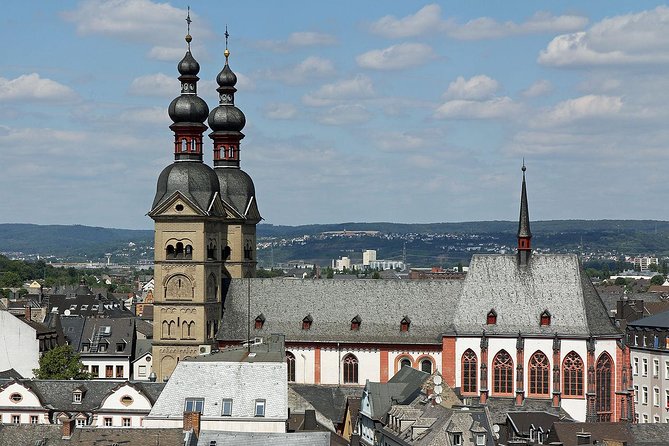
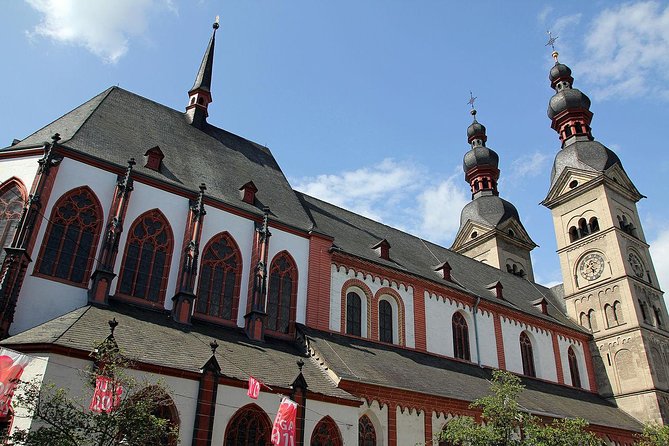
- Liebfrauenkirche’s onion domes, plus the fast story of destruction and rebuilding
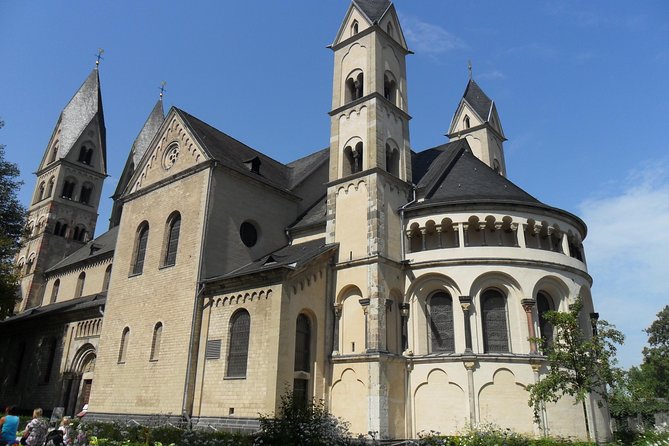
- Basilica of St. Castor (817 to 836), where Carolingian-era origins are right in front of you
- Schangelbrunnen’s French connection, linked to Koblenz being under French allegiance from 1794 to 1813
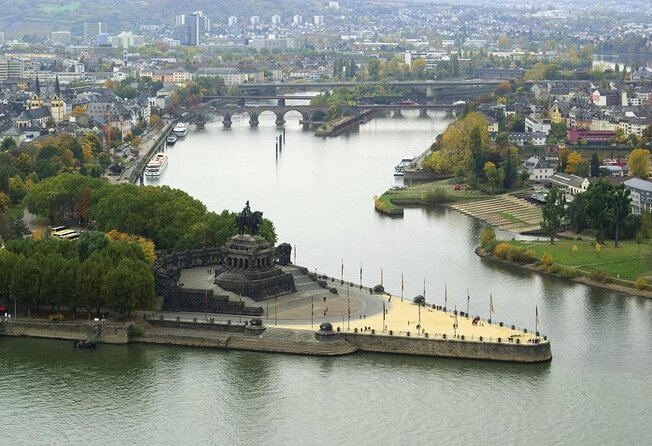
- Deutsches Eck and the Kaiser Wilhelm memorial, anchored to 1897 and end-of-tour views
Getting Your Bearings in Münzplatz and the Roman Confluence
You start at Münzplatz square in Koblenz’s Old Town, and it is a great choice because it immediately connects geography with history. Münzplatz name comes from the electoral coin called Münz, minted in the 11th century. That coin detail sounds small, but it is exactly the kind of clue that makes the city feel specific, not generic.
The fountain in the square was built in 1992 by Wili Heinzen as a gift from Sparkasse Koblenz for the 2000 year anniversary. Then the tour adds the bigger picture: Romans first founded their Castellum apud confluentes, a fort at the confluence, which is part of how Koblenz got its name. Translation for your brain: you are standing where the river meeting point mattered early, not just today.
Practical tip: take a moment here to look around before you move on. Even if you have never visited Koblenz, the square helps you lock onto the Old Town layout so the rest of the walking route feels obvious instead of confusing.
More old-town walks in Koblenz:
- Koblenz: Old Town Sightseeing Cruise along the Rhine
★ 4.5 · 305 reviews - Koblenz – Old Town with the Ehrenbreitstein Fortress
★ 4.0 · 7 reviews - Koblenz: Old Town Tour with the Ehrenbreitstein Fortress
★ 4.8 · 4 reviews
Liebfrauenkirche and the Romantic Street Between Two Churches

From Münzplatz, you move toward Liebfrauenkirche, perched on the highest point of the city. The church is known for its onion domes, and that look is your visual cue that Koblenz has layers of style, not one single era.
The history story is also dramatic in a way that stays understandable. During the French Revolution, Liebfrauenkirche was one of the main parish churches. The building was constructed in the 17th century, destroyed in 1944, and then rebuilt again in 1955. So you are not only seeing a pretty church facade. You are seeing a record of what war did, and how the city chose to restore.
Then you get something I really like: the guide frames the walk as a romantic street between two churches. That matters because it turns a short stroll into a mini experience. You are walking with a story in mind, noticing viewpoints and sightlines, not just reading plaques later.
Possible drawback: if you are hoping for a very long photo stop at the domes, this portion is short. It is designed for orientation, not a slow wander. You can always come back on your own for extra shots once you know what angles you like.
Basilica of St. Castor: Carolingian Roots in Plain Sight
Next up is the Basilica of St. Castor, and this stop is a big deal for anyone who likes older European foundations. The basilica is the oldest church in Koblenz, built by the Archbishop of Trier between 817 and 836, with support from Emperor Louis the Pious. That date range is early enough to make the city feel like it was built on purpose, not by accident.
The tour also explains that it was built as a Carolingian proprietary church. That term can sound heavy, but in context, it signals power. This is a place where ruling influence shaped religion and civic life. In other words, this is not a church you look at from a distance. It helps explain why Koblenz became important.
Why this is valuable for you: when cities have a cathedral or a big centerpiece, it is easy to assume that is where the story starts. St. Castor flips that. It shows you an earlier layer, then ties it into the newer streets and monuments you will see later.
Practical note: entry is free, so you can take advantage of the stop without thinking about ticket math. If the interior is open when you arrive, you will have the option to spend a little time with the details instead of rushing.
Schangelbrunnen at City Hall, France Ties in Stone
After the older church stop, the tour moves into a more city-center, picture-friendly zone at Schangelbrunnen. This is at the city hall area, and it is timed so you get a calm moment to regroup while still learning.
Here is what makes Schangelbrunnen more than a decorative fountain. The word Schängel comes from Koblenz’s 20-year allegiance to France from 1794 to 1813. You are watching how political history turns into local identity, and the fountain becomes a symbol of the city.
The fountain design was made in 1940 by Carl Burger and dedicated to the poet Josef Cornelius. So the story has multiple layers at once: French-era history, a local nickname, and cultural celebration in one visible spot.
If you like travel that feels grounded in everyday place names, this stop hits well. You start connecting “what locals call things” with “why those names exist.” It makes future walks through Koblenz feel less like reading a textbook and more like understanding a living place.
A few more Koblenz walks and trips to compare
- Koblenz: Rhine Valley Castles and Palaces Boat Tour
★ 4.4 · 1,824 reviews - Koblenz:Rhine Valley boat tour along the castles and palaces
★ 4.5 · 1,084 reviews - Koblenz: Panoramic Cruise on Moselle River to Winningen
★ 4.4 · 283 reviews - From Alken: Return Day Trip by Boat to Cochem
★ 4.6 · 141 reviews
Deutsches Eck and the Kaiser Wilhelm Memorial Views
The tour ends at Deutsches Eck, the German Corner headland in Koblenz. This is the stop that gives the whole route meaning, because you finally arrive at the key geographic stage: the end of the Rhine-Moselle story and the landmark point for major monuments.
The name Deutsches Eck is tied to Kaiser Wilhelm. The first German Emperor had a memorial erected in 1897, and the headland is named for him. It is a strong punctuation mark at the end of a history-forward walk, because it shows how the city’s strategic location also shaped national identity.
What you should plan for here: the tour allots more time than earlier stops, around 35 minutes. That extra chunk is helpful if you want to take in river views and linger for photos. It is also where you can think back to what you learned in the Old Town streets and connect the story to the actual confluence setting.
If weather is good, this is where you will feel the payoff. If weather is bad, at least you get an easy walking finale, and you can head off toward coffee or a riverside stroll knowing exactly what you just learned.
Why the Private, English-Led Format Matters for First-Timers
This is a private tour for your group, up to 15 people, and it is offered in English. For first-time visitors, that private element often matters more than people expect. Small group tours can keep things moving, but a private setup tends to let you ask for clarification when something catches your attention.
It also means your time stays coherent. You do not get bounced between multiple groups with different pacing needs. You also start and end at the exact points listed, which reduces the time you spend figuring out where you are supposed to be next.
One more thing: because each stop is built around major, free entry landmarks, the guide can spend less time negotiating tickets and more time explaining what to notice. I find that makes the whole experience feel efficient. In two hours, you cover the most important visual anchors and the stories that tie them together.
Price and Value for a 2-Hour Old Town Introduction
The price is $420.53 per group, up to 15 people, for about 2 hours. That might sound high if you are thinking per person before you consider group size. If your group fills closer to 15, your cost per person drops dramatically. Even if your group is smaller, you are paying for a direct, guided route that does not waste time.
Here is what you are really buying with the price:
- A guided, English-led orientation through core Old Town landmarks
- Free entry stops at each major church and key square points
- A route that ends at Deutsches Eck, so you get views and context in one loop
- A private format, which often means smoother pacing and better explanations
Compared with piecing together Koblenz sights on your own, the big value is the context. Münzplatz’s Roman confluence detail, St. Castor’s 817 to 836 timeline, Liebfrauenkirche’s destruction and rebuild in 1944 and 1955, and Schangelbrunnen’s French-era identity link are the kinds of details that can be hard to assemble by yourself unless you already know what to look for.
Duration also matters. Two hours is short enough to fit on a travel day, but long enough to feel like you did more than a quick stroll.
What to Pair This With After the Tour
Because this is an intro walk, you should treat it as your launchpad. After you finish at Deutsches Eck, you will likely want to:
- Spend extra time simply taking in Rhine and Moselle viewpoints
- Go back to whichever church stop you liked most and linger longer
- Walk a bit further along the Old Town streets you passed earlier, now that you know the why behind the names
If you like good photo timing, Deutsches Eck is your natural first choice for lingering. The extra time built into the route also hints that this is where you will want it most.
If you are a museum or gallery person, you might want to keep your schedule flexible. The tour uses short stop times at earlier points, so you can layer in any additional indoor time based on what is open when you arrive.
Who This Tour Suits Best, and Who Might Want Something Different
This tour is a great match for:
- First-time Koblenz visitors who want orientation fast
- Travelers who enjoy city history told through specific places, not just general background
- Anyone who appreciates churches, squares, and monuments with clear timelines
It may be less ideal if:
- You want long interior time inside churches, because the stops are short and focused
- You prefer deep architectural analysis at length, because the format prioritizes overview and context
- You dislike guided walking tours, even if the guide is clear and lively
The key point is that this tour aims to get you oriented and informed quickly. If that is your goal, it fits well.
Should You Book This Koblenz Old Town and Deutsches Eck Tour?
If you want a simple, high-value way to understand Koblenz in a short window, I think this is an easy yes. The route hits the big visual anchors (Old Town squares, major churches, and the headland), and it layers in specific historical facts that you can carry with you while you wander.
Book it if you are:
- Short on time
- New to Koblenz
- Planning to explore on foot afterward and want your questions answered early
Skip or consider an alternative if:
- You want lots of free time for slow roaming or extended interiors
- You already know Koblenz deeply and only need views, not explanations
If you do book, show up ready to walk and look up. When you leave, you should feel like Koblenz has a clear story, not just a list of sights.
FAQ
How long is the Koblenz Old Town tour?
It lasts about 2 hours.
What is the price?
It costs $420.53 per group, up to 15 people.
Is this a private tour?
Yes. Only your group participates.
What language is the tour offered in?
The tour is offered in English.
Do I get a mobile ticket?
Yes, the tour uses a mobile ticket.
Where do we meet?
The meeting point is Münzplatz (Münzpl., 56068 Koblenz, Germany).
Where does the tour end?
The tour ends at Deutsches Eck (Konrad-Adenauer-Ufer, 56068 Koblenz, Germany).
Are there admission fees for the stops?
The stops listed are marked as free admission.
Can I cancel for a full refund?
Yes. You can cancel up to 24 hours in advance for a full refund.
Is the tour suitable for most people?
Most travelers can participate.
Newest Koblenz reviews on the site
- e-Scavenger hunt Koblenz: Explore the city at your own pace★ 4.0 · 20 reviews
- Koblenz – Old Town with the Ehrenbreitstein Fortress★ 4.0 · 7 reviews
- Koblenz Guided tour of the Ehrenbreitstein Fortress★ 4.5 · 7 reviews
- Loreley-Rhinecruise with All-Inclusive Brunch Buffet★ 4.8 · 14 reviews
- Kultour: Rhine boat trip and Loreley tour★ 3.3 · 6 reviews
- Koblenz: The Living Vineyard, Nature & Wine Enjoyment★ 5.0 · 14 reviews
- Koblenz: Sektmuseum Histor. Kelllergewölbe incl. 1 Glas Sekt★ 4.5 · 41 reviews
- Koblenz: Wein-& Sektgeschichte(n) incl. Wein/Sekt Verkostung★ 4.7 · 8 reviews
Old Town Walking Tours, compared.


Old Town & Viktualienmarkt City Walk in German
Read our review →

Browse the lists this tour appears in