
Reviewed · OLD TOWN WALKING TOURS
Düsseldorf Old town – guided tour
Düsseldorf’s Old Town is basically one bar. On this guided Düsseldorf Altstadt walk, you get the story behind the area nicknamed the longest bar in the world, plus key landmarks like the Marktplatz town square and town hall complex. I like how the tour connects food and drink culture to the city’s architecture, so it feels more real than a checklist.
The big plus is the mix: you’ll move from classic civic sights to a Rhine-side tower museum, then finish at the Tonhalle concert hall area. One thing to plan for is that entrance fees are not included, so you should expect to pay separately for the museum stop.
In This Review
- Key points before you go
- Starting in Altstadt, the longest bar in the world
- Marktplatz in 14th-century form, with Jan Wellem at center stage
- Town hall architecture and what it teaches you about Düsseldorf
- John Sigismund: a statue that explains a political connection
- The Rhine tower stop: preserved palace tower and maritime life
- Inside the Schifffahrt Museum: a focused look at inland navigation
- Tonhalle and Ehrenhof: Wilhelm Kreis architecture to end the loop
- Price and logistics: $406.51 for up to 15, and when it’s a value
- What you’ll notice most: the tour’s strongest strengths
- Who this tour suits best in Düsseldorf
- Practical tips to make the 1.5 hours feel longer
- Should you book this Düsseldorf Old Town guided tour?
- FAQ
- How long is the Düsseldorf Old Town guided tour?
- How much does the tour cost?
- Is the tour private?
- What language is the guide?
- Where does the tour start and where does it end?
- Is pickup available?
- Are entrance fees included?
- Do I get inside the Maritime Museum?
- When do I receive confirmation?
- What is the cancellation policy?
Key points before you go
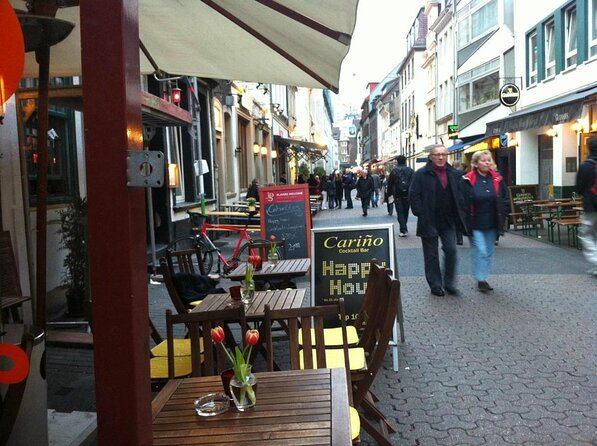
- Altstadt, the longest bar in the world with 300-plus bars and discotheques as your walking backbone
- Marktplatz and town hall complex including Old City Hall, Wilhelminische Bau, and the Grupello house
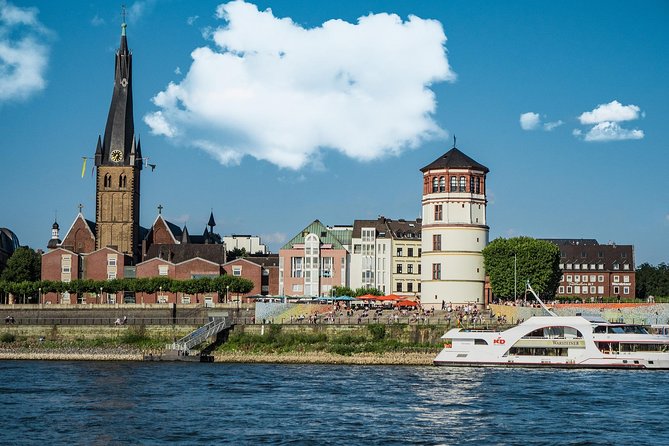
- Rhine-side Schifffahrt Museum inside a preserved castle tower with rounded and hexagonal levels
- John Sigismund statue ties together local power and Prussian connections
- Tonhalle finale near Ehrenhof with Wilhelm Kreis architecture and Düsseldorfer Symphoniker context
- Private, English-speaking group tour limited to your group (up to 15) for more Q and answers
Starting in Altstadt, the longest bar in the world
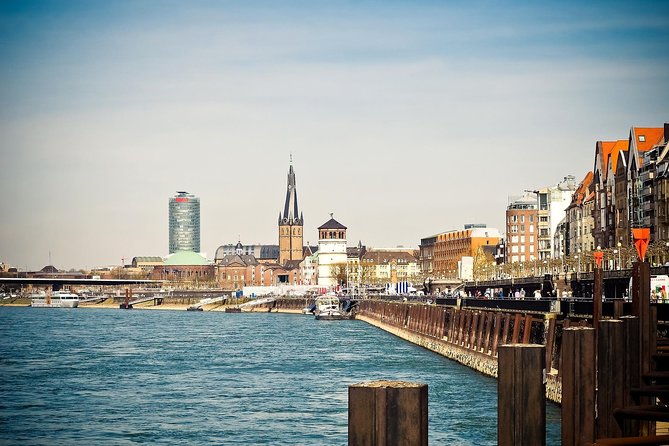
The tour begins in Düsseldorf’s Altstadt, the compact Old Town district where the “longest bar in the world” nickname makes practical sense. You’ll be walking through streets that are so dense with bars and discotheques that the whole area feels like one continuous night out, even in daylight.
What I like about the way this tour starts is that it sets expectations fast. Before you hit the big squares and monuments, you get the social DNA of Düsseldorf, and the rest of the walk clicks into place. You’re not just looking at buildings, you’re learning what people actually came here to do, and why the city’s center still works as a gathering point.
This part is also a good reality check for pacing. Since the tour lasts about 1 hour 30 minutes, you should treat the first segment as your orientation, not a slow meander. Wear comfortable shoes, because “Old Town” in Düsseldorf means lots of short walks through tight streets.
More Old Town Walking Tours in Dusseldorf
- Dusseldorf: Old Town & Altbier Tour
★ 4.7 · 585 reviews - Düsseldorf: Altstadt Guided Tour
★ 4.5 · 447 reviews - Düsseldorf: Sweet Treats Guided Walking Tour of Old Town
★ 4.7 · 66 reviews
Marktplatz in 14th-century form, with Jan Wellem at center stage
Next comes the Marktplatz, the city’s central square in the Old Town. It was created during the first city expansion in the 14th century and is first documented in 1392, so you’re standing on a space that has been serving public and representative purposes for centuries.
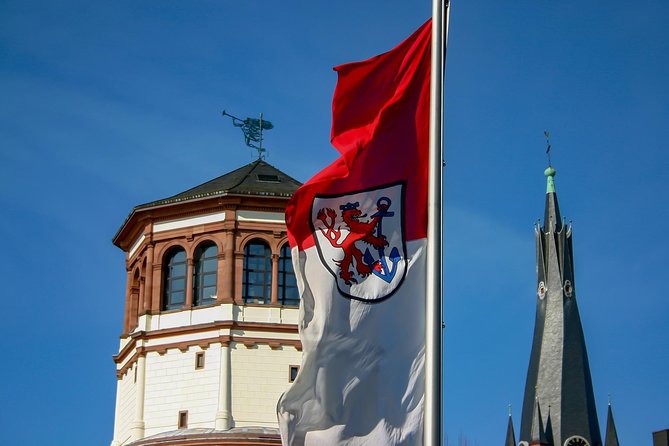
The square is dominated by the town hall complex and the Jan Wellem equestrian monument. That combination matters because it shows how Düsseldorf pictured authority: not hidden in back rooms, but staged out in the open where people could see civic power at work.
Inside the town hall complex, you’ll encounter three distinct buildings from different periods: the so-called old city hall, the Wilhelminische Bau, and the Grupello house. Even if you are not a hardcore architecture person, this trio gives you a quick lesson in how cities evolve, piece by piece, without starting over from scratch.
If you want to get the most out of this stop, I’d suggest asking your guide to explain what each building period changes in the overall look. You’ll usually spot more once you know what to compare, and that turns photos into a memory instead of just a record.
Town hall architecture and what it teaches you about Düsseldorf
Town hall complexes can feel intimidating when you are just rushing past them. Here, the guide’s job is to slow you down enough to notice the differences, so you can tell one building phase from another.
A nice detail on this tour is that you’re not only going to the square, you’re actually seeing the components of the civic complex as a group. That helps you understand why Marktplatz stays important today: it’s not only a historic location, it’s still a visual anchor for the city center.
This is also a good moment to ask practical questions. For example, you can ask what kinds of events typically happen in such public squares, or how the Rhine and Düssel waterways influenced where the city expanded first. The best guides connect landmarks to everyday life, even on a short 1.5-hour route.
John Sigismund: a statue that explains a political connection
After the town hall sights, the walk moves to the statue of John Sigismund. This is not just a name on a pedestal. The statue depicts John Sigismund as a prince-elector of the Margraviate, who later became Duke of Prussia after marrying Duchess Anna.
That family-and-power detail is exactly the kind of context that makes sculpture worth your time. You start noticing that monuments in the Altstadt are doing double duty: honoring individuals, and reminding you how regional politics shaped what happened next.
If you are the type who enjoys historical “why this matters” moments, this stop will land well. If you are less interested in the political timeline, you can still use the statue as a visual landmark to regroup, take a photo, and reset your attention for the Rhine-side museum portion.
More old-town walks in Dusseldorf:
- Düsseldorf: Tipping based – Old Town Walking Tour
★ 4.8 · 38 reviews - Düsseldorf: Guided Old Town Tour with Beer Break
★ 4.9 · 31 reviews - Düsseldorf: Old Town Interactive Crime Tour with actor
★ 4.9 · 22 reviews - Düsseldorf: Old town and banks of Rhine – heart and lifeline
★ 5.0 · 7 reviews
The Rhine tower stop: preserved palace tower and maritime life
One of the most interesting stops on this route is the castle tower, described as the only preserved part of the city’s former palace. This tower has three round floors and one hexagonal decorated with Tuscan columns, and it sits by the Rhine where you can practically feel the connection between the city and the river.
This part is also valuable because it gives you a perspective shift. Up to now, you’ve been in civic space, but here you’re moving into what the river enabled. In many Rhine cities, the real engine of growth was navigation and trade, and this tower is built to reflect that relationship.
Inside, you’ll find the Maritime Museum, also known as the Schifffahrt Museum, with exhibitions focused on life along the Rhine banks. Even if you only have a short visit, it’s a smart use of time because it gives meaning to why a city like Düsseldorf developed where it did.
If you like your tours with a balance of architecture and human story, this museum stop is the “worth it” section. The structure is unique, and the subject is local, not generic.
Inside the Schifffahrt Museum: a focused look at inland navigation
You’ll get an indoor visit at the Schifffahrt Museum in the castle tower. The museum is noted as one of the oldest inland navigation museums in Germany, which matters because it’s not a quick display. It is built to explain the working world of river movement and how people lived around it.
Since this tour is only about 1 hour 30 minutes total, the museum visit is likely short, so don’t expect to read everything slowly. Instead, use it strategically: look for the themes your guide points out and focus on the parts that connect to the city’s location at the confluence of the Rhine and the Düssel.
What I find helpful for this kind of museum stop is to go in with one question. For example, ask how inland navigation shaped everyday life in river towns, or what technologies made navigation possible over time. Your guide can usually tailor the highlight lane so you walk away with a clearer picture, not just a few facts.
Tonhalle and Ehrenhof: Wilhelm Kreis architecture to end the loop
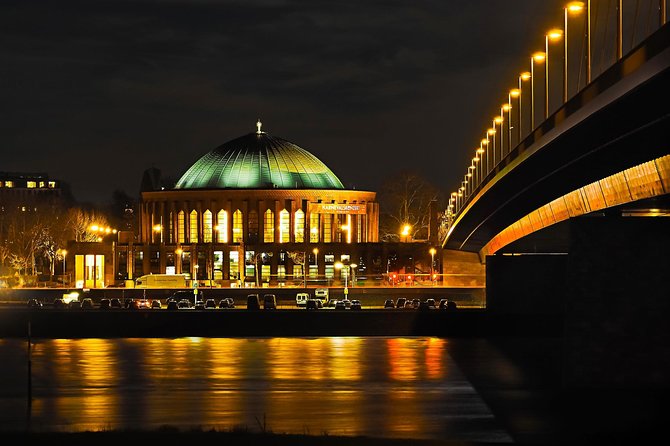
The final stop is the Tonhalle, a concert hall built by architect Wilhelm Kreis. Ending the tour here feels like a natural wrap-up because you move from governance and river life into a cultural landmark that represents how Düsseldorf spends its energy today.
The resident orchestra is the Düsseldorfer Symphoniker, and the Tonhalle also connects to the broader performing arts scene, including opera at the Deutsche Oper am Rhein. Even if you do not attend a performance, knowing that the building hosts both symphonic and opera related culture helps you see it as a living part of the city, not just an exterior photo stop.
Tonhalle is also a strong finish because the area around it gives you an easy visual “last look.” After museum time, concert hall architecture is a nice change of pace, and it helps you close the circuit from the river back to modern public life.
Price and logistics: $406.51 for up to 15, and when it’s a value
This tour is priced at $406.51 per group, up to 15 people, for about 1 hour 30 minutes. That is not a bargain price if you’re traveling solo, but it can become a strong value if you’re splitting cost with friends or family.
Here’s the math in practical terms: if you fill the group with the maximum 15 people, you’re looking at roughly $27 per person. If you have only 2 or 3 people, it quickly becomes a premium, simply because the price is per group, not per person.
The logistics are designed to be easy. You’ll have an easy meetup with your guide at any centrally located hotel, and the tour is limited to just your group, which helps keep it personalized. The route has a clear start in the Altstadt area and finishes at Tonhalle/Ehrenhof (40213), and it’s near public transportation, which helps when you plan your next stop after the tour.
One note to keep your day smooth: entrance fees are not included. Since there is an indoor museum visit, budget for it so you are not surprised at the counter.
What you’ll notice most: the tour’s strongest strengths
This walk’s reputation rests on a few things that matter in real travel time.
First, you get structure without feeling rushed. The stop sequence moves from Altstadt atmosphere to Marktplatz civic architecture, then to a museum by the Rhine, and finally to Tonhalle. That creates a clear arc, so you finish with both place and meaning.
Second, the guide flexibility stands out. In prior experiences, Christa was praised as experienced and able to respond to group wishes during the full 1.5-hour tour. Another communication highlight centered on smooth coordination with Frau Fujiwara, showing that pre-trip planning can be handled well when you have special requests.
Third, the “limited to your group” format is a practical upgrade. With fewer people, you can ask questions without waiting for a lull, and the guide can adjust the focus if your group cares more about architecture, river life, or the city’s story.
Who this tour suits best in Düsseldorf
This tour fits you if you want a guided framework for the Old Town without committing to a full day. It’s especially good for people who like a mix: street atmosphere (the bar district vibe), civic landmarks (Marktplatz and town hall), and a Rhine-focused museum stop.
It’s also a solid choice for groups up to 15. The per-group pricing makes sense when you split cost, and the private format makes it easier to keep everyone together.
If you are a museum fan, the Schifffahrt Museum portion will likely be the highlight. If you are more into architecture and public spaces, Marktplatz and the town hall complex will give you plenty to work with. If you love music culture, the Tonhalle ending gives you a recognizable finish point.
Most travelers can participate, and because the tour is short, it’s a manageable option even if you have a packed itinerary.
Practical tips to make the 1.5 hours feel longer
A guided tour can feel short if you try to do everything at once. Instead, do less, but do it on purpose.
- Bring a couple of questions. Ask about how the Rhine and Düssel shaped the city, or what the different town hall buildings represent.
- Plan for entrance fees. The maritime museum indoor time is a real part of the tour, so treat museum payment as part of your budget.
- Use photos as prompts. Capture the Jan Wellem statue, the tower details like the Tuscan columns, and the Tonhalle exterior, then use your guide’s explanations to label what you see.
- If you are sensitive to crowds, time your next stop right after the tour ends. The ending point at Tonhalle/Ehrenhof makes it easy to connect to other sights or transport.
Should you book this Düsseldorf Old Town guided tour?
I’d book this tour if you want a guided, efficient way to connect Düsseldorf’s Old Town atmosphere to the city’s civic center, river culture, and a major architectural landmark. It is short, structured, and private, which makes it easier to get answers instead of just walking past things.
I would hesitate only if you are traveling solo and the group price feels steep, or if you strongly prefer fully paid, no-surprise attractions since entrance fees are not included. If you can split the cost with a few people or you value the museum and Tonhalle finale, this is the kind of guided loop that gives you a clearer Düsseldorf in just 90 minutes.
FAQ
How long is the Düsseldorf Old Town guided tour?
The tour runs for about 1 hour 30 minutes.
How much does the tour cost?
It costs $406.51 per group, with up to 15 people in the group.
Is the tour private?
Yes. It is a private tour/activity, limited to your group only.
What language is the guide?
The guide speaks English.
Where does the tour start and where does it end?
It starts in the Altstadt area (40213 Düsseldorf) and ends at the Tonhalle/Ehrenhof area (40213 Düsseldorf).
Is pickup available?
You can meet the guide at any centrally located hotel.
Are entrance fees included?
No. Entrance fees are not included.
Do I get inside the Maritime Museum?
Yes. The Maritime Museum (Schifffahrt Museum) has an inside visit.
When do I receive confirmation?
Confirmation is received at the time of booking.
What is the cancellation policy?
This experience is non-refundable and cannot be changed for any reason. If you cancel or request an amendment, the amount you paid is not refunded.
Newest Dusseldorf reviews on the site
- Düsseldorf Segway Rhein Tour: Rhine River Experience★ 5.0 · 27 reviews
- Sightrunning – Private Running Tour in Düsseldorf★ 5.0 · 16 reviews
- Dusseldorf Self Guided Sherlock Holmes Murder Mystery Game★ 3.5 · 3 reviews
- Düsseldorf PubCrawl: 4 Venues, Welcome Shots + Club Entry★ 5.0 · 18 reviews
- Discover Dusseldorf’s most Photogenic Spots with a Local★ 5.0 · 3 reviews
- Düsseldorf Scavenger Hunt and Highlights Self Guided Audio Tour★ 4.5 · 8 reviews
- Private Düsseldorf Walking Tour – History, Culture & Hidden Gems★ 5.0 · 8 reviews
- Düsseldorf Walking Tour: Explore Top Sights & Hidden Gems★ 4.5 · 58 reviews
Old Town Walking Tours, compared.

Old Town & Viktualienmarkt City Walk in German
Read our review →

Browse the lists this tour appears in