
Reviewed · OLD TOWN WALKING TOURS
Aachen – Old town Guided tour
Aachen can be hard to “figure out” fast. This private Old Town walk is a smart way to get your bearings quickly, with Aachen Cathedral and the key sights put into story form, not just photo stops. I love how the route packs major landmarks into a short window, and I also like that the guide connects the places to the people and power that shaped the city. The one drawback to consider is simple: at about 90 minutes, it moves briskly, so you will not linger everywhere.
The big win here is time. If you are visiting Aachen for part of a day and you do not want to spend it scanning a map, you will appreciate having a guide set the pace and keep you pointed the right direction. I also like that this is a private group, so you are not getting steamrolled by other people’s pace or forced to follow a one-size-fits-all script.
What you end up with is a walk that feels like a guided timeline. You see the Roman Catholic cathedral complex, the thermal fountain where locals drink, older civic buildings that predate the city’s more famous eras, and the gates that still mark the edges of the old town. It is especially good if you are curious about Aachen’s Charlemagne-era significance.
In This Review
- Key things I’d watch for on this Aachen Old Town walk
- Why this Aachen Cathedral to Ponttor walk works in limited time
- Getting started at Dominformation and how the timing feels
- Aachen Cathedral: an old European seat of power, plus the Treasury
- Puppenbrunnen and Elisenbrunnen: Aachen’s public art and medicinal-water vibe
- Grashaus and Haus Löwenstein: the oldest layers you can still touch
- Aachen Town Hall and the Granus Tower: Gothic architecture with a practical purpose
- Ponttor city gate: where the old wall still shapes your walk
- Value check: is $406.51 per group worth it?
- Who this Aachen Old Town tour suits best
- Should you book this Aachen Cathedral to Ponttor tour?
- FAQ
- How long is the Aachen Old Town guided tour?
- Is the tour private?
- Where does the tour start?
- Which stops are included?
- Are entrance fees included?
- What is the price and group size?
- Can I change or get a refund if I cancel?
Key things I’d watch for on this Aachen Old Town walk
- A 90-minute route that hits the highlights without making you bounce around the map.
- Aachen Cathedral with the Treasury option, where medieval church treasures are a major focus.
- Puppenbrunnen marionettes and their symbolic pairings, a fun stop that is also historical.
- Elisenbrunnen’s two drinking fountains, tied to healing thermal water lore.
- Old civic buildings like Grashaus and Haus Löwenstein, where Aachen’s layers show up in brickwork and mystery.
- City Hall and Ponttor, for Gothic architecture and the still-standing city gate feel.
Why this Aachen Cathedral to Ponttor walk works in limited time
Aachen Old Town is not huge, but it is dense with meaning. In a short visit, the risk is that you see buildings without understanding what they were for. This tour flips that. You get a guide who ties the sights together, and you spend your time looking at the places instead of decoding them.
This is also the kind of experience where “private” changes the feel. You can ask basic questions, you are not elbowed along, and the timing of each stop tends to match the group’s interest. If your group includes kids, the tour naturally has some lively moments, especially around the marionette fountain.
More Old Town Walking Tours in Cologne
- Cologne: Night Watchman Old Town Walking Tour
★ 4.6 · 1,638 reviews - Cologne: Old Town Highlights Walking Tour
★ 4.6 · 1,093 reviews - Cologne Cathedral and Old Town Tour with 1 Kölsch
★ 4.8 · 674 reviews
Getting started at Dominformation and how the timing feels
The walk begins at Dominformation on Johannes-Paul-II.-Straße 1, in the heart of Aachen’s sightseeing zone. It ends back at the same meeting point, which is handy because you do not have to plan a separate return.
The whole experience is about 1 hour 30 minutes. That is just enough time to cover a strong arc of highlights, from the cathedral area through civic buildings and out to the city gate. The pacing is efficient, so you should be ready to move between stops and grab details when the guide points them out.
Aachen Cathedral: an old European seat of power, plus the Treasury
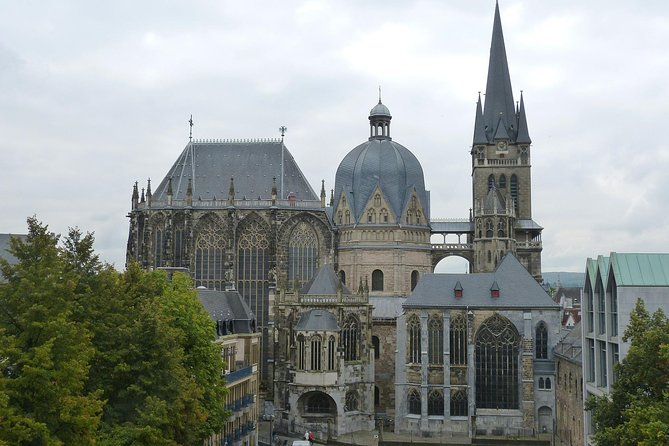
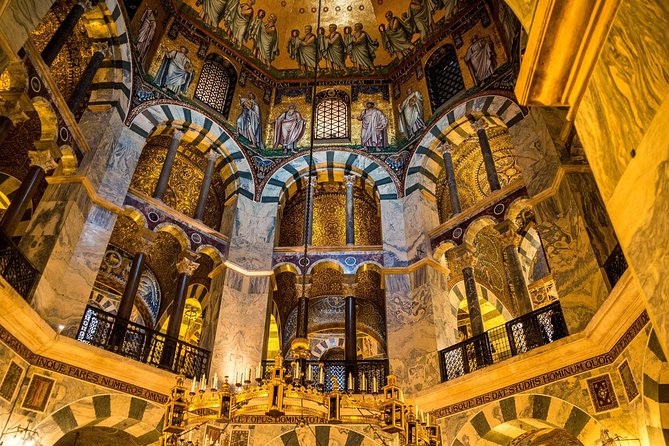
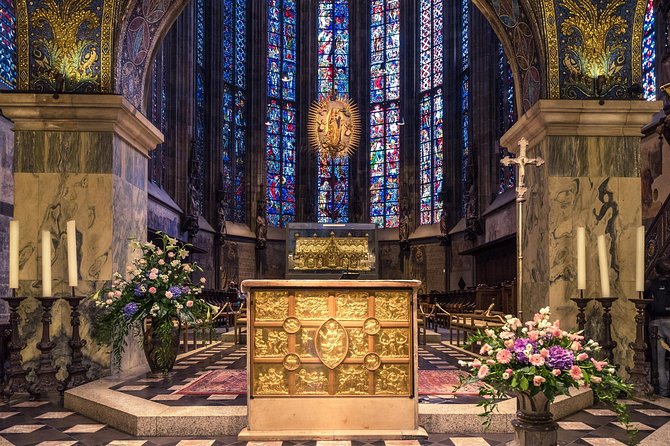
The tour’s first major anchor is Aachen Cathedral, officially the Cathedral of Aix-la-Chapelle. This is a Roman Catholic church that is among the oldest cathedrals in Europe, and it also serves as the seat of the Roman Catholic Diocese of Aachen. Even if you are not a church-history person, the building is worth your time, because it connects directly to why Aachen mattered.
The best part is the chance to visit the Treasury, where important medieval church artworks are housed. You get pointed toward specific treasures such as the Cross of Lothair, the Persephone sarcophagus, and the Bust of Charlemagne. Those names are not just impressive labels. They are a shortcut into the story of Aachen’s political and spiritual weight in medieval Europe, especially around the Charlemagne connection.
Stop time here is about 10 minutes, and the Treasury access is described as an opportunity during the visit. If you want a bit more time with the objects, focus on what the guide highlights rather than trying to read everything yourself in such a short window.
Puppenbrunnen and Elisenbrunnen: Aachen’s public art and medicinal-water vibe
After the cathedral, the walk shifts to something more whimsical but still meaningful: Puppenbrunnen, the Dolls fountain. This bronze marionette fountain uses pairs of figures to symbolize different aspects of Aachen life and history. The pairings include things like textile industry and the doll, horse and rider, bishop and church, trading market woman, professor and harlequin, and doctrine and culture. There is also a clock on top, marking the French occupation.
What I like about this stop is that it teaches history through design. It is not a dry lecture. It is visual, a little playful, and for kids it is especially memorable because the marionettes move. Adults get the added bonus of seeing how civic identity can be built into everyday public spaces.
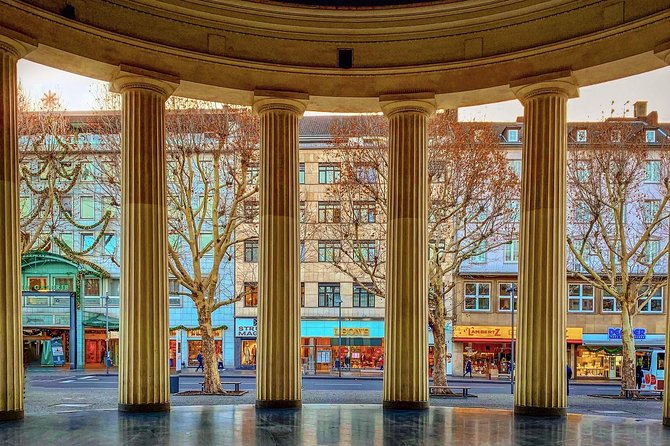
Next comes Elisenbrunnen, the fountain connected to Aachen’s thermal drinking water. There are two drinking fountains, and the water is said to have a high sulphur content with medicinal properties. Even if you are skeptical about the medicinal claims, the cultural fact is what matters: people show up here to drink it, and the whole place is part of Aachen’s lived tradition.
Both stops are brief (around 10 minutes each), so treat them like “taste and look” moments. If you want to linger, you can, but you might have to trade off time at later sights.
More old-town walks in Cologne:
- Cologne: Old Town Virtual Reality Walking Tour
★ 4.7 · 208 reviews - Cologne: 3 Old Town Breweries Guided Walking Tour
★ 4.8 · 120 reviews - Cologne: Old Town Walking Tour with 1 Brewery Visit & 1 Beer
★ 4.7 · 87 reviews - Cologne: Brauerei Tour in the Old Town of Köln
★ 4.8 · 70 reviews
Grashaus and Haus Löwenstein: the oldest layers you can still touch
From the fountains, the tour moves into a different kind of Aachen experience: old buildings that feel like they carry the city’s past right on the surface.
First is Grashaus, described as one of the oldest houses in Aachen. It is located at the fish market area and served as the first town hall. Construction was completed in 1267, though it is said to date back to even older times. The building also connects to an earlier medieval village context, when a prison existed there.
Then you cross to Haus Löwenstein, a building standing parallel to the town hall. It dates to around 1344 and is one of the few Gothic buildings that survived the major fire of 1656. Why it was originally built is unknown, and that mystery is part of the building’s story.
These are the stops where a guided voice really matters. In a self-guided stroll, you might admire the exterior and keep walking. With a guide, you notice how age, function, and survival from events like the 1656 fire shape what you see today. If you like medieval urban life and civic buildings, this is a highlight.
Aachen Town Hall and the Granus Tower: Gothic architecture with a practical purpose
The walk continues to City Hall Aachen, a Gothic building associated with imperial-era ceremony. It was built in the 14th century under Gerhard Chorus, with the goal of hosting the traditional coronation feast ceremony of the Holy Roman Empire. Construction was completed in 1349, and the building later served as an administrative center.
You also get to see the Granus Tower, a 20 meter high structure that was used to store weapons. That detail helps the building make sense. This was not just ceremonial. It was part of the city’s practical infrastructure.
One consideration: admission for this stop is not included. So if you want to go inside, you will need to budget for tickets separately. The good news is that the tour is mostly built around free access moments elsewhere, so this is likely the main add-on cost.
Ponttor city gate: where the old wall still shapes your walk
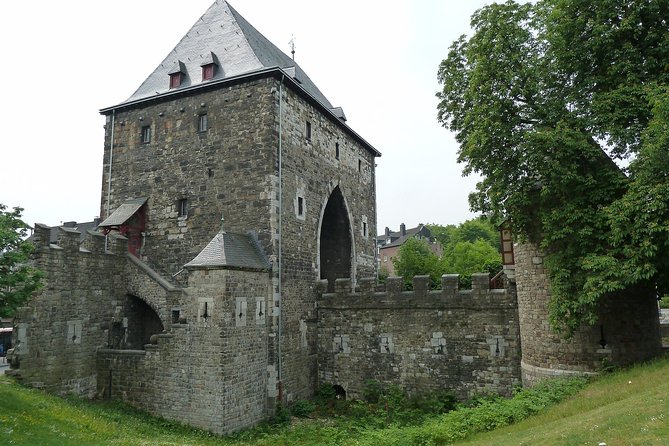
The final stop is Ponttor, the city gates, formerly known as Brückenpforte and Marschiertor. These are among the remaining gates of Aachen’s 14th century city wall.
What I like here is the transition from buildings back to the city’s edges. You can feel how walls and gates acted like checkpoints, defining how people moved in and out of town. Today, the gate areas are used by the German Scout Club and the German Scout Association Saint George, which gives the spot a modern, local rhythm.
It is a fitting finish after centuries of cathedrals and civic power. Ponttor brings you back to the “shape” of Aachen, not just the individual landmarks.
Value check: is $406.51 per group worth it?
This tour costs $406.51 per group for up to 15 people, and it runs about 1 hour 30 minutes. That pricing matters because it is private for your group. If you are traveling as a small group, you are effectively paying for convenience plus context.
Here is the value logic I would use:
- You get a guided experience designed to cover multiple top sights fast, which is hard to replicate well on your own in limited time.
- Several stops are free to enter as described, including the cathedral visit and the main fountain stops, so you are not paying admission at every turn.
- The main potential paid add-on is the Aachen Town Hall admission, which is not included.
So if you are the kind of visitor who likes having the “why” behind what you see, this price can make sense. If you are already comfortable wandering Aachen and reading on your phone, you might decide to do it on your own. But if you want a guided route that protects your time, the private format is where the money can feel justified.
Also, it is booked on average about 39 days in advance, so if your dates are fixed, plan earlier rather than later.
Who this Aachen Old Town tour suits best
This is ideal for you if:
- You have a short window in Aachen and want the highlights without route planning.
- You want history tied to specific places, not just isolated facts.
- You are traveling with mixed ages and want a few moments that land well for kids, like the moving marionettes at Puppenbrunnen.
- You prefer a calm experience where your group pace matters, since it is private.
It may not be ideal if:
- You want a slow, sit-down museum style pace at each stop.
- You plan to spend a long time inside the cathedral complex and Treasury and would rather have a longer visit window.
Should you book this Aachen Cathedral to Ponttor tour?
I’d book it if your goal is to understand Aachen quickly. The standout strength is how the sights feel placed into context, especially around the city’s Charlemagne-era story. You also get a nice blend, cathedral grandeur, symbolic public art at Puppenbrunnen, and civic power through Grashaus and the Town Hall.
You might skip it and go self-guided if you have plenty of time and you enjoy figuring out old towns by yourself, because the stops are mostly free and walkable. But if you are time-crunched and want a guided storyline, this is a solid use of a couple of hours.
FAQ
How long is the Aachen Old Town guided tour?
It lasts about 1 hour 30 minutes.
Is the tour private?
Yes. It is a private tour, and only your group will participate.
Where does the tour start?
It starts at Dominformation, Johannes-Paul-II.-Straße 1, 52062 Aachen, Germany.
Which stops are included?
Stops include Aachen Cathedral, Puppenbrunnen (Dolls fountain), Elisenbrunnen, Grashaus, Haus Löwenstein, City Hall Aachen, and Ponttor.
Are entrance fees included?
No. Entrance fees are not included. The tour notes that some sites are free, but City Hall Aachen admission is not included.
What is the price and group size?
The price is $406.51 per group, up to 15 people.
Can I change or get a refund if I cancel?
No. The experience is non-refundable and cannot be changed for any reason.
Newest Cologne reviews on the site
- Cologne City Tour “Domstadt Experience” Exclusive tour for up to 12 people★ 5.0 · 6 reviews
- Street Art Tour Cologne Ehrenfeld★ 5.0 · 64 reviews
- XXL tour (11km)★ 5.0 · 3 reviews
- Street Art Tour Köln Ehrenfeld★ 5.0 · 33 reviews
- Hard Rock Cafe Cologne With Set Lunch or Dinner★ 4.0 · 45 reviews
- City Tour per Rikscha in Cologne★ 5.0 · 26 reviews
- Scavenger hunt Belgian Quarter Cologne★ 5.0 · 8 reviews
- e-Scavenger hunt Aachen: Explore the city at your own pace★ 4.0 · 13 reviews
Old Town Walking Tours, compared.


Old Town & Viktualienmarkt City Walk in German
Read our review →

Browse the lists this tour appears in